 Safekipedia
Ostracoderm
Adapted from Wikipedia · Discoverer experience
Ostracoderms were an interesting group of ancient fish that lived during the Paleozoic Era. They were special because they had bony, armored plates covering their heads and bodies, which helped protect them from predators. Unlike some other early fish, ostracoderms could not bite with jaws—they were jawless fish. This made them quite different from the fish we see today.
One important feature of ostracoderms was how they used their gills. Instead of using gills to help catch food, like some earlier sea creatures, ostracoderms used their gills only to breathe. They had special pockets along the sides of their heads that were always open, allowing water to flow through for respiration.
Scientists first discovered fossils of these armored fish in the 1800s. The famous Swiss anatomist Louis Agassiz studied these fossils and decided they were so different that he gave them a new name: "ostracoderms," meaning "shell-skinned." These fish came in two main types: heterostracans, which were more basic, and cephalaspids, which had extra fins to help them swim better.
Though ostracoderms were common for a time, they eventually disappeared at the end of the Devonian period, around 420 million years ago. While it was once thought that the arrival of jawed fish caused their decline, researchers now believe that ostracoderms actually lived alongside these new fish for many millions of years before going extinct. Today, we study ostracoderms to learn more about how early vertebrates evolved.
Major groups
Ostracoderms were armored fish that lived during the Paleozoic Era. They did not have jaws, which made them different from many other fish we know today. Though scientists don’t use the term "ostracoderms" very often now, it’s still handy for talking about these early, jawless fish in a general way.
| Major groups of ostracoderms | |||
|---|---|---|---|
| Group | Class | Image | Description |
| Cephalaspido- morphi | Cephalaspidomorphi or cephalaspids ('head-shields'), like most contemporary fishes, were very well armoured. Particularly the head shield was well developed, protecting the head, gills and the anterior section of innards. The body were in most forms well armoured too. The head shield had a series of grooves over the whole surface forming an extensive lateral line organ. The eyes were rather small and placed atop the head. There was no jaw proper. The mouth opening was surrounded by small plates making the lips flexible, but without any ability to bite. Most biologists regard this taxon as extinct, but the name is sometimes used in the classification of lampreys because lampreys were once thought to be related to cephalaspids. If lampreys are included, they would extend the known range of the group from the Silurian and Devonian periods to the present day. | ||
| †Galeaspida (extinct) |  | Galeaspida ('helmet-shields') have massive bone shield on the head. Galeaspida lived in shallow, fresh water and marine environments during the Silurian and Devonian times (430 to 370 million years ago) in what is now Southern China, Tibet and Vietnam. Superficially, their morphology appears more similar to that of Heterostraci than Osteostraci, and one species, Tujiaaspis vividus, had paired fins. Galeaspida are regarded as being more closely related to Osteostraci, based on the closer similarity of the morphology of the braincase. | |
| †Pituriaspida (extinct) | 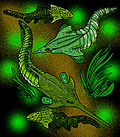 | Pituriaspida ('pituri-shields') are a small group of extinct armoured jawless fishes with tremendous nose-like rostrums, which lived in the marine, deltaic environments of Middle Devonian Australia (about 390 Ma). They are known only by two species, Pituriaspis doylei and Neeyambaspis enigmatica found in a single sandstone location of the Georgina Basin, in Western Queensland, Australia. | |
| †Osteostraci (extinct) | Osteostraci ('bony-shells') lived in what is now North America, Europe and Russia from the Middle Silurian to Late Devonian. Anatomically speaking, the osteostracans, especially the Devonian species, were among the most advanced of all known agnathans. This is due to the development of paired fins, and their complicated cranial anatomy. The osteostracans were more similar to lampreys than to jawed vertebrates in possessing two pairs of semicircular canals in the inner ear, as opposed to the three pairs found in the inner ears of jawed vertebrates. They are thought to be the sister-group of pituriaspids. Together, these two taxa of jawless vertebrates are the sister-group of gnathostomes. Several synapomorphies support this hypothesis, such as the presence of: sclerotic ossicles, paired pectoral fins, a dermal skeleton with three layers (a basal layer of isopedin, a middle layer of spongy bone, and a superficial layer of dentin), and perichondral bone. | ||
| Other groups | Other groups | ||
| †Pteraspido- morphi (extinct) | †Pteraspidomorphi ('wing-shield forms') have extensive shielding of the head. Many had hypocercal tails in order to generate lift to increase ease of movement through the water for their armoured bodies, which were covered in dermal bone. They also had sucking mouth parts and some species may have lived in fresh water. | ||
| †Thelodonti (extinct) | Thelodonti ('feeble-teeth') are a group of small, extinct jawless fishes with distinctive scales instead of large plates of armour. There is much debate over whether the group of Palaeozoic fish known as the Thelodonti (formerly coelolepids) represent a monophyletic grouping, or disparate stem groups to the major lines of jawless and jawed fish. Thelodonts are united in possession of 'thelodont scales'. This defining character is not necessarily a result of shared ancestry, as it may have been evolved independently by different groups. Thus the thelodonts are generally thought to represent a polyphyletic group, although there is no firm agreement on this point; if they are monophyletic, there is no firm evidence on what their ancestral state was.: 206 Thelodonts were morphologically very similar, and probably closely related, to fish of the classes Heterostraci and Anaspida, differing mainly in their covering of distinctive, small, spiny scales. These scales were easily dispersed after death; their small size and resilience makes them the most common vertebrate fossil of their time. The fish lived in both freshwater and marine environments, first appearing during the Ordovician, and perishing during the Frasnian–Famennian extinction event of the Late Devonian. They were predominantly deposit-feeding bottom dwellers, although there is evidence to suggest that some species took to the water column to be free-swimming organisms. | ||
| †Anaspida (extinct) | Anaspida ('no-shields') is an extinct group of primitive jawless vertebrates that lived during the Silurian and Devonian periods. Anaspids were small marine agnathans that lacked heavy bony shield and paired fins, but have a striking highly hypocercal tail. They first appeared in the Early Silurian, and flourished until the Late Devonian extinction, where most species, save for lampreys, became extinct due to the environmental upheaval during that time. | ||
Images
This article is a child-friendly adaptation of the Wikipedia article on Ostracoderm, available under CC BY-SA 4.0.
Images from Wikimedia Commons. Tap any image to view credits and license.