 Safekipedia
Aerosol
Adapted from Wikipedia · Adventurer experience
An aerosol is a mix of tiny solid pieces or liquid drops floating in air or another gas. These particles are very small, usually smaller than a micrometer.
Aerosols can come from nature or human activities. Natural examples include fog, mist, and dust from the earth or living things. Some infections can spread through tiny droplets in a person's breath, called bioaerosols.
Human-made aerosols include things like spray from a spray can, perfume from atomizers, dust from buildings or factories, smoke, mist from irrigation, sprayed pesticides, and air pollution.
These tiny particles can affect the climate. For example, volcanic eruptions release droplets of sulfuric acid high in the sky, where they can stay for a long time and cool the Earth by reflecting sunlight.
Ships also create clouds called ship tracks. When a ship releases exhaust into the air, water molecules gather around the tiny particles from the exhaust, forming cloud seeds. These seeds grow into visible clouds that look like long strings over the ocean. While greenhouse gases warm the planet, human-made aerosols can have a cooling effect.
Definitions
See also: Particulates
An aerosol is a mix of very small solid or liquid pieces floating in a gas, usually air. These tiny pieces can come from nature or from things people do. Scientists use the word "aerosol" to describe the whole mix, not just the small pieces themselves.
Aerosols can form in different ways. Some start as pieces that are put right into the air. Others form when gases turn into tiny pieces. Common pieces found in aerosols include dust, smoke, and sea salt. Scientists measure aerosols in several ways, like how much weight of the pieces is in a certain amount of air, or how many pieces there are. The size of the pieces matters because it changes how they act.
Generation and applications
People create aerosols for many helpful reasons. They can help test science tools, spray products like deodorant and paint, help farming, treat breathing problems, and improve car fuel systems.
Some tools that make aerosols include aerosol sprays, atomizer nozzles, electrosprays, electronic cigarettes, and vibrating orifice aerosol generators.
In the atmosphere
Main article: Particulates
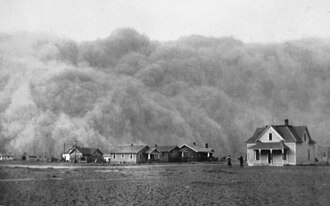
Aerosols in the air come from many places, both natural and human-made. Natural aerosols include dust from deserts, sea salt, and tiny particles from plants. Human-made aerosols come from burning fuels like oil and coal, which create smoke and other tiny particles.
These tiny particles can change the Earth's climate. For example, volcanic eruptions release gases that form particles high in the sky. These particles can block sunlight, making the Earth a bit cooler. Other particles, like those from cars and factories, can also affect clouds and temperature. Some of these particles can get into our lungs and affect our health.
Size distribution
See also: Particulates § Size, shape, and solubility matter
When particles are all the same size, we only need to know that size. But when particles are different sizes, we need a way to describe how many are small, medium, or large. Counting every single particle is hard when there are millions!
Scientists group particles into size ranges. They count how many particles are in each size group and show this in a chart. This chart helps us see which sizes are most common.
One common pattern for particle sizes is called the log-normal distribution. It works well for many types of particles because it can show a wide range of sizes. Other patterns are used for special cases, like dust or water droplets in clouds.
Physics
Terminal velocity of a particle in a fluid
Very small particles can float in the air because the air pushes back on them. These particles settle slowly, and their speed depends on their size and density. We can calculate this speed using a simple formula.
Dynamics
When we look at many particles together, we study how their numbers change over time. Particles move around due to air currents, bump into each other, or form new tiny particles. Scientists use special math to describe these changes.
Coagulation
When particles bump into each other, they can stick together. This makes the particles bigger but reduces the total number of particles.
Dynamics regimes
The way particles move depends on their size compared to the space between air molecules. Very small particles act like tiny balls bouncing off air molecules, while larger ones move more smoothly.
Partitioning
Tiny particles can grow by gathering more material from the air around them. This happens when the air has more of a certain material than it can normally hold.
Activation
Water can coat tiny particles in the air, helping them grow. Smaller particles need more moisture to stay coated compared to bigger ones.
Solution to the general dynamic equation
Solving the complex math that describes how particles change over time can be done in several ways.
Detection
Aerosols can be studied using special tools. Some tools are used close to the particles, like an aerosol mass spectrometer or a condensation particle counter.
Other tools can be used from far away, like a sun photometer or lidar. These tools can help scientists learn about the size of particles in the air and how they might affect our lungs. For example, PM10 and PM2.5 are ways to describe very small particles in the air.
Main article:
Main articles:
Images
Related articles



This article is a child-friendly adaptation of the Wikipedia article on Aerosol, available under CC BY-SA 4.0.
Images from Wikimedia Commons. Tap any image to view credits and license.