 Safekipedia
Barnard College
Adapted from Wikipedia · Adventurer experience
Barnard College is a private women's liberal arts college in New York City, New York, United States. It was founded in 1889 by a group of women led by student activist Annie Nathan Meyer. They asked Columbia University's leaders to create a college for women named after university president Frederick A. P. Barnard.
The college is one of the original Seven Sisters—a group of seven colleges in the Northeastern United States that were originally for women only. Barnard has its own way of admitting students, its own courses, and its own money. It shares some sports teams with Columbia University through a special agreement. This makes Barnard the only women's college to compete in NCAA Division I sports.
Barnard offers Bachelor of Arts degrees in about 50 different subjects. Students can also take classes at Columbia University, the Juilliard School, the Manhattan School of Music, and the Jewish Theological Seminary, all located in New York City. The college's campus is in the Upper Manhattan area known as Morningside Heights, right across from Columbia's main campus.
Many important people have graduated from Barnard College, including leaders in science, politics, medicine, and the arts. Barnard graduates have won awards such as the Emmy, Tony, Grammy, Academy, and Pulitzer Prize.
History
Founding
Barnard College started in 1889 because Columbia University did not want to let women join. At first, classes were held in a rented house on Madison Avenue, with six teachers and 36 students.
The college was named after Frederick Augustus Porter Barnard, a teacher and leader at Columbia who wanted boys and girls to study together. Even though he suggested letting women join Columbia, the leaders there said no. But later, in 1889, they agreed to start a women’s college linked to Columbia. Both men and women helped start Barnard College.
Morningside campus
When Columbia University planned to move to Morningside Heights, Barnard built a new campus close by. They got help and money from generous people like Mary E. Brinckerhoff, Elizabeth Milbank Anderson, and Martha Fiske. Two of them had special rules for their gifts. One wanted Barnard to buy land near Columbia within four years, and they did, buying land between 119th and 120th Streets. Another asked for a specific architect, Charles A. Rich, to design buildings. He made designs for several halls, and the first classes at the new campus happened in 1897.
A leader named Ella Weed helped run the college for the first few years, and then Emily James Smith became the first dean. Another teacher, Jessica Finch, is said to have invented the idea of teaching about what’s happening now, called “current events,” while she was teaching at Barnard.
Over time, Barnard kept growing. By the middle of the 1900s, it had achieved its goal of giving women an excellent education. For many years, only a couple of bigger schools had more women who went on to get advanced degrees. In the 1970s, there were talks about joining with the all-men Columbia College, but the leader of Barnard, Jacquelyn Mattfeld, strongly opposed it.
Presidents
List of presidents and deans of Barnard College from 1889 to present:
| No. | Image | President | Term started | Term ended | |
|---|---|---|---|---|---|
| Chair of the academic committee of Barnard College (1889–1894) | |||||
| 1 | Ella Weed | 1889 | January 10, 1894 | ||
| Deans of Barnard College (1894–1952) | |||||
| 2 | Emily James Smith Putnam | May 11, 1894 | February 1, 1900 | ||
| 3 | Laura Drake Gill | January 1901 | June 1907 | ||
| interim | Willian Tenney Brewster | 1907 | 1911 | ||
| 4 |  | Virginia Gildersleeve | February 1911 | 1947 | |
| Presidents of Barnard College (1952–present) | |||||
| 5 |  | Millicent McIntosh | 1947 | June 1962 | |
| 6 | Rosemary Park | July 1962 | June 1967 | ||
| interim | Henry Boorse | July 1967 | November 1967 | ||
| 7 | Martha Peterson | November 1967 | May 1975 | ||
| interim | Leroy Breunig | May 1975 | June 1976 | ||
| 8 | Jacquelyn Mattfeld | June 1976 | May 29, 1980 | ||
| acting |  | Ellen V. Futter | 1980 | April 1981 | |
| 9 | April 1981 | October 1993 | |||
| interim | Kathryn Rodgers | July 1993 | April 1994 | ||
| 10 | 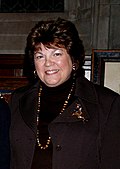 | Judith R. Shapiro | July 1, 1994 | June 30, 2008 | |
| 11 |  | Debora L. Spar | July 1, 2008 | March 5, 2017 | |
| interim | Robert Goldberg | March 6, 2017 | June 30, 2017 | ||
| 12 |  | Sian Beilock | July 1, 2017 | June 11, 2023 | |
| 13 | Laura Rosenbury | June 12, 2023 | present | ||
Academics
Barnard students can earn a bachelor of arts degree in about 50 different subjects. They also have special programs with Columbia University, the Juilliard School, and the Jewish Theological Seminary for bachelor of science and other degrees. Some popular subjects students choose are economics, psychology, history, English, political science, neuroscience, and art history.
All students must take certain courses to get their degree. This includes two science classes (one with a lab), learning a new language for two terms, and taking classes in arts, humanities, and social sciences. They also need to complete a special set of thinking skills courses and meet other requirements.
| 2022 | 2021 | 2020 | 2019 | 2018 | |
|---|---|---|---|---|---|
| Applicants | 12,009 | 10,395 | 9,411 | 9,320 | 7,897 |
| Admits | NA | 1,084 | 1,022 | 1,097 | 1,099 |
| Admit rate | 6% | 10% | 10.8% | 11.8% | 13.9% |
| Enrolled | N/A | N/A | N/A | 632 | 605 |
| SAT mid-50% range | N/A | N/A | N/A | 1360–1500 | 1330–1500 |
| ACT mid-50% range | N/A | N/A | N/A | 31–34 | 30–33 |
Campus
Library
Barnard College has its own library. Students can also use the libraries at Columbia University. The Barnard Library has special collections and archives. These show the history of the college from when it started until today. One special collection includes the papers of writer Ntozake Shange.
Zine collection
The Barnard Zine Library is part of the college's library system. It focuses on topics important to women, people who are not straight, people of color, and people who don't fit typical gender roles. In 2004, it became the first zine library in the United States to be fully listed in a big library database. The library opened for students to use in 2008 and by 2018 had about 5,000 zines. It also supports a student group called the Barnard Zine Club.
Student life
Every student at Barnard is part of the Student Government Association (SGA). This group helps students share ideas about the school.
Students can join many groups, like theater clubs, music groups, language clubs, and a radio station called WBAR. They can also join clubs at Columbia University. The McIntosh Activities Council plans fun events like Big Sub and Midnight Breakfast. These events have special themes and are enjoyed by everyone at the school.
Barnard students also take part in traditions such as the Barnard Greek Games and Take Back the Night. Midnight Breakfast is a special meal served by school leaders to students before exams. Big Sub is a giant sandwich that students can enjoy at the start of the school year.
Academic affiliations
Relationship with Columbia University
Barnard College has a special connection with Columbia University. People often think of Barnard as part of Columbia, but it is its own school with its own leaders and money. However, it works closely with Columbia in many ways.
Barnard students can take classes at Columbia, and Columbia students can take classes at Barnard. Barnard graduates receive diplomas from both schools, and they are part of the Columbia Alumni Association. Both schools share many resources, and Barnard students can join Columbia sports teams and other activities.
Before Columbia started admitting women, Barnard and Columbia worked together to allow Barnard students to attend Columbia classes. Over time, the schools have kept working together, even though they remain separate institutions. Today, Barnard pays Columbia a certain amount each year to use some of Columbia’s resources, but it remains independent in many ways.
Controversies
In 1960, the president of Columbia University asked Barnard College to make rules about student clothing. Students could wear pants or shorts only at Barnard, with rules about how short shorts could be.
In 1968, a Barnard student made news for living with her boyfriend, which broke college rules. This led to protests, and after talks, the student was allowed to stay but with some limits.
In 2025, two students were expelled for disrupting a class at Columbia University. This led to protests where students wanted the expulsions reversed. During the protest, a Barnard employee was hurt and needed to go to the hospital. After many hours of talking, an agreement was reached for a private meeting between protesters and college leaders.
Notable people
For a more comprehensive list, see List of Barnard College people.
Barnard College has many famous graduates who have become leaders in many fields such as science, politics, medicine, law, education, communications, theater, business, and the arts. Some well-known graduates include author Zora Neale Hurston, television host Ronnie Eldridge, U.S. Representative Helen Gahagan, author Erica Jong, actress Cynthia Nixon, musician Laurie Anderson, and author Jhumpa Lahiri.
Other notable graduates include businesswoman Martha Stewart, actress Lauren Graham, comedian Joan Rivers, architect Norma Merrick Sklarek, journalist Maria Hinojosa, playwright Ntozake Shange, chemist Jacqueline K. Barton, and many more influential people in various areas.
Images
Related articles


This article is a child-friendly adaptation of the Wikipedia article on Barnard College, available under CC BY-SA 4.0.
Images from Wikimedia Commons. Tap any image to view credits and license.