 Safekipedia
Biology
Adapted from Wikipedia · Adventurer experience
Biology is the scientific study of life and living organisms. It is a big natural science that looks at many parts of living things. Biologists study how living things are built, how they grow, where they come from, how they change over time, and how they fit into the world around us.
Central to biology are five main ideas: the cell as the smallest unit of life, genes and heredity which explain how traits are passed from parents to children, evolution which shows how life changes and creates new forms, energy use which helps living things stay alive, and homeostasis, the way living things keep their inner conditions stable.
Biology looks at life from many angles, from tiny molecules and cells all the way up to whole populations and ecosystems. There are many parts of biology, such as molecular biology, physiology, ecology, evolutionary biology, developmental biology, and systematics. Each of these areas uses different ways to study living things, like watching them, doing experiments, and using math models.
Modern biology is built on the idea of evolution by natural selection, first described by Charles Darwin, and on understanding genes through DNA. The discovery of the structure of DNA and advances in molecular genetics have changed many parts of biology. These discoveries have helped improve medicine, agriculture, biotechnology, and environmental science.
Biologists group organisms — from simple single-celled archaea and bacteria to complex plants, fungi, and animals — based on what they have in common and how they are related, using taxonomic and phylogenetics methods.
Etymology
The word "biology" comes from two old Greek words: bíos, meaning "life," and logia, meaning "study of." People began using the term "biology" in the late 1700s and early 1800s to talk about the study of living things.
History
Main article: History of biology
The study of science, including medicine, started long ago in places like ancient Egypt and Mesopotamia. These ideas inspired thinkers in ancient Greece, like Aristotle, who looked at many living things. Later, scholars in the medieval Islamic world also wrote about plants and animals.
Biology advanced when Anton van Leeuwenhoek made better microscopes, letting people see tiny creatures like bacteria. In the 1800s, scientists learned that cells are the tiny parts that make up all living things.
Charles Darwin came up with the idea of natural selection, showing how species change over time. Gregor Mendel’s work with plants helped us learn how traits are passed from parents to children. In the 1950s, scientists found out about DNA, the molecule that holds genetic information.
Fields
See also: List of biology disciplines
Biochemistry is the study of chemical processes inside living organisms.
Molecular biology is a part of biology that looks at how tiny parts inside cells work. It focuses on nucleic acids (like DNA and RNA) and proteins.
Main article: Cell biology
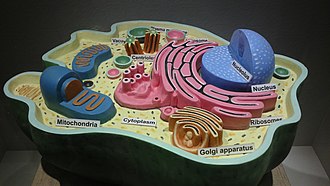
Cell biology studies the tiny building blocks called cells that make up all living things.
Bioenergetics is a part of biochemistry and cell biology that looks at how energy moves through living things.
Main article: Genetics
Genetics is the study of how traits are passed from parents to their children. Classical genetics looks at how genes and traits are shared between generations. Scientists use tools like a Punnett square to predict what traits offspring might have. The chromosome theory of inheritance tells us that genes are found on tiny structures called chromosomes.
Main article: Evolutionary developmental biology
Evolutionary developmental biology looks at how different organisms grow and develop. Scientists compare how animals and plants grow to understand how these processes have changed over time.
Main article: Evolutionary biology
Evolutionary biology is a part of biology that studies how and why species change over time. Evolution helps explain why there is so much variety in living things on Earth. Population genetics looks at how genes change and spread in groups of the same species. Evolutionary biology uses ideas from many areas, including molecular genetics, to understand how species develop new traits.
Main article: Ecology
Ecology is the study of how living things interact with each other and with their environment.
Systematics is the study of how different kinds of living things are related to each other. Scientists use phylogenetics to create family trees that show these relationships and build a unified taxonomy of all life.
Main article: Conservation biology
Conservation biology studies how to protect Earth's rich variety of life. It looks at ways to save species and their homes from disappearing. Scientists study why biodiversity loss happens and how it affects humans. They work to keep Earth's many forms of life healthy.
Images
Related articles




This article is a child-friendly adaptation of the Wikipedia article on Biology, available under CC BY-SA 4.0.
Images from Wikimedia Commons. Tap any image to view credits and license.