 Safekipedia
Chemnitz
Adapted from Wikipedia · Adventurer experience
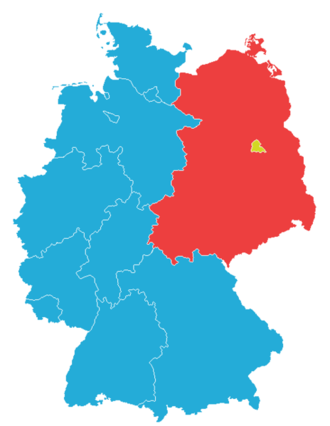
Chemnit is the third-largest city in the German state of Saxony after Leipzig and Dresden. It is also the fourth-largest city in the area of the former East Germany after (East) Berlin, Leipzig, and Dresden.
The city is in the middle of a line of cities in the northern foreland of the Elster and Ore Mountains. These cities go from Plauen in the southwest through Zwickau, Chemnitz, and Freiberg to Dresden in the northeast. Chemnitz is surrounded by the Ore Mountains to the south and the Central Saxon Hill Country to the north. The city sits on the Chemnitz River, which begins where the rivers Zwönitz and Würschnitz meet in the Altchemnitz area.
The city's name and the names of its rivers come from Slavic origins. Chemnitz is the third-largest city in the Thuringian-Upper Saxon dialect area, after Leipzig and Dresden. The local economy focuses on services and manufacturing. The Chemnitz University of Technology has about 10,000 students.
Chemnitz is famous for its many buildings and monuments from the time of industry growth. In 2025, it will be named the European Capital of Culture.
Toponymy
Chemnitz is named after the river Chemnitz, which flows into the Zwickau Mulde. The name comes from a Slavic word meaning "stone". This idea of "stone" is also used in other place names around the world, like Kamianske and Kamianets-Podilskyi.
History
For a chronological guide, see Timeline of Chemnitz.
Medieval beginnings
The area around Chemnitz was home to Slavic tribes related to the modern Sorbs. The city's name comes from a river first mentioned in records in 1012 or 1018 as "Caminizi fluvium." In 1143, King Conrad III of Germany confirmed rights for a Benedictine monastery, including land and the right to hold a market. This is the first known record of Chemnitz. A settlement grew around this market. By around 1170, the town gained the status of a free imperial city under Emperor Frederick I.
Meissen and Saxony
In 1307, Chemnitz came under control of the Margraviate of Meissen, which later became part of Saxony. The town became known for weaving and textile trading. Over a third of the people worked in these industries.
The scientist Georgius Agricola lived in Chemnitz from 1533 until he died in 1555. He wrote important books about mining and metallurgy, including De re metallica. Despite being a respected citizen, he was buried elsewhere because of his religious beliefs.
During the Thirty Years' War, the Swedish army fought against Saxon and Imperial forces near Chemnitz in 1639.
In 1806, the area became part of the Kingdom of Saxony, which lasted until 1918 after the First World War.
By the early 1800s, Chemnitz was growing as an industrial city, sometimes called "the Saxon Manchester." Important companies were started by local businessmen. Chemnitz became a leader in innovation. By 1913, the city had 320,000 people. After the First World War, the population grew to a peak of 360,250 in 1930 before slowing due to the world economic crisis.
Weimar Republic
See also: Saxony in the German Revolution (1918–1919)
After the First World War, Chemnitz was an important city for socialist groups. Many people joined the Communist Party. A modern train station opened in 1929, and the car company Auto Union (now Audi) was founded in 1932.
World War II
Allied bombing during the Second World War destroyed part of Chemnitz. The city had factories making military supplies and was targeted because of this. The city was taken by Soviet troops in May 1945.
The headquarters of Auto Union were damaged, and the company moved to Ingolstadt, where it became Audi.
After the war, East Germany rebuilt the city, adding new housing. Many older buildings were replaced.
German Democratic Republic
In 1953, the East German government renamed Chemnitz to German: Karl-Marx-Stadt (Karl Marx City) to honor the thinker Karl Marx. The city center, damaged in the war, was rebuilt with new roads and housing.
After reunification
In 1990, people voted to change the city's name back to Chemnitz. After reunification of Germany, many people moved away, and jobs were hard to find. New shopping areas were built around the city.
Chemnitz redid its center after 1990. Famous architects helped design new buildings. Some older buildings were removed, which caused debate. By 2010, the center was mostly rebuilt.
In August 2018, the city saw protests with clashes between different groups.
Culture and sights
Chemnitz was chosen as one of the European Capitals of Culture for 2025.
The city has many places to see and enjoy. The Theater Chemnitz offers many kinds of shows, such as plays, opera, ballet, and puppet shows. It also has concerts.
Visitors can explore the Kassberg neighborhood, which has old buildings from the 1700s and 1800s. There is a large statue of Karl Marx, called Nischel by local people. Other sights include the Old Town Hall, a castle where a monastery once stood, and the area around the opera house and an old university building. A red tower, built long ago, is a well-known landmark.
The city also has a special petrified forest inside a shopping place called Kulturkaufhaus Tietz. This forest is very old, dating back millions of years, and can be seen in the Museum of Natural Sciences. There is also a small castle in the Rabenstein area.
Since Germany reunited, Chemnitz has changed a lot. Many factories are gone, and the city center has new shops and big shopping areas.
Chemnitz has museums about industry, archaeology, and art. There is also a garden with plants from cold and mountain areas, and an old house built in an art-nouveau style. Every year, the city holds a film festival for children and young people called the Schlingel International Film Festival.
Climate
Chemnitz has an oceanic climate. The city gets about 732.7 mm (28.85 in) of rain each year. There is more rain in the summer than in the winter.
Weather records show that the hottest day was 37.8 °C (100.0 °F) on August 20, 2012. The coldest day was −28.4 °C (−19.1 °F) on February 11, 1956. Some years have had more rain than others.
Administrative divisions
Chemnitz has 39 different areas called neighbourhoods. Eight of these joined Chemnitz after 1990 and have a special status. Each of these areas has its own local council with leaders who help make decisions. The main city council of Chemnitz makes the final choices.
The city numbers its areas starting from the centre and moving outwards in a circle.
Adelsberg (25) Altchemnitz (41) Altendorf (92) Bernsdorf (42) Borna-Heinersdorf (13) Ebersdorf (14) Einsiedel ¹ (46) Erfenschlag (44) Euba ¹ (16) Furth (11) Gablenz (24) Glösa-Draisdorf (12) Grüna ¹ (95) Harthau (45) Helbersdorf (61) Hilbersdorf (15) Hutholz (64) Kapellenberg (81) Kappel (82) Kaßberg (91) Klaffenbach ¹ (47) Kleinolbersdorf-Altenhain ¹ (26) Lutherviertel (22) Markersdorf (62) Mittelbach ¹ (87) Morgenleite (63) Rabenstein (94) Reichenbrand (86) Reichenhain (43) Röhrsdorf ¹ (96) Rottluff (93) Schloßchemnitz (02) Schönau (83) Siegmar (85) Sonnenberg (21) Stelzendorf (84) Wittgensdorf ¹ (97) Yorckgebiet (23) Zentrum (01) ¹ also a locality |
Politics
Mayor
After Germany reunited, the first mayor chosen in a free vote was Dieter Noll from the Christian Democratic Union. He served from 1990 to 1991. Then Joachim Pilz took over until 1993. Since 1994, people have voted directly for the mayor. Peter Seifert served from 1993 to 2006. Barbara Ludwig was mayor from 2006 to 2020. In 2020, Sven Schulze became the mayor.
The latest mayoral election happened on September 20, 2020, with a second round on October 11.
City council
The most recent city council election took place on June 9, 2024.
Economy
Chemnitz is a big city in the new states of Germany. It is very important for its economy. Since around the year 2000, Chemnitz has been growing fast and is one of the top ten cities in Germany for growth.
Many people work in Chemnitz, about 100,000 in total. Lots of them come from nearby places to work here. Many workers have special education or college degrees. The city has many middle-sized companies. Important jobs are in making machines, working with metal, and building vehicles.
Demographics
Chemnitz has 246,000 people and is the third-largest city in Saxony. The city's population grew fast from the early 1900s because of factories, reaching about 362,000 in 1930. During this time, the city was called Karl-Marx-Stadt and made many textiles and leather goods. After German Reunification, the city lost many people, with the population falling from 300,000 in 1989 to under 250,000 in 2003. Growth started again in the 2010s as people moved to the city from other places.
Foreign population
Chemnitz University of Technology brings many international students to the city. In 2017, about 25% of the students there were from other countries.
Languages
- Standard German
- Chemnitz dialect, which is a type of Upper Saxon German
| Year | Pop. | ±% |
|---|---|---|
| 1466 | 3,455 | — |
| 1801 | 10,835 | +213.6% |
| 1852 | 35,163 | +224.5% |
| 1871 | 68,229 | +94.0% |
| 1885 | 110,817 | +62.4% |
| 1900 | 206,913 | +86.7% |
| 1910 | 287,807 | +39.1% |
| 1920 | 313,444 | +8.9% |
| 1930 | 361,200 | +15.2% |
| 1940 | 332,200 | −8.0% |
| 1950 | 293,373 | −11.7% |
| 1960 | 286,329 | −2.4% |
| 1970 | 299,411 | +4.6% |
| 1980 | 317,644 | +6.1% |
| 1990 | 294,244 | −7.4% |
| 2001 | 255,798 | −13.1% |
| 2011 | 240,253 | −6.1% |
| 2022 | 240,078 | −0.1% |
| Population size may be affected by changes in administrative divisions. Source for 2001–2022: | ||
Transport
Chemnitz has good road connections. It links to two major highways, A4 going from Erfurt to Dresden and A72 from Hof to Leipzig. There is a highway junction called Kreuz Chemnitz to the northwest of the city. The A72 highway between Borna and Leipzig is still being built. Chemnitz has eight highway exits, and the A4 highway is part of a long European road called E40, linking Chemnitz to places far east and west.
Public transport in Chemnitz includes trams, buses, and a special train called Stadtbahn. The city has one Stadtbahn line, five tram lines, 27 city bus lines, and several regional bus lines. At night, two bus lines, two tram lines, and the Stadtbahn line keep running. The main train station, Chemnitz Hauptbahnhof, connects the city to bigger towns in Saxony and beyond. In June 2022, a long-distance train service started again from Chemnitz to places like Dresden, Berlin, and Rostock-Warnemünde. Before this, Chemnitz was a big city without such services for a long time. There are also regional train routes to nearby cities.
Chemnitz has three nearby airports. The two big international airports in Saxony are Leipzig/Halle Airport and Dresden Airport, both about 70 kilometers away. Chemnitz also has a small commercial airport called Flugplatz Chemnitz-Jahnsdorf, about 13.5 kilometers south of the city. After its upgrade, this airport will have a long runway for planes.
Sports
Chemnitz has many sports teams that play different games. Some of the teams include BV Chemnitz 99 for basketball, Chemnitzer FC for football, and ERC Chemnitz e.V. for ice hockey.
Notable people
Chemnitz has been home to many interesting people over the years. Some of them include:
- Paul Oswald Ahnert (1897–1989), an astronomer
- Brigitte Ahrens (born 1945), a pop singer
- Olaf Altmann (born 1960), a scenic designer
- Mark Arndt (born 1941), a Russian Orthodox Archbishop
- Michael Ballack (born 1976), a German footballer and former captain of Bayern Munich and Germany
- Veronika Bellmann (born 1960), a politician
- Fritz Bennewitz (1926–1995), a theater director
- Gerd Böckmann (born 1944), a television actor and director
- Werner Bräunig (1934–1976), a writer
- Marianne Brandt (1893–1983), an artist and designer
- Valery Bykovsky (1934–2019), a Soviet cosmonaut
- C418 (real name Daniel Rosenfeld, born 1989), a music producer and sound engineer for Minecraft and Wanderstop
- Hans Carl von Carlowitz (1645–1714), a forest scientist
- Max Eckert-Greifendorff (1868–1938), a cartographer and professor
- Gerson Goldhaber (1924–2010), an American nuclear and astrophysicist
- Friedrich Goldmann (1941–2009), a composer and conductor
- Carl Hahn (1926–2023), a businessman and head of the Volkswagen Group
- Johannes Hähle (1906–1944), a military photographer
- Peter Härtling (1933–2017), a writer
- Richard Hartmann (1809–1878), an important entrepreneur known as the "Saxon locomotive king"
- Frank Heinrich (born 1964), a politician and member of the Bundestag
- Stephan Hermlin (1915–1997), a writer
- Stefan Heym (1913–2001), a writer and member of the Bundestag
- Christian Gottlob Heyne (1729–1812), a classical scholar and archaeologist
- Sigmund Jähn (1937–2019), the first German astronaut who flew on the Interkosmos mission in 1978
- Eduard Johnson (1840–1903), a local historian, journalist, and author of Latin and Greek phrasebooks
- John Kluge (1921–2010), a German-American billionaire and media mogul
- Eva Kunz (1947–2023), a politician
- Helga Lindner (born 1951), a swimmer and Olympic silver medalist
- Max Littmann (1862–1931), an architect
- Anja Mittag (born 1985), a footballer and World Champion in 2007
- Frederick and William Nevoigt, founders of the Diamant bicycle brand
- Carsten Nicolai (born 1965), a contemporary artist
- Frei Otto (1925–2015), an architect and professor who helped build the Munich Olympic Park
- Sylke Otto (born 1969), a luge athlete
- Siegfried Rapp (1917–1977), a one-armed German pianist
- Frederick Emil Resche (1866–1946), a U.S. Army brigadier general
- Frank Rost (born 1973), a retired football goalkeeper
- Bruno Salzer (1859–1919), one of Chemnitz's leading entrepreneurs
- Aliona Savchenko, an ice figure skater
- Helmut Schelsky (1912–1984), a sociologist and university lecturer
- Karl Schmidt-Rottluff (1884–1976), a painter and graphic artist known for expressionism
- Maria Schüppel (1923–2011), a composer and pioneering music therapist
- Christina Schultheiß (1918–2016), a civil engineer known for her work with the Protestant church in East Germany
- Matthias Schweighöfer (born 1981), an actor and film director
- Jörg Schüttauf (born 1961), an actor
- Nadja Stefanoff (born 1983), a soprano
- Matthias Steiner (born 1982), a German-Austrian weightlifter and Olympic gold medalist in 2008
- Ingo Steuer (born 1966), a figure skater
- Robin Szolkowy, an ice figure skater
- Hans-Günther Thalheim (1924–2018), a Germanist and linguist
- Luise Emilie Tschersich (born 1998) an actress
- Tom Unger (born 1985), a politician
- Siegfried Vogel (born 1937), an operatic bass
- Kurt Wagner (1904–1989), a German general
- Katarina Witt (born 1965), a figure skater
- Mandy Wötzel (born 1973), a figure skater
- Klaus Wunderlich (1931–1997), an organist
Twin towns – sister cities
See also: List of twin towns and sister cities in Germany
Chemnitz has many sister cities around the world. Some of these cities include:
- Tampere, Finland (since 1961)
- Ljubljana, Slovenia (since 1966)
- Timbuktu, Mali (since 1968)
- Ústí nad Labem, Czech Republic (since 1970)
- Łódź, Poland (since 1972)
- Mulhouse, France (since 1981)
- Manchester, England, UK (since 1983)
- Volgograd, Russia (since 1988)
- Düsseldorf, Germany (since 1988)
- Akron, United States (since 1997)
- Taiyuan, China (since 1999)
- Kiryat Bialik, Israel (since 2022)
One former sister city was Arras, France, which was a twin city from 1967 to 2021.
Images
Related articles




This article is a child-friendly adaptation of the Wikipedia article on Chemnitz, available under CC BY-SA 4.0.
Images from Wikimedia Commons. Tap any image to view credits and license.