 Safekipedia
Chinese language
Adapted from Wikipedia · Adventurer experience
The Chinese language is spoken by more than 1.39 billion people around the world, making it one of the most widely spoken languages. It is used by the Han Chinese majority and many minority groups in Greater China, as well as by Chinese communities living outside of China. The language has many different varieties, and people speaking different varieties may not understand each other.
Chinese is part of the Sino-Tibetan language family. The most common variety is Mandarin, spoken by about 800 million people. Other major varieties include Min, Wu, and Yue, such as Cantonese. All of these varieties use tones and have their own unique sounds.
Chinese is written with characters that represent whole words or ideas, rather than just sounds. These characters have been used for thousands of years, with the earliest examples found on oracle bones from around 1250 BCE. Today, some places use simplified characters, while others use traditional characters. Standard Chinese, based on the Beijing dialect, is the official language in China, Taiwan, and one of the official languages of Singapore and the United Nations. Standard Chinese Traditional Chinese characters Languages of China Sinitic languages
Classification
Linguists group Chinese with languages like Burmese and Tibetan into a family called the Sino-Tibetan language family. This idea started in the early 1800s and most people agree with it now. However, learning how these languages are connected is tricky. This is because the languages are very different, many don’t change much in their word endings, and they have been influenced by other languages. Some of these languages are also spoken in remote, mountainous areas that are hard to visit. Because of this, the full family tree of Sino-Tibetan languages is still not completely understood. Some people think Chinese and Tibeto-Burman languages are the two main branches, but this hasn’t been proven yet.
History
Main article: History of the Chinese language
The Chinese language has a very long history. The first written records appeared over 3,000 years ago during the Shang dynasty. Over time, different local varieties of Chinese developed and became hard to understand with each other. Leaders tried many times to create one standard language for everyone to use.
Old and Middle Chinese
Main articles: Old Chinese and Middle Chinese
Further information: Reconstruction of Old Chinese
The earliest examples of Old Chinese come from markings on oracle bones from around 1250 BCE during the Late Shang. Later, writings on bronze artifacts from the Western Zhou period (1046–771 BCE) were found. Scholars study these to understand how Old Chinese sounded. They found that Old Chinese had sounds very different from Middle Chinese.
Middle Chinese was used from the 6th to the 10th centuries. We know about it from old books that list sounds and rhymes. By comparing these with modern Chinese and words borrowed into other languages, we can guess what the sounds were like.
Classical and vernacular written forms
Main articles: Classical Chinese and Written vernacular Chinese
For a long time, people spoke many different kinds of Chinese, but they all wrote in a special, formal style called Classical or Literary Chinese. This way of writing started during the Spring and Autumn period and was used until the late 1800s. Then, people began using a more everyday style of writing called written vernacular Chinese, especially after the May Fourth Movement in 1919.
Rise of northern dialects
After the Northern Song dynasty ended, a common way of speaking developed in northern China. This was based on the dialects around the capital city. A book from 1324, the Zhongyuan Yinyun, described how people spoke and rhymed in poems at that time.
For a long time, most people only spoke their own local language. Leaders needed a common way to talk to everyone, so they used a special form of the northern dialects, called 官话; 官話; Guānhuà; 'language of officials'. By the 1800s, the way people spoke in Beijing became the most important.
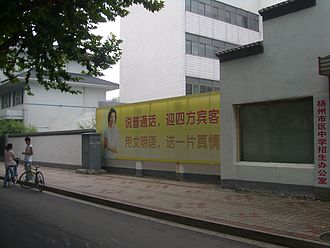
In the 1930s, leaders chose the Beijing way of speaking as the standard language for the whole country, called 国语; 國語; Guóyǔ; 'national language'. After 1949, this became known as 普通话; 普通話; pǔtōnghuà; 'common speech'. Today, this is used in schools, news, and formal places in China and Taiwan.
In Hong Kong and Macau, most people speak Cantonese. This is because of history and culture from nearby areas. But Mandarin, the common speech, is also taught in schools there.
Influence
See also: Adoption of Chinese literary culture and Sino-Xenic vocabularies
Chinese words and writing spread to many places. When Vietnam was ruled by China long ago, many Chinese words entered Vietnamese. Chinese Buddhism also helped spread Chinese writing and ideas to Korea, Japan, and Vietnam. These countries used Chinese for important writing and learning for many years.
Even though they wrote in Chinese, each country read the words in their own way. They also added many Chinese words to their own languages. For example, many words in Korean, Japanese, and Vietnamese come from Chinese.
Countries also made their own ways to write their languages. Korea made the hangul alphabet, Japan used kana letters along with Chinese characters called kanji, and Vietnam used the chữ Nôm script. Today, Japanese uses both kanji and kana, Korean mostly uses hangul, and Vietnamese uses the Latin alphabet.
Some English words come from Chinese too, like tea, dim sum, and kumquat.
Varieties
Main article: Varieties of Chinese
There are many different ways people speak Chinese, and these ways can change a lot depending on where you are. Some areas have very different ways of speaking, even if they are close together.
Chinese speaking has many groups, like Mandarin, Wu, Gan, Xiang, Min, Hakka, and Yue. Mandarin is the most common and includes the way people speak in Beijing. It is used as the standard way to speak Chinese in schools and on the news. Other groups have their own special ways of speaking too.
Phonology
Further information: Standard Chinese phonology, Historical Chinese phonology, and Varieties of Chinese § Phonology
Chinese words, or syllables, have special sounds and rules. Each syllable usually starts with a consonant sound, followed by a vowel sound. Syllables also have different pitches or "tones" that help give meaning to words.
All forms of Chinese use tones to tell words apart. Some areas have just a few tones, while others have many. The syllable "ma" can mean different things depending on its tone. Cantonese uses even more tones to express different meanings.
Grammar
Main article: Chinese grammar
See also: Chinese classifiers
Chinese is called a "monosyllabic" language because many words have just one sound. This was more true in older forms of the language. Today, most everyday words in Chinese, especially in Mandarin, have two sounds. Over time, the sounds in the language have changed.
Chinese words are often made by combining two sounds together. This helps avoid confusion because many single sounds can mean different things. For example, the sound "shí" can mean several different words. To make meaning clearer, people add another sound to the word.
Chinese sentences are built by placing the subject, then the verb, and finally the object. The language uses special words, called particles, to show details like time or feeling. Chinese also uses classifiers, which are words that help count or describe things, similar to saying "a piece of" or "a bunch of" in English.
| Character | Gloss | MC | Cantonese |
|---|---|---|---|
| 十 | 'ten' | dzyip | sap6 |
| 实; 實 | 'actual' | zyit | sat6 |
| 识; 識 | 'recognize' | dzyek | sik1 |
| 石 | 'stone' | dzyi | sek6 |
| 时; 時 | 'time' | dzyi | si4 |
| 食 | 'food' | zyik | sik6 |
| Word | Pinyin | Gloss |
|---|---|---|
| 实际; 實際 | shíjì | 'actual-connection' |
| 认识; 認識 | rènshi | 'recognize-know' |
| 石头; 石頭 | shítou | 'stone-head' |
| 时间; 時間 | shíjiān | 'time-interval' |
| 食物 | shíwù | 'foodstuff' |
Vocabulary
The Chinese language uses many characters to write words. There are over 50,000 characters, but we only use about 10,000 today. Words are often made from two or more characters together.
Chinese has lots of words and phrases. Big dictionaries can have over 370,000 definitions!
Chinese also uses words from other languages. For example, words like "grape" and "pomegranate" came from ancient times, often from places along the Silk Road. Buddhist words came from Sanskrit or Pali. Modern words, like technology terms, are often made using existing Chinese characters. The word for "telephone" is one example.
Today, many new words come from English, especially with the internet. Words like "fans" (粉丝) and "blog" (博客) are written using Chinese characters that sound like the English words. Some words also come from Japanese, where they were created using Chinese characters and then shared back into Chinese.
Writing system
Main articles: Written Chinese, Mainland Chinese Braille, and Taiwanese Braille
The Chinese writing system uses special symbols called characters. These characters are written in square shapes. They can be arranged in columns going from top to bottom and right to left, or in rows going from left to right like English. Each character stands for a word part that can sound different depending on the language or dialect.
Today, most written Chinese is based on the way people speak Standard Chinese. This changed from an older, more formal style in the early 1900s. Words from different parts of China can be different when written down.
Chinese did not have a way to write sounds clearly until the middle of the 1900s, though people tried to describe sounds in books long ago. Some tried using letters from other languages to write Chinese sounds.
In some places in China, special ways of writing exist, like a special system used by some women in Hunan.
Chinese characters
Main article: Chinese characters
See also: Chinese character classification
Each Chinese character stands for a single sound and word part. Long ago, a scholar grouped characters into six types. Only a few were simple pictures, like the character for “person” or “sun”. Most characters combine sounds and meanings together.
Modern characters are written in a clear, regular style. Artists can use different styles for beautiful writing, and they often use the older, more complex characters for art.
There are two main types of characters today. The older type is used in places like Hong Kong and Taiwan. The newer type, with simpler shapes, was created in the 1950s to help more people learn to read. This simpler type is used in China and also in Singapore.
The internet helps people practice reading both types, and most readers can understand the other type if needed.
Romanization
Main article: Romanization of Chinese
Romanization means writing Chinese sounds using letters from the Latin alphabet, like the one used for English. The most common way today is called Hanyu Pinyin. It was introduced in 1956 and is used to teach Chinese in schools around the world. Parents also use it to help children learn new words.
Another older system is Wade–Giles, which was used a lot in the past, especially in English-speaking places.
Other systems exist for different Chinese languages and dialects.
Other phonetic transcriptions
Chinese varieties have been phonetically transcribed into many other writing systems over the centuries. The 'Phags-pa script has been very helpful in reconstructing the pronunciations of premodern forms of Chinese. Bopomofo (or zhuyin) is a semi-syllabary that is still widely used in Taiwan to aid standard pronunciation. There are also at least two systems of cyrillization for Chinese. The most widespread is the Palladius system.
| Characters | Wade–Giles | Pinyin | Meaning |
|---|---|---|---|
| 中国; 中國 | Chung1-kuo2 | Zhōngguó | China |
| 台湾; 臺灣 | T'ai2-wan1 | Táiwān | Taiwan |
| 北京 | Pei3-ching1 | Běijīng | Beijing |
| 台北; 臺北 | T'ai2-pei3 | Táiběi | Taipei |
| 孙中山; 孫中山 | Sun1 Chung1-shan1 | Sūn Zhōngshān | Sun Yat-sen |
| 毛泽东; 毛澤東 | Mao2 Tse2-tung1 | Máo Zédōng | Mao Zedong |
| 蒋介石; 蔣介石 | Chiang3 Chieh4-shih2 | Jiǎng Jièshí | Chiang Kai-shek |
| 孔子 | K'ung3 Tsu3 | Kǒngzǐ | Confucius |
As a foreign language
Main article: Chinese as a foreign language
As China's economy grows, more people want to learn Standard Chinese in schools across East Asia, Southeast Asia, and the Western world.
Besides Mandarin, Cantonese is another Chinese language often taught to people outside of China. This is because of the big influence from Hong Kong and many Chinese communities around the world. In 1991, about 2,000 people took a big test to check how well they know Chinese, called Hanyu Shuiping Kaoshi (HSK). By 2005, that number grew to over 117,000, and by 2010, it was up to 750,000 people taking the test.
Related articles




This article is a child-friendly adaptation of the Wikipedia article on Chinese language, available under CC BY-SA 4.0.
Images from Wikimedia Commons. Tap any image to view credits and license.