 Safekipedia
Colossus of Rhodes
Adapted from Wikipedia · Adventurer experience
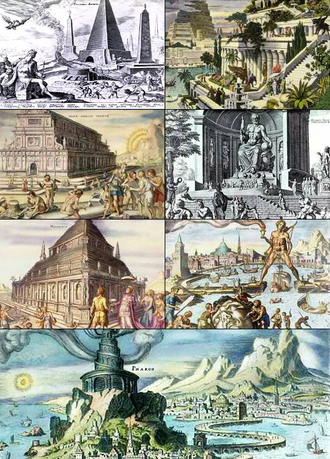
The Colossus of Rhodes was a very tall statue built on the island of Rhodes in ancient Greece. It was made to honor the sun god Helios and to celebrate the people of Rhodes winning a big battle. The statue was built by a man named Chares of Lindos around the year 280 BC.
The Colossus was very impressive—it was about 33 meters (108 feet) tall, almost two-thirds the height of today’s Statue of Liberty. That made it the tallest statue in the ancient world! Sadly, the statue fell down during a big earthquake in 226 BC. Even though some pieces were saved, the people of Rhodes decided not to rebuild it.
Many years later, in 653, a group led by a leader named Mu'awiya I took over Rhodes, and the remaining parts of the Colossus were taken away. Today, people sometimes talk about building a new statue, but we still don’t know exactly where the original one stood. It remains one of the famous Seven Wonders of the Ancient World.
Siege of Rhodes
Main article: Siege of Rhodes (305–304 BC)
In the late fourth century BC, the island of Rhodes worked with Ptolemy I of Egypt to stop a big attack from their enemy, Antigonus I Monophthalmus. In 304 BC, help arrived from Ptolemy, and the attacking army led by Demetrius I of Macedon had to leave. They left a lot of tools behind, which the people of Rhodes sold for 300 talents. They used that money to build a very tall statue of their god, Helios. A sculptor named Chares was chosen to build it. He had experience with big statues, and his teacher, Lysippos, had even made a huge statue of Zeus in Tarentum.
Construction
The Colossus of Rhodes was built starting in 292 BC. It was made with iron bars and bronze plates for its skin, and stone blocks filled its inside. The statue stood on a tall white marble pedestal near the harbor in Rhodes. It was about 32 metres (105 feet) tall.
The materials came from weapons left by an enemy army. After twelve years, the statue was finished in 280 BC. It was one of the tallest statues of the ancient world.
Collapse (226 BC)
Further information: 226 BC Rhodes earthquake
The Colossus stood for 54 years until an earthquake in 226 BC shook Rhodes. The earthquake damaged the harbor and buildings, and the statue broke at the knees and fell to the ground. A ruler named Ptolemy III offered to help rebuild the statue, but the people of Rhodes chose not to, fearing they might upset the sun god Helios.
Fallen state (226 BC to 653 AD)
After the statue fell to the ground during an earthquake, it stayed there for over 800 years. Many people still visited just to see it, even though it was broken.
Two famous writers talked about the fallen statue. Strabo, a Greek writer, wrote about the city of Rhodes and mentioned the statue. He noted that it had fallen and broken but was still one of the great wonders of the ancient world. Pliny the Elder, another writer, also wrote about the statue. He said it was very tall—about 70 cubits high—and even on the ground, it was still amazing to see.
Destruction of the remains
We do not know for sure what happened to the pieces of the statue. The island of Rhodes had many earthquakes, which probably broke more of the statue. By the 4th century, the people of Rhodes were Christians, so they likely would not fix a statue of an old god.
Some stories say that in 653, Arab forces took apart what was left of the statue and sold the pieces. But historians think this story may not be true. They think it might have been made up to send a message. Because of the earthquakes and people possibly using the metal for other things, it seems unlikely that much of the statue was still around when the raid happened.
Posture
The idea that the Colossus of Rhodes stood with one foot on each side of the harbour is just a story from later times. People imagined it this way because of old writings and poems. For example, a famous writer named William Shakespeare wrote about someone "bestriding the narrow world Like a Colossus." Even a poem by Emma Lazarus at the base of the Statue of Liberty mentions a "brazen giant of Greek fame" standing between lands.
But experts think this image is not possible. If the statue had really stood across the harbour, it would have blocked the water and people could not have used their harbour. Also, the statue was made of bronze and would have been too heavy to stand that way without falling over.
Researchers think the statue may have stood in a different, more realistic way. We do not really know how it looked, but we think the head likely had curly hair.
Possible locations
People often picture the Colossus of Rhodes standing with one foot on each side of the harbor, but this is not proven true. The exact place where the statue stood is still a mystery. Some think it may have been near two pillars at the entrance to Mandraki port today.
There is a special floor made of sandstone blocks inside the Fortress of St Nicholas, close to the harbor. Some curved marble pieces found there might have been part of a base for the Colossus, resting on those sandstone blocks.
One archaeologist, Ursula Vedder, thinks the Colossus might not have been by the harbor at all. Instead, she believes it could have been part of the Acropolis of Rhodes, on a hill overlooking the port. At the top of this hill are ruins of a big temple, usually linked to the god Apollo. Vedder thinks this area may have been a place to honor Helios and that part of the temple’s stone base could have held up the Colossus.
Modern Colossus projects
In 2008, a report said that a new version of the Colossus would be built at the harbor entrance. It would be a giant light sculpture made from melted-down weapons. It would cost up to €200 million.
In 2015, some European architects announced plans for a new Colossus. It would stand between two piers at the harbor entrance. This new statue would be 150 meters tall, five times taller than the original. It would cost about US$283 million. It would include a cultural center, a library, an exhibition hall, and a lighthouse powered by solar panels. However, these plans were never carried out, and the project's website is no longer online.[original research?]
Images
Related articles




This article is a child-friendly adaptation of the Wikipedia article on Colossus of Rhodes, available under CC BY-SA 4.0.
Images from Wikimedia Commons. Tap any image to view credits and license.