 Safekipedia
Constitutional right
Adapted from Wikipedia · Adventurer experience
A constitutional right is a special power or protection that a country or group of countries says is important. These rights are often written in a country's constitution. The constitution is the main set of rules for a country. It tells what the government can and cannot do. Laws that go against the constitution are not allowed.
The constitution usually explains how the government works. It also talks about the freedoms and duties of people. It helps make sure these important points are protected. Today, most countries have a written constitution with many different constitutional rights.
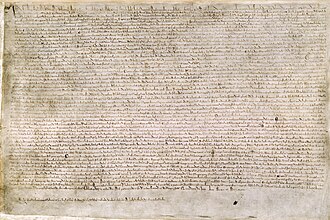
Even before modern constitutions, there were important rules that worked in similar ways. For example, the United Kingdom had the 1215 Magna Carta, and Virginia had its Bill of Rights in 1776. These older documents helped shape the idea of constitutional rights we have today.
Specific rights
Many countries have special rules to protect important rights. One of these is the freedom of assembly, which lets people come together for meetings or events. Many constitutions say this must be peaceful and for legal purposes.
Another important right is the right to vote. Many constitutions mention this right. Voting might be done in a secret way, or it might be required for everyone. There can be rules about who can vote, like where you live or how old you are.
United States
Further information: Constitutional law of the United States § Rights of individuals
Federal constitution
On September 17, 1787, the United States Constitution was signed during the Constitutional Convention (United States) in Philadelphia at the Independence Hall.
On December 15, 1791, the Bill of Rights, which includes the first 10 Amendments, became part of the U.S. Constitution. Later, 17 more Amendments were added, making a total of 27 Amendments and 7 Articles. Only one amendment overturned a previous one—the twenty-first Amendment ended the prohibition of alcohol that began with the eighteenth Amendment in 1919.
At first, the rights in the Bill of Rights applied only to the federal government. Over time, most of these rights were also applied to the states through a process called selective incorporation into the Due Process Clause of the Fourteenth Amendment.
For example, the Second Amendment was fully applied to the states in 2010. The Sixth Amendment guarantees the right to confront witnesses, and many parts of the First Amendment protect freedoms like speech and the press.
The Fifth Amendment protects the right to a grand jury in federal cases, but this right does not apply to state cases.
State constitutions
Each state in the United States has its own Constitution. These documents are usually longer and more detailed than the U.S. Constitution. For example, the Alabama Constitution has over 600 pages, and the New Jersey Constitution from 1947 is three times longer than the U.S. Constitution. State constitutions can offer more protections than the federal one, but they cannot take away any rights guaranteed by the federal Constitution. They can also include rights not mentioned in the federal Constitution.
Other nations
See also: Human rights in Germany and Constitution of Japan
Some countries, like Germany, India, and Japan, have special parts in their laws called a bill of rights. These help protect important freedoms.
The United Kingdom does not have a bill of rights in its laws, but it has something called the Human Rights Act 1998 that helps protect similar ideas. In places that follow rules set by the European Convention of Human Rights, people can ask a special court, the European Court of Human Rights, for help if their rights are not respected.
Related articles


This article is a child-friendly adaptation of the Wikipedia article on Constitutional right, available under CC BY-SA 4.0.