 Safekipedia
Danish krone
Adapted from Wikipedia · Adventurer experience
The krone is the official currency of the Kingdom of Denmark, which includes Denmark, Greenland, and the Faroe Islands. It started being used on 1 January 1875. It is sometimes called the "Danish crown" in English because krone means crown. You will often see the currency sign "kr." or the code "DKK" when looking at prices.
One krone is divided into 100 øre. The smallest coin used today is the 50 øre coin, which is half of a krone. In the past, there were more øre coins, but they stopped being made because prices got higher.
The krone’s value is linked to the euro through a system called the ERM II. Some people in Denmark want to switch to the euro, but in a 2000 referendum, most people voted to keep the krone instead of joining the Eurozone.
History
The oldest known Danish coin is from around AD 825–840. Later, King Harald Bluetooth made special coins called korsmønter in the late 10th century. Coin-making grew bigger under King Canute the Great in the 1020s. Many cities in Denmark became important for making coins.
For nearly 1,000 years, Danish kings put their names or pictures on coins. Over time, the value of coins changed, making people unsure about their worth. Denmark changed its money system many times to fix this.
The modern krone became Denmark’s money in January 1875, replacing an older currency called the rigsdaler. Paper money later became more common for everyday use.
Status
Relationship to the euro
Main article: Denmark and the euro
Denmark does not use the euro. In a vote in 2000, people chose not to use it. But Denmark's money, the Danish krone, stays very close to the euro. This helps keep prices steady. Denmark shares a border with Germany, which uses the euro, and with Sweden, which plans to use the euro later but is not ready yet.
Faroe Islands and Greenland
Main articles: Faroese króna and Greenlandic krone
The Faroe Islands use their own version of the Danish krone, called the Faroese króna. It looks almost the same as Danish money but has special banknotes.
Greenland also uses the Danish krone as its money. Even though there were plans to make special Greenlandic banknotes, those plans were stopped. So, Greenland still uses the same coins and banknotes as Denmark.
The Faroe Islands and Greenland have their own special codes for bank accounts. This makes transfers between them act like international money moves with extra fees.
Coins
The coins are made to be easy to tell apart. They come in three colors: copper-colored for the smallest coins, silver-colored for medium coins, and golden for the largest coins. The smallest coins are made from copper-colored metal, the next set from silver-colored metal, and the largest from a golden metal.
The coins also differ in size and shape. Some have smooth edges, some have lines, and some have holes in the middle. These differences help people who cannot see well to know which coin they are holding.
Commemoratives and thematic coins
Main article: Commemorative coins of Denmark
Special coins are made to celebrate important places, events, or stories. These coins are the same size and metal as regular coins.
One group of special coins shows famous towers in Denmark, the Faroe Islands, and Greenland. These coins were made between 2002 and 2007.
Another group of coins shows ships, celebrating Denmark’s history with the sea. These coins were released starting in 2007.
In 2005, coins were made with pictures from Hans Christian Andersen’s fairy tales. The final coin in this set, inspired by The Nightingale, came out in 2007.
Later, coins were made to celebrate the International Polar Year. These coins showed a polar bear, a special sled team, and the beautiful lights in the sky called the Aurora Borealis. The final coin in this group came out in 2009.
| Circulating coins | ||||||||||
|---|---|---|---|---|---|---|---|---|---|---|
| Image | Value | Technical parameters | Description | Issued from | ||||||
| Diameter (mm) | Thickness (mm) | Mass (g) | Composition | Edge | Obverse | Reverse | ||||
| 50 øre | 21.50 | 1.55 | 4.30 | Tin-bronze | Smooth | Crown of Christian V | Heart (mintmark); value | 1989 | ||
| 1 kr. | 20.25 | 1.60 | 3.60 | Cupronickel: Cu: 75%; Ni: 25% | Reeded | Monogram of Margrethe II | Traditional design (holed); Lettering: Danmark; value | 1992 | ||
| 2 kr. | 24.50 | 1.80 | 5.90 | Interrupted reeding | ||||||
| 5 kr. | 28.50 | 2.00 | 9.20 | Reeded | 1990 | |||||
| 10 kr. | 23.35 | 2.30 | 7.00 | Aluminium bronze: Cu: 92%; Al: 6%; Ni: 2% | Smooth | Margrethe II | Coat of arms; value | 1989 | ||
| 20 kr. | 27.00 | 2.35 | 9.30 | Interrupted reeding | 1990 | |||||
| For table standards, see the coin specification table. | ||||||||||
Banknotes
Most Danish banknotes issued after 1945 are still used for payments. They come in values of 5 kroner, 10 kroner, 20 kroner, 50 kroner, 100 kroner, 200 kroner, 500 kroner, and 1000 kroner.
In November 2023, it was announced that banknotes issued before 2009, including the 1000-kroner note, will no longer be legal tender by May 2025. However, they will still be accepted by Danmarks Nationalbank until May 2026.
1944 series
The 1944 series was created in secret during 1943–1944 by Danish painter Gerhard Heilmann.
1952 series
The 1952 series included portraits and landscapes. It was issued between 1952 and 1964 and later replaced in 1972. These banknotes showed famous Danes on one side and Danish landscapes on the other.
1972 series
Main article: Banknotes of Denmark, 1972 series
The 1972 series featured portraits and animals. It was issued from 1975 to 1980 and replaced in 1997. Each note had a portrait painted by Jens Juel on one side, with animals designed by Ib Andersen and Gunnar Andersen on the other.
1997 series
Main article: Banknotes of Denmark, 1997 series
The 1997 series included portraits and church art. It was issued from 1997 to 1999 and replaced in 2009. These banknotes showed Danish artists and scientists on one side and cultural and religious art on the other.
2009 series
Main article: Banknotes of Denmark, 2009 series
The 2009 series, known as the 'Bridge' banknotes, began design in 2006. They feature Danish bridges and surrounding landscapes. The banknotes include security features like a moving wave pattern and a colorful hologram.
Starting in 2020, a new version of the 500-kroner banknote with updated security features was released. Updates for the 50-, 100-, and 200-kroner banknotes are planned for 2024–2025.
2028 series
The next series of banknotes will be released in 2028 and will not include a 1000-krone note, which will no longer be legal tender as of May 2025. The design process began in spring 2024 and will be completed by early 2026. The front of the new banknotes will show important achievements and the people behind them, while the back will feature the sea. The selected achievements and people include:
- Fairy tales and Hans Christian Andersen
- Astronomy and Tycho Brahe
- The Earth's core and Inge Lehmann
- The Thule Expedition and Arnarulunnguaq
| Value | Dimensions (mm) | Main colour | Description | Issue | Withdrawn | Lapse | ||
|---|---|---|---|---|---|---|---|---|
| Obverse | Reverse | |||||||
| 5 kr. | 130 × 72 | Blue | Value | Rosettes, lesser coat of arms | 1945 | 1954 | ||
| 10 kr. | 131 × 80 | Orange | 1945 | |||||
| 130 × 80 | Green | Seaweed | 1947 | |||||
| 50 kr. | 159 × 100 | Purple | Boat with fishermen | 1945 | 31 May 2025 | 31 May 2026 | ||
| 100 kr. | 159 × 100 | Dark Green | Seaweed decoration, dolphins | |||||
| 500 kr. | 174 × 108 | Red | Farmer behind horse-drawn plough | |||||
| For table standards, see the banknote specification table. | ||||||||
| Value | Dimensions (mm) | Main colour | Description | Issued from | First issued | Withdrawn | Lapse | ||
|---|---|---|---|---|---|---|---|---|---|
| Obverse | Reverse | ||||||||
| 5 kr. | 125 × 65 | Green | Bertel Thorvaldsen The Three Graces | Kalundborg | 1952–1960 | 14 October 1952 | 31 May 2025 | 31 May 2026 | |
| 10 kr. | Orange | Hans Christian Andersen Stork's nest | Egeskov Mill | 1952 | |||||
| 125 × 71 | Gold | 1954–1974 | 1954 | ||||||
| 50 kr. | 153 × 78 | Blue | Ole Rømer Rundetaarn | Stenvad long barrow | 1957–1970 | 21 May 1957 | |||
| 100 kr. | 155 × 78 | Red | Hans Christian Ørsted Compass | Kronborg | 1961–1970 | 3 May 1962 | |||
| 500 kr. | 175 × 90 | Green | Christian Ditlev Frederik Reventlow Plough man | Roskilde | 1963–1967 | 2 June 1964 | |||
| For table standards, see the banknote specification table. | |||||||||
| Value | Dimensions (mm) | Main colour | Description | Issued from | First issued | Withdrawn | Lapse | ||
|---|---|---|---|---|---|---|---|---|---|
| Obverse | Reverse | ||||||||
| 10 kr. | 125 × 67 | Olive | Cathrine Sophie Kirchhoff | Common eider | 1972–1978 | 8 April 1975 | 31 May 2025 | 31 May 2026 | |
| 20 kr. | 125 × 72 | Orange | Pauline Maria Tutein | Two house sparrows | 1979–1988 | 11 March 1980 | |||
| 50 kr. | 139 × 72 | Blue | Engelke Charlotte Ryberg | Crucian carp | 1972–1998 | 21 January 1975 | |||
| 100 kr. | 150 × 78 | Red | Jens Juel (self-portrait) | Red underwing | 1972–1993 | 22 October 1974 | |||
| Orange | 1994–1998 | 16 October 1995 | |||||||
| 500 kr. | 164 × 85 | Green | Unknown (likely Franziska Genoveva von Qualen) | Sand lizard | 1974–1988 | 18 April 1974 | |||
| 1000 kr. | 176 × 94 | Grey | Thomasine Heiberg | Red squirrel | 1972–1992 | 11 March 1975 | |||
| For table standards, see the banknote specification table. | |||||||||
| Value | Dimensions (mm) | Main colour | Description | Issued from | First issued | Withdrawn | Lapse | ||
|---|---|---|---|---|---|---|---|---|---|
| Obverse | Reverse | ||||||||
| 50 kr. | 125 × 72 | Purple | Karen Blixen | Centaur (Landet Church, Tåsinge) | 1999–2002 2004–2007 | 7 May 1999 | 31 May 2025 | 31 May 2026 | |
| 100 kr. | 135 × 72 | Golden orange | Carl Nielsen | Basilisk (Tømmeby Church, Hanherred) | 1999–2001 2002–2008 | 22 November 1999 | |||
| 200 kr. | 145 × 72 | Green | Johanne Luise Heiberg | Lion (Viborg Cathedral) | 1997–2000 2003–2008 | 10 March 1997 | |||
| 500 kr. | 155 × 72 | Blue | Niels Bohr | Knight fighting a dragon (Lihme Church) | 1997–2003 2003–2008 | 12 September 1997 | |||
| 1000 kr. | 165 × 72 | Red | Anna and Michael Ancher | Tournament scene (Bislev Church) | 1998 2004–2006 | 18 September 1998 | |||
| For table standards, see the banknote specification table. | |||||||||
| Image | Value | Dimensions (mm) | Main colour | Description | Issued from | First issued | Withdrawn | Lapse | |||
|---|---|---|---|---|---|---|---|---|---|---|---|
| Obverse | Reverse | Obverse | Reverse | ||||||||
 | 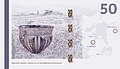 | 50 kr. | 125 × 72 | Violet | Sallingsund Bridge | Skarpsalling vessel | 2009 | 11 August 2009 | Current | ||
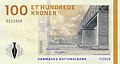 |  | 100 kr. | 135 × 72 | Orange-yellow | Little Belt Bridge | Hindsgavl Dagger | 2010 | 4 May 2010 | |||
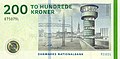 | 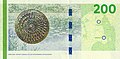 | 200 kr. | 145 × 72 | Green | Knippelsbro | Langstrup belt plate | 19 October 2010 | ||||
 |  | 500 kr. | 155 × 72 | Blue | Queen Alexandrine Bridge | Keldby bronze pail | 2011 | 15 February 2011 | |||
| 1000 kr. | 165 × 72 | Red | Great Belt Bridge | Trundholm sun chariot | 24 May 2011 | 31 May 2025 | 31 May 2026 | ||||
| For table standards, see the banknote specification table. | |||||||||||
Exchange rates
Related articles


This article is a child-friendly adaptation of the Wikipedia article on Danish krone, available under CC BY-SA 4.0.
Images from Wikimedia Commons. Tap any image to view credits and license.