 Safekipedia
Electron
Adapted from Wikipedia · Adventurer experience
The electron (e−, or β− in nuclear reactions) is a subatomic particle with a negative electric charge. It is one of the building blocks of ordinary matter in the universe, along with up and down quarks.
Electrons are very light and move around the center, or atomic nucleus, of an atom. The way electrons are arranged decides how atoms react with each other to form molecules and crystals. The electrons on the outer edges of atoms, called valence electrons, help atoms connect and create new substances through chemical reactions.
Electrons help explain many everyday things. In metals, electrons can move freely, which is why metals are good at conducting electricity and heat. In semiconductors, scientists can control how many electrons move, which is the basis for modern electronics. Electrons can also exist on their own and be used in tools like electron microscopes and particle accelerators.
Characterization
Electrons are tiny particles that belong to a group called leptons. They are very small and have no known parts inside them. This means they are basic building blocks of matter. Electrons are much lighter than protons, another type of particle.
Electrons act like both particles and waves. This means they can bump into things like particles but also spread out and bend like waves of light. They are important for many things we see in the world, like electricity, magnetism, and how chemicals react. Electrons can be found in labs and even in space. They are used in many technologies such as computers, solar panels, and medical equipment.
History
See also: History of electromagnetism
Discovery of effect of electric force
The ancient Greeks noticed that amber could pull small objects when rubbed with fur. Along with lightning, this was one of the first known examples of electricity. In 1600, an English scientist named William Gilbert called these special materials electrica in his book De Magnete. The words electric and electricity come from a Latin word that means amber.
Discovery of two kinds of charges
In the early 1700s, a French chemist named Charles François du Fay found that some materials could push or pull each other, depending on their charges. He thought electricity had two types of "fluids." Later, an American scientist named Ebenezer Kinnersley found the same thing. Then Benjamin Franklin suggested that electricity was just one type of fluid that could be too much or too little.
Discovery of free electrons outside matter
See also: Cathode ray and J. J. Thomson § Discovery of the electron
While studying gases in 1859, a German scientist named Julius Plücker saw strange lights from electric currents. His student Johann Wilhelm Hittorf discovered that these lights could cast shadows, showing they were straight beams from the electric source.
In 1876, another German scientist named Eugen Goldstein named these beams cathode rays. Later, a British scientist named William Crookes showed these rays could push tiny objects and could be bent by magnets, proving they carried a negative charge.
In 1897, a British scientist named J. J. Thomson proved that cathode rays were tiny particles, which we now call electrons. He measured their mass and charge, showing they were much smaller than any known atom.
In 1900, a French scientist named Henri Becquerel found that some rocks could glow on their own. A New Zealand scientist named Ernest Rutherford studied these glowing rocks and found they shot out tiny particles. In 1897, J. J. Thomson showed these particles were electrons.
The name "electron" was chosen by scientists after suggestions from several researchers. It combines the words for "electric" and a tiny particle.
The charge of the electron was measured very carefully in 1909 by American scientists Robert Millikan and Harvey Fletcher. Their experiment showed how much charge a tiny drop of oil could hold.
Atomic theory
By 1914, scientists like Ernest Rutherford had learned that atoms have a tiny, heavy center called a nucleus, with lighter electrons orbiting around it. In 1913, a Danish scientist named Niels Bohr suggested that electrons move in fixed paths or "orbits" around the nucleus.
In 1924, an Austrian scientist named Wolfgang Pauli found that each electron has a special quality called "spin." This helped explain why some parts of atoms behave the way they do.
Quantum mechanics
See also: History of quantum mechanics
In 1924, a French scientist named Louis de Broglie suggested that tiny particles like electrons could also behave like waves. This idea helped scientists understand more about how atoms work.
In 1926, an Austrian scientist named Erwin Schrödinger created a math rule called the Schrödinger equation to describe how electron waves move. This helped explain the energy levels of electrons in atoms.
Particle accelerators
With new machines called particle accelerators, scientists could study electrons more closely. In 1942, a scientist named Donald Kerst built a machine called a betatron to give electrons more energy.
Confinement of individual electrons
Today, scientists can trap single electrons in very tiny pieces of material called transistors. This helps them study the strange behaviors of these tiny particles.
Classification
In the Standard Model of particle physics, electrons are tiny particles called leptons. These particles are basic building blocks of matter and cannot be broken down further. Electrons are the lightest of the charged leptons and are in the first group of these particles. Other charged leptons, like the muon and the tau, are like electrons but have more mass. Leptons are different from another group of particles called quarks because they do not take part in strong interactions. All leptons, including electrons, have a special property called spin, and electrons have a spin of _ħ_/2.
Fundamental properties
Electrons are tiny particles that make up ordinary matter in the universe. They have a negative electric charge, which is a standard unit called the elementary charge. Electrons are very light, with a mass much smaller than that of a proton.
Electrons also have a property called spin, which is like a tiny magnet. They do not have any known smaller parts, so they are considered simple particles. Scientists have studied electrons and found that they act like points with no size. According to our best understanding, electrons do not change over time and are considered stable.
Quantum properties
Electrons, like all tiny particles, can behave like waves. This special behavior is called wave-particle duality. It can be shown in experiments using two narrow openings called slits. When electrons act like waves, they can pass through both slits at the same time.
Electrons are all exactly the same and cannot be told apart from one another. In the world of quantum physics, when two electrons swap places, the way they behave changes in a special way. This helps explain why electrons in atoms settle into different areas instead of all being in the same spot.
Virtual particles
Main article: Virtual particle
In simple terms, a photon can briefly become a pair of tiny particles — a virtual electron and its opposite, called a virtual positron. These pairs disappear quickly, so they are hard to detect. This happens because of rules in quantum physics.
When these pairs appear near a real electron, they change how the electron behaves. Experiments have shown this effect. Virtual particles help explain why the electron acts a little differently than we might expect, and they play a role in how atoms and light interact.
Interaction
An electron creates an electric field. It pulls toward particles with a positive charge, like protons, and pushes away particles with a negative charge. When an electron moves, it also makes a magnetic field. This magnetic field helps power electric motors.
When an electron moves through a magnetic field, it follows a curved path. Light can also bounce off electrons. Electrons can also come together with their opposite particles, called positrons.
In atoms and molecules
Main article: Atom
Electrons are tiny parts that stick to the center of an atom, called the nucleus, because of a special pull. When electrons are stuck to a nucleus, we call the whole thing an atom. If an atom has a different number of electrons than the nucleus needs, it is called an ion.
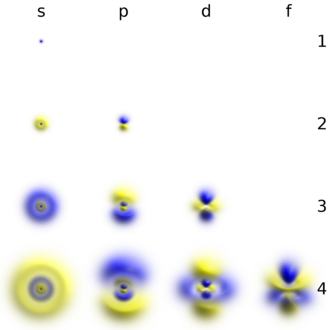
Electrons act in wave-like ways, and we describe where they might be using something called an atomic orbital. Each orbital can hold up to two electrons, and these electrons must spin in opposite ways.
Electrons can move between orbitals by taking in or giving off energy. They can also move after bumping into other particles or getting a push, like from a flash of light.
Electrons help atoms stick together to form molecules. When atoms share or trade electrons, they form strong connections called chemical bonds. Inside molecules, electrons move around more than one nucleus and settle into places called molecular orbitals. Pairs of electrons with opposite spins can share the same orbital, which helps atoms bond together.
Conductivity
When the number of negative charges from electrons equals the number of positive charges from nuclei, an object is neutral. If there are extra electrons, the object is negatively charged. If there are fewer electrons, the object is positively charged. Rubbing objects together can create a charge through the triboelectric effect.
Moving electrons create an electric current, which can also be made by changing magnetic fields. Metals like copper and gold are good conductors because their electrons act almost like free particles. These electrons can move through the metal when a charge is applied, creating a current. Other materials like glass and Teflon are poor conductors because their electrons are stuck to their atoms.
Even though electrons move slowly, changes in current happen very fast because they travel as waves. Metals are also good at conducting heat because their free electrons can carry energy. Some materials can become perfect conductors, called superconductors, when cooled enough, allowing electricity to flow without any resistance.
Relativistic effects
According to Einstein's theory of special relativity, when an electron moves very fast, it gets harder to make it go even faster. An electron can get close to the speed of light but it will never reach it.
When electrons move very fast through some materials like water, they can go faster than light does in that material. This makes a soft glow called Cherenkov radiation.
Formation
The Big Bang theory tells us about the early universe. At first, the universe was very hot. Tiny particles called photons had enough energy to make pairs of electrons and positrons. As the universe cooled, most of these particles disappeared, but some electrons stayed. These electrons helped make the first atoms.
Later, stars formed and made more positrons through their reactions. These positrons would vanish when they met electrons, creating energy. Very big stars can sometimes collapse into black holes. Near black holes, special processes might make electrons and positrons. High-energy particles from space, called cosmic rays, can also create electrons when they hit Earth's atmosphere.
Observation
We can watch electrons by seeing the energy they give off. In hot places like the corona of a star, loose electrons form a special gas that sends out energy because of Bremsstrahlung radiation. This gas can move in waves due to plasma oscillation, making energy bursts that can be found with radio telescopes.
The frequency of a photon is linked to its energy. When an electron in an atom moves between energy places, it takes in or sends out photons at certain frequencies. For example, when we shine light on atoms, we see dark spots in the colors where the atom’s electrons take in that color. Each element has its own set of color spots, like the hydrogen spectral series. By checking these spots with spectroscopic tools, we can learn what things are made of.
In labs, we can watch single electrons using special particle detectors. These tools help us measure an electron’s energy, spin, and charge. With tools like the Paul trap and Penning trap, scientists can keep charged particles in one place for a long time. This helps make very exact measurements.
In February 2008, a team at Lund University in Sweden captured the first video images of how electrons spread out in energy. They used super quick flashes of light, called attosecond pulses, to see an electron’s movement for the first time.
We can also see how electrons are arranged in solid things using angle-resolved photoemission spectroscopy (ARPES). This method uses a light effect to measure reciprocal space, a math way to show patterns, helping us understand how electrons move and act inside materials.
Plasma applications
Electron beams are used in welding to join materials that are hard to weld. This process needs to happen in a vacuum.
Electron beams can also etch tiny patterns on semiconductors, but this method is expensive and slow. They are used to change the properties of materials or to clean medical and food products. In hospitals, electron beams can help treat certain skin cancers by targeting them without affecting deeper tissues.
Electron beams are used in special microscopes that can see very small details, much better than regular microscopes. These tools help scientists study tiny structures in materials. Electrons also played a role in older display technologies like television sets and computer monitors, but these have mostly been replaced by newer technologies.
Images
Related articles


This article is a child-friendly adaptation of the Wikipedia article on Electron, available under CC BY-SA 4.0.
Images from Wikimedia Commons. Tap any image to view credits and license.