 Safekipedia
Eyak
Adapted from Wikipedia · Adventurer experience
The Eyak (Eyak: ’i:ya:GdAlahGAyu: /ʔiːyaːqdalahqayuː/) are an Alaska Native people who lived near the Copper River Delta and the town of Cordova, Alaska. They are part of the Indigenous peoples of the Northwest Coast. Today, many Eyak people live in Cordova, Yakutat, and other parts of Alaska and the United States.
Although many Eyak descendants exist, they do not always qualify to be members of the Native Village of Eyak, a federally recognized Alaska Native tribe. This tribe was created in 1971 through the Alaska Native Claims Settlement Act. The rules for joining the tribe require people to live mostly in Cordova, which means not all Eyak descendants can join.
Name
In the Eyak language, their name is ’i:ya:GdAlahGAyu:. This name started from a village at Mile 6 and might mean "hiding spot" or "river mouth." Over time, it came to represent all Eyak people.
The name has roots in the Alutiiq language of the Chugach people.
Territory
The Eyak people lived near the Copper River Delta in Alaska, close to the town of Cordova. Their land reached from Cordova east to the Martin River and north to the Miles Glacier.
They had four main villages: Alaganik, Eyak, an unnamed village, and Orca. These were all near today's roads and places. They also used special fishing spots at Point Whitshed and Mountain Slough at certain times of the year.
History
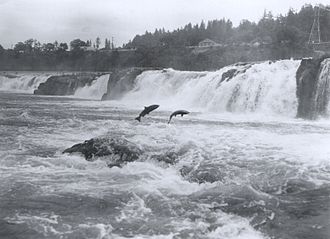
The Eyak people moved from the interior to the coast along the Copper River, where they fished for salmon. When Russian explorers arrived, they noted the Eyak as a unique group and traded with them, even sending missionaries. Because their numbers were small, they sometimes faced trouble from nearby groups like the Chugach and the Tlingit.
When American settlers came, they built canneries and took over much of the Eyak's fishing grounds. New diseases brought by these settlers also caused the Eyak population to shrink. Over time, the remaining Eyak people gathered near a place called Orca. By 1900, their numbers had dropped to around 60. Eventually, the area became the town of Cordova. The last person known to be a full-blooded Eyak was Marie Smith Jones, who passed away in 2008.
Language
The Eyak people had their own special way of talking, called the Eyak language. It was very close to the Athabaskan languages. But as more people spoke English, fewer Eyak people used their language. The last person who could speak Eyak as their native language was Marie Smith Jones. She lived from 1918 to 2008. A man named Michael Krauss studied and taught the Eyak language.
Notable Eyak people
One well-known Eyak person was Marie Smith Jones. She was the last person who spoke the Eyak language as their first language.
Related articles

This article is a child-friendly adaptation of the Wikipedia article on Eyak, available under CC BY-SA 4.0.
Images from Wikimedia Commons. Tap any image to view credits and license.