 Safekipedia
Fiddle
Adapted from Wikipedia · Adventurer experience
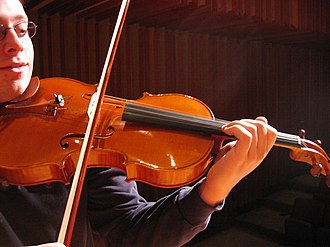
A fiddle is a bowed string musical instrument, most often a violin or a bass. The word "fiddle" is a friendly name for the violin, especially when playing different kinds of music.
While a violin and a fiddle are very similar, the way they are made and played can be a little different depending on the music style. Fiddles might have a special part called a bridge that is flatter, making it easier to play fast and fun tunes. Fiddlers often use steel strings to give the music a brighter sound.
Fiddling is what we call playing the fiddle, and fiddlers are the people who play it. Fiddling music is usually made to make people dance, with quick beats and changes in notes. It is also okay for fiddlers to add their own special touches to the music, called ornamentation, which makes each performance unique. Many fiddlers today, like Alasdair Fraser, Brittany Haas, and Alison Krauss, started with classical music training, but they enjoy playing all kinds of styles.
History
The medieval fiddle began in Europe in the 10th century. It came from the Byzantine lira, a bowed string instrument from the Byzantine Empire. Over time, the words fiddle and lira were used together.
The violin, as we know it today, started in early 16th-century northern Italy. The earliest pictures of violins, with three strings, appeared around 1530. By 1556, the violin was spreading across Europe. Both street musicians and nobles loved the fiddle. In 1560, the French king Charles IX asked Andrea Amati to make 24 violins for him. One of these, called the Charles IX, is the oldest violin we still have today.
Etymology
The word fiddle has an uncertain origin. It likely comes from the Latin word fidula, an early term for the violin. It may also have Germanic roots. The name seems connected to the Icelandic word fiðla and the Old English word fiðele. In medieval times, fiddle described an early version of today’s violin. These instruments usually had four strings and came in many shapes and sizes. Another group of instruments that helped shape the modern fiddle are the viols, played vertically between the legs with fretted fingerboards.
Ensembles
In performances, you might see a solo fiddler or a few fiddlers with other musicians. In some styles from North America, Scandinavia, Scotland, and Ireland, two fiddlers sometimes play together. After folk music became popular in the late 20th century, it became common for many fiddlers to play together in informal settings. Examples include the Calgary Fiddlers, Swedish Spelmanslag folk-musician clubs, and Irish sessions around the world.
In orchestras, violins are usually in sections or "chairs." These different ways of playing might come from old performance places: big concert halls needed more violins for loud music, while smaller dance halls and homes had fiddlers.
The sound of fiddle music and violin music can be different. Fiddle music was often dance music, while violin music could be dance music or something else. Violin music often aimed for smoothness, but fiddle music followed a clear dance beat. When more volume was needed, fiddlers could play their instruments harder while keeping the beat.
In the late 20th century, some artists brought back the Scottish way of playing violin and "big fiddle," or cello. Examples include Iain Fraser and Christine Hanson, Amelia Kaminski and Christine Hanson’s Bonnie Lasses, Alasdair Fraser and Natalie Haas’s Fire and Grace, and Tim Macdonald and Jeremy Ward’s The Wilds.
In Hungary, Slovenia, and Romania, fiddle players are often joined by a three-stringed variant of the viola, called the kontra, along with a double bass. Sometimes, a cimbalom and clarinet are also added to the band. In Hungary, the kontra or háromhúros brácsa is part of traditional folk music. Its flat bridge lets the musician play three-string chords. A three-stringed double bass is also used.
Styles
Fiddle playing has many styles from folk and ethnic music traditions around the world, each with its own special sound.
Europe
Great Britain
-
English folk music fiddling includes:
- Northumbrian fiddle style, with a second fiddler playing harmony.
- Lakeland or Cumbrian fiddling with tunes based on hornpipes.
- Yorkshire fiddling mixes clear phrases with flowing styles.
-
Scottish fiddling includes many traditions such as:
- Shetland with ringing strings and syncopated rhythms.
- North East (like Aberdeenshire and Moray) with baroque influences.
- Scottish Borders heavy in hornpipes.
- Highland style influenced by bagpipes.
- West Highland and Hebridean closely related to Highland style.
- Orkney with simpler bowing and accidentals.
-
Welsh fiddling is a revived tradition.
Ireland
- Irish folk music fiddling includes styles from different regions:
Nordic countries
-
Norwegian fiddling includes styles such as:
- Røros and Nord-Noreg
- Finnskogen with Finnish influences
- Voss and Telemark using Hardanger fiddle
- Setesdal using both types of fiddles
-
Swedish fiddling includes styles from:
-
Finnish fiddling includes styles from:
- Kaustinen
- Ostrobothnia influenced by Swedish fiddling.
Continental Europe
- Austrian fiddling
- French fiddling from Corrèze and Brittany
- Hungarian folk music traditions
- Italian fiddling
- Klezmer fiddling
- Polish fiddling
- Mainland Portuguese and Azorean fiddling
- Romanian fiddling
Americas
United States
American fiddling includes many styles:
Traditional
-
Blues fiddling
-
Native American fiddling such as:
-
Old time fiddling including:
-
Appalachia with droning and syncopation
-
Athabaskan from Interior Alaska
-
Midwestern influenced by Scandinavian music
-
Ozarks with faster bowing
-
Texas with Mexican influences and competition
-
New England with Québécois and British influences
-
Northwest mixing Ozark and Midwestern styles with competition
-
Modern
- Bluegrass fiddling
- Country fiddling
- Western swing style fiddling
Canada
Fiddling is a big part of Canada’s culture:
- Cape Breton fiddling with Scottish influence
- French Canadian fiddling with irregular beats
- Métis fiddling from central and western Canada
- Newfoundland fiddling with ‘singles’ and ‘doubles’
- Maritimes, Acadian or Downeast style similar to Cape Breton fiddling
- English Canadian fiddling
Mexico
Mexican fiddling includes:
- Danza indígena
- Mariachi
- Son arribeño
- Son calentano
- Son huasteco
- Son planeco
- Violín-tambora
- Violín tuxtleco
- Violín mixteco
South America
- Forró from Brazil, including the rabeca fiddle tradition
- Peruvian violin
Africa, Asia and Australia
- African fiddle
- Australian folk music traditions
- Huqin Chinese fiddles
- Morna fiddling from Cape Verde
- Indian fiddle
- Indian classical music
Related instruments
The fiddle is closely related to several other musical instruments. Some are very similar, like the Hardanger fiddle and the Stroh violin, also called a phonofiddle or Vioara cu goarnă in Romanian.
Other near relatives of the fiddle include the Cello, Double bass, Kontra, Låtfiol, Rebec, Rabeca, and Viola.
More distant relatives are the Apache fiddle, Byzantine lyra, Cretan Lyra, Crwth, Gadulka, Gudok, Gusle, Hurdy-gurdy (also known as the wheel fiddle), Kamancheh, Lijerica, Nyckelharpa, Rebab, Erhu, and morin khuur.
Images
Related articles




This article is a child-friendly adaptation of the Wikipedia article on Fiddle, available under CC BY-SA 4.0.
Images from Wikimedia Commons. Tap any image to view credits and license.