 Safekipedia
Geological history of Earth
Adapted from Wikipedia · Adventurer experience
The geological history of Earth tells the story of our planet from its beginning to today. Earth formed approximately 4.54 billion years ago from dust and gas left over when the Sun was born. At first, Earth was very hot and liquid, but it slowly cooled and formed a solid outer layer. Water gathered in the air and then fell as rain, creating the oceans.
Over hundreds of millions of years, Earth’s surface changed a lot. The land moved around and sometimes came together to make one big landmass, called a supercontinent. One of the earliest supercontinents was Rodinia, which broke apart long ago. Later, the continents joined again to form Pannotia and then Pangaea, which eventually split up into the continents we know today.
For a longer look at Earth’s story, see the History of Earth. The planet has gone through many changes, including periods when ice covered large parts of it. These icy times happened in cycles, and the most recent big icy period ended about 10,000 years ago.
Precambrian
Main article: Precambrian
The Precambrian is the longest part of Earth's history. It started about 4.6 billion years ago and ended around 539 million years ago. It has three parts: the Hadean, Archean, and Proterozoic. After this came the Phanerozoic.
Hadean Eon
Main article: Hadean
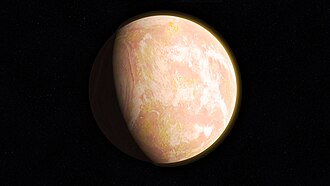
The Hadean Eon began when the Solar System was created from a cloud of gas and dust. Earth formed about 4.5 billion years ago in this time. We call it the Hadean, but we have very few rocks from it to study. The oldest tiny crystals, called zircons, are about 4.4 billion years old.
At first, Earth was very hot and liquid because of volcanoes and crashes with space rocks. Slowly, the surface cooled and hardened. The Moon may have formed when a big object hit Earth. Volcanoes and gases made the first atmosphere, and water vapor became rain, filling the first oceans. Some scientists think Earth may have always had water since it formed.
Archean Eon
Main article: Archean
The Archean Eon lasted from about 4 billion to 2.5 billion years ago. During this time, Earth's surface cooled enough for solid rocks and early land to form. Scientists are not sure if Earth's outer layers moved differently then or if they worked like they do today. Some think Earth was hotter and more active, while others think the processes were similar but slower.
Special rocks from this time include deep-water sediments and volcanic rocks. One important feature is greenstone belts, which are mixtures of different rocks formed near early volcanic islands. Earth's magnetic field, which helps protect our atmosphere, appeared about 3.5 billion years ago.
Proterozoic Eon
Main article: Proterozoic
The Proterozoic Eon lasted from about 2.5 billion to nearly 539 million years ago. We have more rocks from this time, showing shallow sea deposits. This time saw Earth's continents move and join together into large landmasses. One early supercontinent called Rodinia began to break apart around 750 million years ago, later forming another called Pannotia.
This period also had some of Earth's biggest freezes, including a very cold time called Snowball Earth.
Phanerozoic
Main article: Phanerozoic
The Phanerozoic is the time we are living in now. It has lasted about 539 million years. This time is split into three parts: the Paleozoic, Mesozoic, and Cenozoic. During this time, the continents moved apart and then came together as one land called Pangea before moving apart again.
Most life forms that could live on land and in water evolved during this time.
Paleozoic Era
Main article: Paleozoic
The Paleozoic Era lasted about 539 to 251 million years ago. It is divided into six time periods: Cambrian, Ordovician, Silurian, Devonian, Carboniferous, and Permian. At the start of the Paleozoic, a supercontinent called Pannotia broke apart, ending an ice age. Early in this era, Earth's land was split into many small continents. By the end, the continents came together to form Pangea.
Cambrian Period
Main article: Cambrian
The Cambrian Period began about 538.8 million years ago. During this time, the continents came from the breakup of Pannotia. The oceans were wide and shallow. Lands such as Laurentia, Baltica, and Siberia stayed separate. Gondwana moved toward the South Pole. Panthalassa covered most of the southern hemisphere. Smaller oceans included the Proto-Tethys Ocean, Iapetus Ocean, and Khanty Ocean.
Ordovician period
Main article: Ordovician
The Ordovician Period began about 485.4 million years ago. Southern continents formed Gondwana, which moved toward the South Pole. Early on, Laurentia, Siberia, and Baltica were separate, but Baltica moved toward Laurentia, shrinking the Iapetus Ocean. Avalonia broke away from Gondwana and moved north toward Laurentia, forming the Rheic Ocean. By the end, Gondwana was near the pole and covered in ice.
The Ordovician ended with extinction events about 447 to 444 million years ago, marking the start of the Silurian Period.
Silurian Period
Main article: Silurian
The Silurian Period began about 443.8 million years ago. Gondwana continued moving south, but its ice caps were smaller than in the Ordovician. Melting ice raised sea levels. Other landmasses drifted together near the equator, forming Euramerica. Panthalassa covered most of the northern hemisphere. Other oceans included Proto-Tethys, Paleo-Tethys, Rheic Ocean, and the Ural Ocean.
Devonian Period
Main article: Devonian
The Devonian Period lasted from 419 to 359 million years ago. It was a time of much mountain building as Laurasia and Gondwana moved closer. Euramerica formed from Laurentia and Baltica. In near-desert areas, red sandstone formed. Near the equator, Pangea started to form. Sea levels were high, and much land was covered by shallow seas. Panthalassa covered the rest of the planet. Other oceans were Paleo-Tethys, Proto-Tethys, Rheic Ocean, and Ural Ocean.
Carboniferous Period
Main article: Carboniferous
The Carboniferous Period lasted from about 358.9 to 298.9 million years ago.
Sea levels dropped at the end of the Devonian and early Carboniferous, creating wide shallow seas. Cold temperatures in the south kept Gondwana icy, but the tropics had lush swamps. A drop in sea level caused a major die-off of sea creatures. This separated the Mississippian from the Pennsylvanian periods.
The Carboniferous saw more mountain building as Pangea formed. Gondwana collided with North America-Europe along today's eastern North America. This created mountains in Europe and North America and extended the Appalachian Mountains. Much of Eurasia joined Europe along the Ural Mountains. Major oceans were Panthalassa and Paleo-Tethys. Other oceans closed, like the Rheic Ocean and Ural Ocean.
Permian Period
Main article: Permian
The Permian Period lasted from about 298.9 to 252.17 million years ago.
During the Permian, all major landmasses except parts of East Asia formed Pangea. Pangea sat across the equator, affecting ocean currents. The Cimmeria continent moved north to Laurasia, shrinking the Paleo-Tethys Ocean. A new ocean, the Tethys Ocean, formed. Large landmasses created extreme climates, with deserts common on Pangea.
Mesozoic Era
Main article: Mesozoic
The Mesozoic lasted about 252 to 66 million years ago.
After the mountain building of the late Paleozoic, the Mesozoic had less mountain building. But the supercontinent Pangea split into Laurasia to the north and Gondwana to the south. This created the edges we see today along the Atlantic coast.
Triassic Period
Main article: Triassic
The Triassic Period lasted from about 252.17 to 201.3 million years ago. Almost all land was one supercontinent called Pangea, shaped like a giant Pac-Man with the Tethys sea in its mouth. The rest was the ocean Panthalassa. Pangea began to break apart during the Triassic. Deep ocean sediments from this time have been lost, so we know little about the open ocean. Triassic rock layers are mostly from lagoons and land animals.
Jurassic Period
Main article: Jurassic
The Jurassic Period lasted from about 201.3 to 145.0 million years ago. Early in the Jurassic, Pangea split into Laurasia to the north and Gondwana to the south. The Gulf of Mexico opened between North America and Yucatan. The North Atlantic was narrow, but the South Atlantic did not open until the Cretaceous. The Tethys Sea closed, and the Neotethys basin formed. Climates were warm, with no ice caps. The Jurassic record is best in western Europe, with many marine fossils. North America's record is poorer, with mostly continental sediments. Important Jurassic rocks are found in Russia, India, South America, Australasia, and the United Kingdom.
Cretaceous Period
Main article: Cretaceous
The Cretaceous Period lasted from about 145.0 to 66 million years ago.
During the Cretaceous, Pangea finished breaking up into today's continents, though they were in different places. As the Atlantic Ocean widened, mountain building continued in North America. Gondwana broke up as South America, Antarctica, and Australia separated from Africa. India and Madagascar stayed connected. This created the South Atlantic and Indian Oceans. Shallow seas covered much of central North America and Europe. The Cretaceous is known for chalk, formed from tiny ocean creatures. Famous rock layers include Kansas's Smoky Hill Chalk and the Hell Creek Formation. Important Cretaceous rocks are also in Europe and China. In India, large lava flows called the Deccan Traps formed late in the Cretaceous.
Cenozoic Era
Main article: Cenozoic
The Cenozoic Era covers the last 66 million years up to today. By the end of the Mesozoic, the continents were near their current positions. Laurasia became North America and Eurasia. Gondwana split into South America, Africa, Australia, Antarctica, and the Indian subcontinent, which crashed into Asia, forming the Himalayas. The Tethys Sea closed, forming the Mediterranean Sea.
Paleogene Period
Main article: Paleogene
The Paleogene Period lasted 66 to 23.03 million years ago and includes the Paleocene, Eocene, and Oligocene.
Paleocene Epoch
Main article: Paleocene
The Paleocene lasted from 66 to 56.0 million years ago.
The Paleocene continued changes that started in the late Cretaceous. Continents kept moving toward their current spots. Laurasia had not fully split into three continents. Europe and Greenland were still connected. North America and Asia were sometimes joined by land, while Greenland and North America began to split. The Laramide orogeny uplifted the Rocky Mountains, ending in the next epoch. South and North America stayed apart by seas. Gondwana's parts continued to split, with Africa, South America, Antarctica, and Australia moving apart. Africa moved north toward Europe, closing the Tethys Ocean. India began moving toward Asia, leading to the Himalayas.
Eocene Epoch
Main article: Eocene
The Eocene lasted from 56.0 to 33.9 million years ago.
During the Eocene, continents kept moving toward their current places. Australia and Antarctica were still connected, and warm currents mixed with cold Antarctic waters, keeping temperatures high. When Australia split away around 45 million years ago, warm currents were blocked, cooling Antarctica and starting today's ice ages.
Laurasia began to break up as Europe, Greenland, and North America drifted apart. In western North America, mountains formed and large lakes appeared. In Europe, the Tethys Sea disappeared, and the rising Alps isolated the Mediterranean, creating shallow seas and islands to the north. The North Atlantic opened, but a land bridge may have stayed between North America and Europe. India continued moving from Africa toward Asia, starting the Himalayan mountains.
Oligocene Epoch
Main article: Oligocene
The Oligocene Epoch lasted from about 34 to 23 million years ago. Continents kept moving toward their current positions.
Antarctica became more isolated and developed a permanent ice cap. Mountain building continued in western North America, and the Alps rose in Europe as Africa pushed north into Eurasia, isolating parts of the Tethys Sea. A brief sea covered early Oligocene Europe. A land bridge existed between North America and Europe. South America finally separated from Antarctica and drifted north toward North America, allowing the Antarctic Circumpolar Current to form, cooling Antarctica quickly.
Neogene Period
Main article: Neogene
The Neogene Period lasted from 23.03 to 2.588 million years ago and includes the Miocene and Pliocene. It follows the Paleogene Period.
Miocene Epoch
Main article: Miocene
The Miocene lasted from 23.03 to 5.333 million years ago.
During the Miocene, continents kept moving toward their current spots. Only the land bridge between South and North America was missing. Subduction along South America's Pacific coast raised the Andes and extended the Meso-American peninsula. India continued crashing into Asia. The Tethys Seaway shrank and vanished as Africa collided with Eurasia between 19 and 12 million years ago. Mountain uplift in the western Mediterranean and falling sea levels dried up the Mediterranean Sea temporarily near the end of the Miocene.
Pliocene Epoch
Main article: Pliocene
The Pliocene lasted from 5.333 to 2.588 million years ago. Continents kept moving toward their current places, from 250 km away to only 70 km away.
South America connected to North America through the Isthmus of Panama, ending South America's unique animal groups. This also changed global temperatures by blocking warm ocean currents and starting Atlantic cooling. Africa's crash into Europe formed the Mediterranean Sea. Sea level changes exposed a land bridge between Alaska and Asia. Near the Pliocene's end, about 2.58 million years ago, the current ice age began, with repeated glacial cycles every 40,000–100,000 years.
Quaternary Period
Main article: Quaternary
Pleistocene Epoch
Main article: Pleistocene
The Pleistocene lasted from 2.588 million years ago to 11,700 years ago. The continents were mostly in their current positions, having moved less than 100 km since the period began.
Holocene Epoch
Main article: Holocene
The Holocene Epoch began about 11,700 years ago and continues today. Continental movements have been less than a kilometer.
The last glacial period of the current ice age ended about 10,000 years ago. Melting ice raised sea levels by about 35 meters. Areas above 40 degrees north, pressed down by glaciers, are still rising. Sea level rise and land changes allowed seas to reach places now far inland. Holocene fossils are mainly in lakes, floodplains, and caves. Marine fossils from this time are rare near the equator because rising seas covered possible sites. Post-glacial rebound in Scandinavia raised coastal areas around the Baltic Sea, including Finland. The region still rises, causing small earthquakes in Northern Europe. A similar rebound happened around Hudson Bay in North America as it shrank from its larger Tyrrell Sea phase.
Images
Related articles



This article is a child-friendly adaptation of the Wikipedia article on Geological history of Earth, available under CC BY-SA 4.0.
Images from Wikimedia Commons. Tap any image to view credits and license.