 Safekipedia
Greco-Buddhist art
Adapted from Wikipedia · Adventurer experience
Greco-Buddhist art
The Greco-Buddhist art or Gandhara art is the artistic expression of Greco-Buddhism, a mixing of cultures between Ancient Greek art and Buddhism. It mostly developed in an ancient place called Gandhara, which was on the edges of the Indian subcontinent.
This art began after many different groups, like soldiers and rulers, came to the area. It started with Alexander the Great visiting the place, and later Ashoka, a Buddhist ruler, helped spread Buddhism there. The art grew most during the time of the Kushan Empire.
Gandhara art shows Buddhist ideas but uses styles from Greco-Roman art. It has realistic and detailed pictures, and it is thought to be the first time Buddha was shown as a human in art. This way of showing Buddha influenced other parts of India and even far away places like Japan as Buddhism spread.
Historical outline
Main article: Greco-Buddhism
Further information: Buddhist art, Hellenization, and History of Buddhism
Greco-Buddhist art, also called Gandharan art, is a mix of ancient Greek and Buddhist styles. It began in a place called Gandhara, in the northwest part of India today.
This art started after many cultures shared ideas. When Alexander the Great traveled through the area, Buddhism was not very common there. Later, under the Maurya Empire, Emperor Ashoka helped spread Buddhism, even to Greek people living nearby.
After the Maurya Empire, rulers like the Greco-Bactrian kingdom and the Indo-Greek kingdom supported Buddhism. They mixed Greek styles with Buddhist ideas in their art. Later, the Kushan Empire helped this art grow, sending it along the Silk Road to other parts of Asia.
Early Buddhist art and aniconic Buddhist representations
Buddhist art began to grow during the time of Ashoka the Great in the Maurya Empire. Art from this time, called Mauryan art, influenced early Buddhist styles. You can see this in structures like the Pillars of Ashoka and places such as the Sanchi and Bharhut stupas.
Early Buddhist art used symbols that are still important today, such as the Dharmachakra, lotus, and the Bodhi tree. It also showed mythological characters like yakshas, including Kubera, and yakshini like Chanda, as well as celestial Devas and Asuras. The art told stories about the life of the Buddha.
Even though the art showed many people and divine beings, the Buddha himself was not shown as a human. Instead, symbols were used to represent him. For example, a riderless horse showed his leaving his kingdom, the Bodhi tree stood for his moment of enlightenment, and Buddha footprints reminded people of his teachings. Some believe this choice was made out of respect.
Hellenistic art in South Asia
Main article: Hellenistic influence on Indian art
The clearest examples of art from ancient Greek styles are seen in coins from kings like Demetrius I of Bactria. Many coins from these kings have been found. Some coins are large and beautifully made, showing more detail than coins from other kings in Greece.
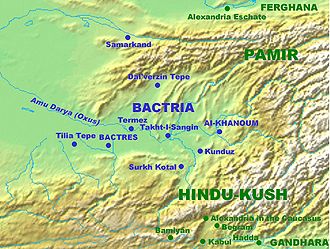
These kingdoms built cities like Ai-Khanoum, which had buildings and statues made in the Greek style. Even in India, Greek styles appeared early, like in a special stone piece from Pataliputra around the year 300 BC. Later, after the Greco-Bactrians came to India in 180 BC, forming the Indo-Greek kingdom, Greek designs such as fruit patterns became common. Art pieces showing sea creatures and other Greek themes have also been found.
Early Gandhara creations: stone palettes (2nd century BC – 1st century AD)
Main article: Stone palettes
The Greeks who lived in Asia made special round stone trays, often called "toilet trays". These trays were found in places like Bactria and Gandhara. They showed scenes from Greek mythology. The oldest ones are from the time of the Indo-Greeks in the 2nd and 1st century BC. Some were found at Sirkap. People kept making these trays until the time of the Indo-Parthians, but they stopped after the 1st century.
| Early stone palettes | |
Apollo and Daphne. Couple with sea serpent. Poseidon with attendants. Ancient Orient Museum. Aphrodite at her bath. Man with cup in hand, riding a Ketos sea-monster. Female triton, Tokyo National Museum Friendly animals. |
Interaction
When the Greeks came to Northwestern South Asia and formed the Indo-Greek kingdom, they started mixing their art with Buddhist ideas. This mixing grew for many years and became very strong during the Kushan Empire starting in the 1st century AD.
Artists from the Gandhara area helped shape early Buddhist art places like Sanchi and Bharhut. We can see Greek influences in designs such as curved shapes and special flower patterns. For example, around 115 BC, a Greek visitor named Heliodorus built a pillar to honor a Buddhist leader. Craftsmen from Gandhara also added beautiful carvings to these important Buddhist places.
Craftsmen from Gandhara helped build the gateways at Bharhut between 100 and 75 BC. Marks left by the builders show they came from Gandhara, where a special writing style was used. These gateways show a mix of Greek and local styles, with curved shapes and flower designs that came from Greek art.
| Early reliefs at Sanchi, Stupa No 2 (circa 115 BC) | |
| Sanchi, Stupa No2 Mason's marks in Kharoshti point to craftsmen from the north-west (region of Gandhara) for the earliest reliefs at Sanchi, circa 115 BC. | Foreigner on a horse. The medallions are dated circa 115 BC. Lakshmi with lotus and two child attendants, probably derived from similar images of Venus Female riding a Centaur. Lotus within Hellenistic beads and reels motif. Floral motif. |
Characteristics of Greco-Buddhist art
Greco-Buddhist art mixes styles from Ancient Greece and Buddhism. It mainly developed in a place called Gandhara, in the northwest part of the Indian subcontinent.
This art shows scenes from the life of the Buddha. The Buddhas are often shown looking like Greek kings, wearing robes similar to Greek clothing. Buildings in these artworks have Greek-style designs, like special columns and decorative patterns. Sometimes, Greek gods appear alongside Indian gods in these artworks.
Artists in Gandhara used stone and stucco to create sculptures for temples and other important places. This style of art spread from Gandhara to places like India, Afghanistan, Central Asia, and China.
Over time, the art changed from very realistic styles to more symbolic and decorative ones. These early Buddha statues show a mix of Greek and Indian styles, with elements like robes and hairstyles that come from Greek art.
The art also included figures from Greek mythology, like Herakles and Atlas, who were used to represent Buddhist ideas and protectors.
Kushan contribution
The later part of Greco-Buddhist art in northwestern India is linked to the Kushan Empire. The Kushans were nomadic people who moved from the Tarim Basin in Central Asia around 170 BC. They later established an empire in northwestern India during the 2nd century BC. After taking over areas once ruled by Greco-Bactrians and Indo-Greeks, the Kushans embraced Greco-Buddhist art.
Later period (5th-7th centuries)
The Greco-Buddhist art of Gandhara mostly stopped between the 5th and 7th centuries. During this time, Buddha figures began to appear with a halo and a special shape called a mandorla around them. This period happened when the Alchon Huns were defeated, which led to the end of Gandhara art. A traveler named Xuanzang visited the area around 630 AD and found that Buddhism had become much weaker, and many monasteries were empty and broken.
Seated Buddha with halo and mandorla 5th-6th century Gandhara.
The Buddha with a radiate mandorla, [Gandhara](/wiki/Gandhara), 6th century
Last stages of Greco-Buddhist art. 7th century, [Ghorband District](/wiki/Ghorband_District), [Afghanistan](/wiki/Afghanistan).
Southern influences
Art of the Shunga
Examples of how Greek and Greco-Buddhist art influenced the art of the Shunga Empire (183-73 BC) are usually small. The main religion at the start seems to have been Hinduism, though some later Buddhist works in Madhya Pradesh are known, such as some building projects at the stupas of Sanchi and Bharhut, which began under King Ashoka.
Art of Mathura
Main article: Mathura art
The pictures of the Buddha from Mathura, in central northern India, are generally from a later time than those from Gandhara, though this is debated, and there are fewer of them. Before this, Indian Buddhist art mostly avoided showing the Buddha directly, using symbols like the wheel or the Bodhi tree instead, though some older Mathuran sculptures of Yaksas (earth spirits) from the 1st century BC show some Greek influence, possibly from when the Indo-Greeks ruled Mathura in the 2nd century BC.
Greek art helped shape how the Buddha was first shown as a human figure, since Indian art before this had no examples of such realistic human forms. Mathura sculptures mix Greek styles, like realistic looks and designs for hair and clothes, with Indian ideas. Over time, the clothes in these sculptures became looser to suit warmer weather, and the faces looked more Indian. The art of Mathura also influenced areas as far as Amaravati on India’s east coast, where Greek designs like scrolls and chariots appear with Indian gods.
Hindu art began to develop from the 1st to the 2nd century AD, inspired by the Buddhist art of Mathura. It later added many new Hindu styles and symbols, differing from the simpler balance of Buddhist art.
Arts of Western India
It has been suggested that the art of Devnimori in Gujarat, from the 4th century AD, shows a Western Indian style influenced by the Greco-Buddhist art of Gandhara. This style may have affected later art of the Gupta Empire, and also art at the Ajanta Caves, Sarnath, and other places from the 5th century onward. Devnimori may have also been influenced by Mathura art. At Devnimori, many early Buddhist sculptures made of terracotta (but not stone) show clear links to Gandhara style.
The Indo-Scythian Western Satraps (1st century AD-405 AD) and later the southern movement of the Alchon Huns in the 6th-7th century may have helped spread Gandhara art to western Deccan region.
Art of the Gupta
The art of Mathura became more Indian in style and reached its peak during the Gupta Empire between the 4th and 6th century AD. The art of the Gupta is seen as the highest point of Indian art, showing Hindu, Buddhist and Jain ideas.
Greek influences can still be seen in the clean lines of the statues and the way the clothes are shown, but these are made even better with soft pink sandstone. The art becomes less realistic, with symbolic curls used for the Buddha’s hair.
Expansion in Central Asia
Greco-Buddhist art spread with Buddhism to Central and East Asia starting from the 1st century BC.
Bactria was ruled by Greeks for over two hundred years after Alexander the Great arrived in 332 BC until around 125 BC. The art there showed strong Greek styles, seen in old cities like Alexandria on the Oxus and in coins made by Greek rulers. When Buddhism later grew in Central Asia from the 1st century AD, Bactria experienced a mix of Greek and Buddhist styles. Famous examples include the Buddhas of Bamyan, whose design shows clear Greek influence.
In a place called Fondukistan, some Buddhist art with Greek style lasted until the 7th century AD. Much of this art was damaged over time.
The art of the Tarim Basin, known as Serindian art, developed between the 2nd and 11th centuries in what is now western China. This art came from Gandhara and blended Indian, Greek, Roman, Chinese, and Persian styles. Buddhist travelers on the Silk Road brought this art and Buddhism to the region.
See also: Silk Road transmission of Buddhism
Influences in East Asia
The arts of China, Korea, and Japan used ideas from Greco-Buddhist art and added their own styles. We can still see these influences in things like realistic sculptures, detailed clothing folds, curly hair, and figures with wings holding wreaths.
China
In China, Buddhist art shows Greco-Buddhist influences, changing with different time periods and rulers. For example, Han dynasty "money tree" items often show the Buddha with styles similar to Gandhara art, like a special hair bump called an ushnisha, a vertical hair bun, a small moustache, and symmetric robe designs.
Some statues from the Northern Wei and Northern Qi periods look like Buddhas from Gandhara but in a more symbolic way. Statues from the Eastern Wei period sometimes show Buddhas with robe folds inspired by Greek art, and above them are figures holding wreaths.
Japan
In Japan, Buddhist art grew when the country adopted Buddhism in AD 548. Art from the Asuka Period shows a classic style with Greek-like clothing and realistic details, typical of Greco-Buddhist art. Japanese art also mixed in Chinese and Korean styles, making Buddhist art diverse. Even today, we can see Greek-style clothing folds in Buddha images.
Greek influence appears in how the wind god Fūjin is shown, looking similar to the god Boreas. Both hold a "wind bag" above their heads in almost the same way.
Influences on Southeast Asian art
The culture of ancient India influenced many countries in Southeast Asia. These countries used Indian writing and ideas, including Hinduism and both Mahayana and Theravada Buddhism.
We can see the influence of Greco-Buddhist art in how Buddha is shown in Southeast Asia. This includes the way Buddha looks very real and the details of his clothing. Over time, these styles mixed with Indian Hindu art and also started to include more local traditions.
Museums
Major collections
Greco-Buddhist art is in many museums around the world. The biggest collection is at the Peshawar Museum in Peshawar, Pakistan. Other major museums are the Lahore Museum in Lahore, Pakistan; the Taxila Museum in Taxila, Pakistan; and the National Museum of Pakistan in Karachi, Pakistan.
In India, the largest collection is at the Indian Museum in Kolkata, West Bengal. The Government Museum and Art Gallery in Chandigarh also has many pieces. Other important Indian museums are the Mathura Museum in Mathura and the National Museum, New Delhi.
Outside of Asia, the Musée Guimet in Paris, France, has many artifacts. The British Museum in London, Great Britain, has around 100 artifacts, including a Seated Buddha from Gandhara. The Tokyo National Museum in Tokyo, Japan, has about 50 artifacts. The National Museum of Oriental Art in Rome, Italy, has about 80 artifacts. The Museum of Asian Art in Dahlem, Berlin, Germany, also shows Greco-Buddhist art.
Small collections
Smaller collections are at the Metropolitan Museum of Art in New York, United States; the Ancient Orient Museum in Tokyo, Japan; the Victoria and Albert Museum in London, Great Britain; the City Museum of Ancient Art in Palazzo Madama, Turin, Italy; the Rubin Museum of Art in New York City, NY, United States; and the Chazen Museum of Art in Madison, WI, United States.
Private collections
One notable private collection is the Collection de Marteau in Brussels, Belgium.
Images
Related articles


This article is a child-friendly adaptation of the Wikipedia article on Greco-Buddhist art, available under CC BY-SA 4.0.
Images from Wikimedia Commons. Tap any image to view credits and license.