 Safekipedia
History of the United States
Adapted from Wikipedia · Adventurer experience
The history of the United States begins with the people who lived on the land for thousands of years, the Native Americans. In 1607, people from the Kingdom of England settled in Jamestown, and later others came to Plymouth in 1620. Over time, more settlers came from Europe, changing the land.
By the 1760s, thirteen colonies existed along the east coast, ruled by the Kingdom of Great Britain. Tensions grew between the colonies and Britain, especially over taxes and rules. This led to the Revolutionary War, beginning in 1775, and ending with the Declaration of Independence on July 4, 1776. The United States became its own country after winning its freedom.
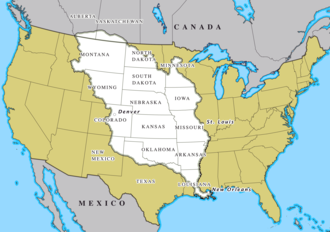
In the early years, leaders like George Washington and Thomas Jefferson helped shape the new nation. The country grew through purchases like the Louisiana Purchase in 1803 and expansion westward. However, this growth often brought conflict with Native American tribes and debates over slavery.
The Civil War from 1861 to 1865 was a hard time when the southern states tried to leave the United States. The war ended with the Union's victory, leading to changes to protect rights for all citizens.
In the 20th century, the United States became a world leader. It joined World Wars I and II, helped build the world after those wars, and faced off with the Soviet Union during the Cold War. More recent history includes dealing with events like the September 11 attacks, the Great Recession, and the COVID-19 pandemic. Today, the U.S. continues to play an important role in global affairs and explores new frontiers like space through programs such as the Artemis Program.
Indigenous inhabitants
Main articles: Geological history of North America, History of Native Americans in the United States, and Pre-Columbian era
See also: Native Americans in the United States
Native Americans lived in North America long before Europeans came. Most experts think they came from Asia across a land bridge named Beringia during a cold time called the Ice Age. These first people, called Paleo-Indians, moved all over the land and created many different cultures.
Over time, Native American societies grew and changed. Some built big earthworks, like the mounds made by the Adena and Hopewell cultures. Others, like the Anasazi, built stone homes in cliffs. In the Pacific Northwest, people lived in villages where they fished for salmon. In Hawaii, Polynesian settlers started their own special ways of living. These groups had rich traditions, traded with each other, and made their own lives.
European colonization (1075–1754)
Main article: Colonial history of the United States
The land that would become the United States was home to many Native American peoples for thousands of years. European explorers arrived in the late 1500s. They brought new animals and plants to the Americas. Unfortunately, they also brought diseases that made many Native Americans very sick.
Early European settlers included Norse explorers around the year 1000. Later, English settlers came in 1607 at Jamestown, Virginia. In 1620, more settlers arrived at Plymouth, Massachusetts. These settlers faced many challenges, including disease, harsh weather, and conflicts with Native Americans. Over time, more colonies were established along the East Coast by different European countries. This helped create the diverse early America.
Revolutionary period (1754–1793)
The French and Indian War (1754–1763) was a big war that helped the Thirteen Colonies grow. It was part of a larger war called the Seven Years' War. After the war, the colonies became closer together.
Tensions grew between the colonists and the British Crown. When the British Parliament taxed the colonies without their approval, many colonists said, "No taxation without representation." These tensions led to events like the Boston Massacre and the Boston Tea Party. Finally, leaders from the colonies decided to declare their independence. On July 4, 1776, the Declaration of Independence was signed. It said that all people should be treated equally and have the right to Life, Liberty and the pursuit of Happiness. The war ended in 1783 with the Treaty of Paris, which recognized the United States as an independent country.
Main article: American Revolution
Main article: Confederation period
Early republic (1793–1830)
The United States Electoral College chose George Washington as the first President in 1789. The nation’s capital moved from New York to Philadelphia in 1790 and then to Washington, D.C. in 1800.
Washington’s government created a strong national system. Treasury Secretary Alexander Hamilton helped set up taxes and a national bank. The United States Bill of Rights was added to the Constitution in 1791 to protect important freedoms.
Thomas Jefferson and James Madison started the Democratic-Republican Party. The country faced challenges like wars with Native American tribes and protests over taxes. Washington set a tradition by only serving two terms as president. John Adams followed him, leading during tense times with France.
Increasing demand for slave labor
Main article: Slavery in the United States
After the Revolutionary War, many Northern states ended slavery. Some southern states made it easier for people to free enslaved individuals. In 1807, the U.S. stopped importing enslaved people from other countries.
Second Great Awakening
Main article: Second Great Awakening
The Second Great Awakening was a big movement that encouraged many people to join churches. It started around 1790 and grew strong after 1820. It inspired new ideas and reforms.
Louisiana and Jeffersonian republicanism
Main articles: Presidency of Thomas Jefferson and Louisiana Purchase
Thomas Jefferson became president in 1801 and bought a huge area of land from France in 1803, known as the Louisiana Purchase. This let Americans expand west of the Mississippi River. Jefferson sent explorers to learn about the new land.
Jefferson believed in a country led by farmers and distrusted big cities and banks. John Marshall, the Chief Justice of the United States, helped define the powers of the Supreme Court.
War of 1812
Main article: War of 1812
See also: History of the United States (1789–1815)
In the early 1800s, relations between the U.S. and Britain got worse. Britain took American ships and sometimes forced American sailors to work on British ships. In 1812, the U.S. declared war on Britain.
Both sides tried to attack each other but faced difficulties. The British attacked cities, like Washington in 1814. However, American forces won important battles, such as at Baltimore and New Orleans in 1815. Even though the war ended without clear winners, it helped build a stronger sense of national pride in the United States.
Era of Good Feelings
Main article: Era of Good Feelings
After the War of 1812, many Americans felt united. The Federalist Party lost support, and there was less fighting between political groups. President James Monroe worked to keep the country calm during his time in office from 1817 to 1825. In 1823, he announced the Monroe Doctrine, saying Europe should not try to control places in the Americas.
Expansion and reform (1830–1848)
The years between 1830 and 1848 were a time of big changes in the United States. Political groups changed, with the Democratic Party forming from part of an older group and the Whig Party forming from another part. Leaders like Andrew Jackson and Henry Clay played important roles.
The country grew as people moved west. Many Native American tribes were moved far from their homes to make room for new settlers. This was very hard for them. The idea that the United States should stretch across the whole continent was called manifest destiny. The United States added new lands after a war with Mexico and discovered gold in California, which brought many people to the area. Women also began to speak up for equal rights, meeting in places like Seneca Falls to ask for the right to vote.
Civil War and Reconstruction (1848–1877)
Main articles: American Civil War, Reconstruction era, and Greater Reconstruction
The years between 1848 and 1877 were a time of big changes in the United States, especially about slavery. Some people in the North, called abolitionists, wanted to end slavery. When Abraham Lincoln became president in 1860, some Southern states left the United States because they wanted to keep slavery. This led to the Civil War, which started in 1861.
The war lasted four years and was very hard on everyone. Many soldiers and civilians died. After the war ended in 1865, a time called Reconstruction began. New laws were made to help freed people get rights, like the right to vote. Building railroads during this time changed the country, making travel and trade faster and easier.
Gilded Age and the Progressive Era (1877–1914)
Main articles: Gilded Age, Progressive Era, and Second Industrial Revolution
The "Gilded Age" was a time when the United States grew very rich. But there were also problems, like corruption in government. Some very rich people became powerful, and this made others worry that things were not fair.
Many people came from Europe to work in factories and on farms. They brought new cultures and ideas, but sometimes working conditions were not good. Because of these concerns, a movement called the Progressive Era began. Progressives wanted to make things better for everyone. They worked for new laws to help workers and make government fairer. They also pushed for changes in voting and taxes.
During this time, the United States had conflicts with Native American tribes as new settlers moved onto their lands. Many Native Americans were moved to special areas set aside for them. The country also went to war with Spain and gained new lands. Women worked hard to earn the right to vote, and in 1920, women in the United States were finally allowed to vote in elections.
Modern America and World Wars (1914–1945)
World War I and the interwar years
See also: American entry into World War I, United States home front during World War I, United States in World War I, and Roaring Twenties
When World War I started in Europe in 1914, President Woodrow Wilson wanted to keep the United States out of the fight. But Germany sank some American ships, and the United States declared war in 1917. American soldiers went to Europe, and the war ended in 1918 when the Allies won. After the war, President Wilson hoped countries would work together for peace through a group called the League of Nations, but the United States did not join.
In the 1920s, the United States grew and changed. Many new people moved to cities, and music like jazz became popular. But there were also problems, like not enough jobs and rules that made it hard to buy or sell alcohol.
Great Depression and the New Deal
Main articles: New Deal, Presidency of Herbert Hoover, and Presidency of Franklin D. Roosevelt
The Great Depression began in 1929 when many people lost their jobs and money. President Franklin D. Roosevelt started the New Deal to help people find work and improve their lives. He made new rules to help workers, farmers, and banks. These changes helped the country start to grow again, even though it took many years for things to get better.
World War II
Main articles: World War II, United States in World War II, and Military history of the United States during World War II
See also: Historiography of World War II and United States home front during World War II
When Germany started World War II in 1939, the United States tried to stay out of the fight. But in 1941, Japan attacked a place called Pearl Harbor, and the United States joined the war. The country worked hard to fight Germany and Japan. Many people, including women and Black Americans, took on new jobs to help make things for the war.
The war ended in 1945. The United States helped build a safer world after the war, but there were still many challenges ahead.
Cold War (1945–1991)
In the years after World War II, the United States grew to be very important around the world. The United States and the Soviet Union were the two biggest powerful countries. The United States joined the United Nations and started the Central Intelligence Agency in 1947.
The United States wanted to help Europe get better after World War II and stop the spread of communism. The Truman Doctrine gave help to Greece and Turkey. The Marshall Plan gave money and trade to Western Europe. In 1949, the United States made the North Atlantic Treaty Organization (NATO). The Soviet Union made the Warsaw Pact in return.
The United States fought in the Korean War and Vietnam War. At home, Dwight D. Eisenhower ended the Korean War and made Social Security bigger. The economy grew, and many people moved to live in new neighborhoods outside of cities.
In the 1960s, John F. Kennedy became president. His time saw big changes in space, the Vietnam War, and civil rights. After he died, Lyndon B. Johnson kept working on these things. The civil rights movement worked for fairness, and many laws were made to end unfair treatment.
Later presidents like Richard Nixon and Ronald Reagan worked to make friends with other countries. The Cold War ended when the Soviet Union broke apart in 1991, leaving the United States as the main power in the world.
Contemporary United States (1991–present)
George H. W. Bush and Clinton administrations
Main articles: Presidency of George H. W. Bush, Presidency of Bill Clinton, Third Way (United States), and Republican Revolution
After a big war ended, the United States stayed busy around the world. George H. W. Bush helped other countries when one was attacked. Under Bush, the country was also in a few other conflicts.
Elected in 1992, President Bill Clinton helped the economy grow and reached an important budget goal. Much of this growth came from new technologies and the growing use of the Internet. During Clinton's time, the country was in conflicts in two places.
George W. Bush administration
Main articles: Presidency of George W. Bush, September 11 attacks, and War on terror
In 2001, a terrible attack happened in the United States when hijackers took over airplanes and caused damage in several places. Many people died, and it was one of the worst attacks in history.
After the attacks, the country worked to prevent future attacks. New laws were passed to help share information better among police and security teams. The government also created a new department to focus on keeping the country safe.
Obama administration
Main articles: Great Recession in the United States, Presidency of Barack Obama, and Tea Party movement
Barack Obama, the first person of mixed race and African American to be president, was elected in 2008. He worked to help the economy recover and signed important laws to improve health care and protect consumers. The economy got better, and by 2019, job numbers were at their best in 50 years.
First Trump administration
Main articles: First presidency of Donald Trump and COVID-19 pandemic in the United States
Donald Trump became president after an unexpected election win. His time as president included changes to policies on borders, trade, and the environment. He also faced challenges, including investigations and accusations.
The year 2020 brought a serious illness that affected the whole world. Many people got very sick, and the country made big changes to slow the spread of the illness. There were also large protests after an event involving a person in police custody, and many people talked about fairness and safety for everyone.
Biden administration
Main article: Presidency of Joe Biden
In 2021, Joe Biden became president again after winning the election. He focused on helping the country recover from the illness and worked on laws to improve roads, help people with money during hard times, and support veterans. In 2022, a very important court decision changed laws about health choices, leading to protests across the country. Biden also worked with other countries to support Ukraine after it was attacked and helped Israel during a conflict.
Second Trump administration
Main article: Second presidency of Donald Trump
Domestic affairs
In November 2024, Trump was elected again, making him one of only a few presidents to serve two separate terms. In his first days as president, he made many changes through special orders and laws, including steps to change rules about who can enter the country and efforts to cut spending. He also started plans for building more structures along the southern border and made changes to taxes.
In April 2026, a mission to send astronauts around the moon happened, continuing a plan started earlier to build a permanent base there in the future.
Foreign affairs
Trump made several changes in how the country works with others around the world. He took steps to leave groups that help countries work together and started trade disagreements with some countries. He also worked on peace talks in some areas but faced challenges. In early 2026, a leader in another country was attacked, leading to more conflicts. He also took actions against leaders in other places and talked about changing how the country works with its allies.
Images
Related articles




This article is a child-friendly adaptation of the Wikipedia article on History of the United States, available under CC BY-SA 4.0.
Images from Wikimedia Commons. Tap any image to view credits and license.