 Safekipedia
Hydrostatic equilibrium
Adapted from Wikipedia · Adventurer experience
In fluid mechanics, hydrostatic equilibrium is an important idea. It means a fluid or plastic solid that is not moving. This happens when forces like gravity are balanced by something called a pressure-gradient force.
On Earth, this balance stops gravity from squeezing the atmosphere of Earth into a tiny, heavy layer. It also stops the air from spreading out into outer space. This balance is why objects in space often look round.
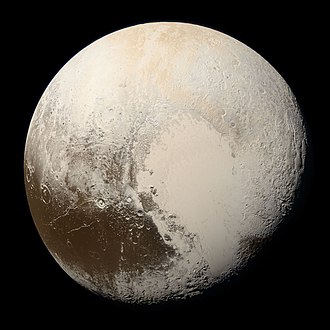
Hydrostatic equilibrium helps us tell the difference between dwarf planets and smaller objects in space. It is important in astrophysics and planetary geology. Besides the Sun, we know of a dozen or so equilibrium objects confirmed to exist in our Solar System.
Mathematical consideration
Derivation from force summation
Further information: Mechanical equilibrium
Newton's laws of motion tell us that if a fluid is not moving or moving at a steady speed, the forces pushing in different directions must balance out. This balance is called hydrostatic equilibrium.
We can think of the fluid as many small blocks. By looking at one block, we can understand how the fluid behaves.
There are three forces acting on the block:
- The pressure from the fluid above pushes down on the top of the block.
- The pressure from the fluid below pushes up on the bottom of the block.
- The weight of the block pulls it down.
When these forces balance, the block does not move. This helps us understand how fluids stay still or move at a steady pace.
Applications
Fluids
Hydrostatic equilibrium is about how fluids stay balanced. It helps us understand how things weigh in water and how fluids act when they are still or moving slowly. This balance matters when fluids are not moving too fast.
Astrophysics and planetary science
For a long time, scientists have studied how fluids behave when they spin in space. This helps us learn about stars and planets, which might have been fluid in the past or change shape under strong forces.
In stars, there is a balance between the pressure pushing out and the weight of material pressing in. Planets also follow this balance. When a star or planet spins and is in balance, it usually looks like an oblate spheroid, meaning it is wider around the middle and narrower at the poles.
An example is the star Vega, which spins very fast and is larger around its middle than at its poles. Scientists like Newton and Maclaurin discovered how these shapes form and change under gravity and spinning motion.
Images
Related articles



This article is a child-friendly adaptation of the Wikipedia article on Hydrostatic equilibrium, available under CC BY-SA 4.0.
Images from Wikimedia Commons. Tap any image to view credits and license.