 Safekipedia
Interstellar medium
Adapted from Wikipedia · Adventurer experience
The interstellar medium (ISM) is the matter and radiation found in the space between star systems in a galaxy. It is made of gas in different forms, dust, and cosmic rays. Even though space between stars looks empty, it is filled with these materials, making a thin but important part of our universe.
The ISM is mostly hydrogen and helium, with tiny amounts of other elements such as carbon, oxygen, and nitrogen. These elements were created when stars formed and changed over time. The ISM helps stars to be born and affects how galaxies change. Dense parts of the ISM can come together to make new stars, while older stars send material back into the ISM through stellar winds and supernovae.
In 2012, the spacecraft Voyager 1 became the first human-made object to enter the ISM, and Voyager 2 followed in 2018. These missions give us useful information about the space between the stars. The ISM helps us learn how galaxies live and change over millions of years.
Interstellar matter
The interstellar medium (ISM) is the matter and energy found in the space between star systems in a galaxy. It includes gases, dust, and cosmic rays. These fill the space between stars and even stretch into the space between galaxies.
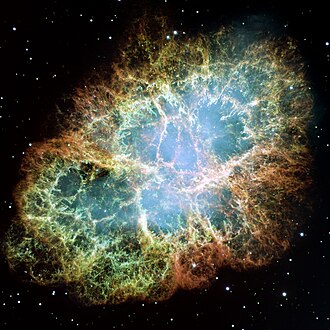
Astronomers say the ISM is turbulent. This means the gas moves in complex patterns. Stars are born inside big clouds of gas and dust. During their lives, stars interact with the ISM through winds and explosions. These interactions add energy and create structures like bubbles of hot gas. The Sun moves through a nearby cloud of this material, called the Local Interstellar Cloud.
| Component | Fractional volume | Scale height (pc) | Temperature (K) | Density (particles/cm3) | State of hydrogen | Primary observational techniques |
|---|---|---|---|---|---|---|
| Molecular clouds | 80 | 10–20 | 102–106 | molecular | Radio and infrared molecular emission and absorption lines | |
| Cold neutral medium (CNM) | 1–5% | 100–300 | 50–100 | 20–50 | neutral atomic | H I 21 cm line absorption |
| Warm neutral medium (WNM) | 10–20% | 300–400 | 6000–10000 | 0.2–0.5 | neutral atomic | H I 21 cm line emission |
| Warm ionized medium (WIM) | 20–50% | 1000 | 8000 | 0.2–0.5 | ionized | Hα emission and pulsar dispersion |
| H II regions | 70 | 8000 | 102–104 | ionized | Hα emission, pulsar dispersion, and radio recombination lines | |
| Coronal gas Hot ionized medium (HIM) | 30–70% | 1000–3000 | 106–107 | 10−4–10−2 | ionized (metals also highly ionized) | X-ray emission; absorption lines of highly ionized metals, primarily in the ultraviolet |
Observations of the ISM
Even though space between stars has very little matter, we can see it with special tools. These tools look at different kinds of light.
Scientists used to mostly look at visible light, but it is hard to see space between stars that way.
We can learn about this space by looking at the different types of light it gives off. Hot gas can glow in microwaves and X-rays. Some gases change and give off light at special wavelengths. One kind of light can make some clouds look green. We can see cold gas and molecules by the light they give off, especially a type of light called the 21-cm line. Dust in space can glow too, especially in far infrared light. Tiny pieces of dust can spin and give off microwaves. High-energy particles called cosmic rays can create gamma rays when they hit atoms in space.
Radiowave propagation
Radio waves travel through the space between stars, but they are changed by the material there. Very low-frequency radio waves cannot pass through because the space is too "dense." For higher frequencies, the waves can travel, but they change a little depending on the tiny particles and how they are spread out. This change can make distant objects look bigger or smaller.
Another effect changes the direction of polarized waves, which helps scientists study magnetic fields in space. Most of the time, radio waves can pass through space without any problem, letting us see through our galaxy. Some special waves can become blocked, making it hard to see behind certain clouds of material. But for most radio waves, especially microwaves, we can see right through the galaxy.
History of knowledge of interstellar space
The word 'interstellar' means "between the stars" and was first used by a scientist named Francis Bacon. For a long time, people wondered if the space between stars was empty or filled with something. Some thought it might be a special kind of material called aether.
In 1864, an astronomer named William Huggins discovered that some glowing clouds in space, called nebulae, were made of gas. Around 1889, Edward Barnard took pictures of the night sky and found dark patches. These are now called dark nebulae.
In 1904, a scientist named Johannes Hartmann found proof that cold gas exists between stars. He studied a star called Mintaka and noticed something unusual in its light. This helped start the study of the material found between stars.
More discoveries followed. In 1909, a scientist named Slipher confirmed the presence of gas, and in 1912, he confirmed that dust also exists between stars. Later, scientists found that this material forms clouds.
In 2012, scientists reported that certain chemicals in space can change and become more complex materials. In 2014, they said these chemicals might be a big part of all carbon in space. In 2019, they found very complex molecules called buckyballs floating between stars. In 2020, they found evidence of water ice mixed with dust grains in space.
Images
Related articles




This article is a child-friendly adaptation of the Wikipedia article on Interstellar medium, available under CC BY-SA 4.0.
Images from Wikimedia Commons. Tap any image to view credits and license.