 Safekipedia
Juno (mythology)
Adapted from Wikipedia · Adventurer experience
Juno is a goddess from ancient Roman religion. She protects the state and is known as the queen of the gods. Juno is the daughter of Saturn and Ops, and she is the sister and wife of Jupiter. She is the mother of several important gods and goddesses, including Mars, Vulcan, Bellona, Lucina, and Juventas.
Like her Greek counterpart Hera, Juno watches over marriage and women in Rome. Her sacred animal is the peacock. As the patron goddess of Rome and the Roman Empire, she was called Regina, meaning "Queen." Juno is one of the three main gods in the Capitoline Triad, which includes Jupiter and Minerva, the goddess of wisdom.
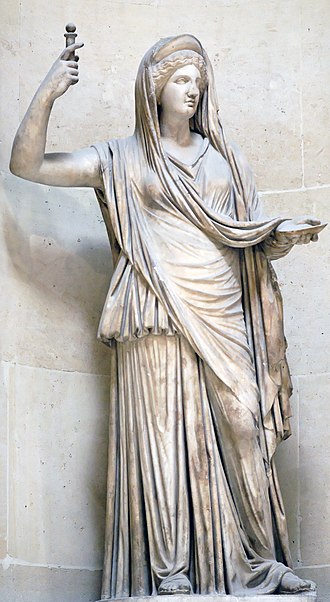
Juno was often shown wearing armor and a goatskin cloak. She was also shown wearing a diadem, a crown-like headpiece, to show her royal status. Her appearance was influenced by the Greek goddess Athena.
Etymology
The name Juno was thought to come from Iove, another name for the god Jupiter. Later, people believed it came from a word meaning "youth" in Latin. A scholar named Georg Wissowa helped this idea become popular.
The word for youth is related to ideas of energy and new beginnings in Latin and Greek. Some old writings called Jupiter "the youngest" and linked Juno to youth and new growth. Ancient stories also connected Juno's name to words meaning "to help" and "to renew."
Roles and epithets
Juno was an important goddess in ancient Roman religion. She had many names and titles, called "epithets," showing the different jobs she had. As the goddess of marriage, she was known as Pronuba and Cinxia. But she had many other jobs too.
Juno was seen as a protector of the community. She was worshipped in many towns across ancient Italy, with different titles in each place. In Rome, she was known by several names including Lucina, Mater, and Regina.
Her many roles and titles showed her important place in Roman life. Juno was connected to beginnings, marriages, and the changing of the months.
Theological and comparative study
Scholars have many ideas about the goddess Juno because she has many roles. Some think she stands for youth and life, while others see her as important for marriage and family.
Georges Dumézil thought that Juno has three big roles: leading, fighting, and helping people have children. He believed that many female goddesses have these three roles, showing how important women are in society. He compared Juno to other goddesses from different cultures who also have these roles. Even though Juno is best known for family and life, she is also strong in leading and fighting.
Associations with other deities
Juno and Jupiter
Juno and Jupiter were very important in ancient Roman religion. Juno was linked to marriage and was called Iuno Pronuba because she watched over weddings. These two gods were respected in every Roman town.
Juno and Janus
Juno worked with Janus, the god of beginnings. They were both important for the start of each month and helped bring in the new moon. Their teamwork was shown in special rituals and festivals.
Juno and Hercules
Hercules came from Greek stories but became part of Roman religion too. Juno and Hercules sometimes appeared together, especially to protect new babies. They shared roles in fertility and war.
Juno and Genius
Some Romans thought Juno was like the feminine side of Genius, a spirit that represents a man's life force. While Genius was linked to men, Juno had a similar role for women.
Juno and the Penates
In some religious views, Juno, along with Jupiter and Minerva, was one of the Penates—gods who protected the home. Juno was seen as the one who gave people their bodies.
Heries Junonis
In Roman prayers, Juno was sometimes linked with Heries, a term shared with Mars.
Festivals
Main article: Matronalia
In ancient Roman times, people celebrated many festivals to honor the goddess Juno. Most of these festivals happened on the first day of each month, but a few special ones had different dates.
One important festival was the Matronalia, held each year on March 1st. This festival honored Juno Lucina, who was called "she who brings children into light." On this day, people gave offerings in her honor.
Other festivals for Juno happened on different days throughout the year. For example, Juno Moneta was celebrated on June 1st, and Juno Regina was honored on September 1st. These festivals were important ways for people to show respect to Juno, the goddess who protected marriage and the state. Many people thought June, the month named after Juno, was a lucky time to get married.
Etrurian Uni, Hera, Astarte and Juno
The Etruscans were a people who had many connections with other peoples around the Mediterranean Sea, including the Greeks, the Phoenicians, and the Carthaginians.
We know about their goddess Uni from discoveries made in places like Gravisca near Tarquinia and Pyrgi, a port of Caere. Scholars believe Uni was strongly influenced by the Greek goddess Hera and had a counterpart in the Carthaginian goddess Tanit, whom the Romans called Juno Caelestis. The discovery of the Pyrgi Tablets showed that Juno was also named Astarte in the Punic language. This shows how different cultures mixed their gods over time.
In the work of Martianus Capella, Juno is placed in different regions of Heaven along with other gods. For example, Juno Hospitae Genius is in region IX, and Juno Caelestis is in region XIV with Saturn. This shows how Roman, Greek, and Punic ideas about gods blended together.
Juno Caelestis
Juno was highly respected in North Africa, where she was linked with the local Goddess Tanit.
A large temple named the temple of Juno Caelestis was built in Carthage. It was one of the biggest buildings in the Roman Empire and drew visitors from across Northern Africa and Spain.
Temple at Samos
The people of the island of Samos built a special place to honor the goddess Hera around the 8th century BC. The writer Herodotus said this temple was one of the amazing buildings on the island, along with the Tunnel of Eupalinos and the harbor of the main city harbor works of the island capital. Since Hera is the same as the Roman goddess Juno, this temple is also linked to Juno. The writer Giovanni Boccaccio wrote about the old temple in his book Genealogia Deorum.
In literature
Juno is in many old Roman stories. In Virgil’s book called Aeneid, she is a strong goddess who helps Dido and Turnus and the Rutulians. She does not help Aeneas, who wants to build a new city called Troy in Italy. In another book, Metamorphoses, written by Ovid, there is a story about why Juno is linked to the beautiful peacock. She is also in a book called De Mulieribus Claris by Giovanni Boccaccio, which tells stories about important women from history and myths. William Shakespeare also used Juno in a scene in his play The Tempest.
Modern reception
Spaceflight
See also: Juno (spacecraft)
NASA sent a spacecraft called Juno to the planet Jupiter in 2011. They named it after the goddess Juno because she had a special connection to Jupiter in old stories.
Images
Related articles




This article is a child-friendly adaptation of the Wikipedia article on Juno (mythology), available under CC BY-SA 4.0.
Images from Wikimedia Commons. Tap any image to view credits and license.