 Safekipedia
Kluane National Park and Reserve
Adapted from Wikipedia · Adventurer experience
Kluane National Park and Reserve are two protected areas in the southwest corner of the territory of Yukon. The National Park Reserve was set aside in 1972 to become a national park, but it needed agreements with local First Nations. In 1993, after reaching an agreement with the Champagne and Aishihik First Nations, a part of the Reserve became a national park. This part is now managed together with Parks Canada. The larger western section is still a Reserve, waiting for a final agreement with the Kluane First Nation. The park borders British Columbia to the south, and the Reserve borders British Columbia, and the United States (Alaska) to the south and west.
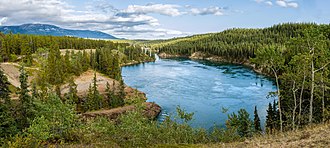
The Reserve includes the highest mountain in Canada, Mount Logan, which is part of the Saint Elias Mountains. The landscape is mostly covered by mountains and glaciers, like the Donjek Glacier. The rest of the land has forests and tundra, where the climate is colder and drier. Trees only grow at the lowest elevations, and the main types are white spruce, balsam poplar, and trembling aspen.
Activities
Kluane National Park and Reserve has many fun things to do. You can hike on trails like St. Elias Lake and Alsek Trail. You can go rafting on the Alsek River or try mountain biking on old mining roads. You can also enjoy boating and fishing on Kathleen Lake and Mush Lake for fish like lake trout and Arctic grayling.
The park has a place to spend the day at Kathleen Lake with picnic spots and a campground. It is open from mid-May to mid-September. The park was featured in a film in 2011. It was also visited by Robert F. Kennedy, Jr. in 2013 to see Mount Kennedy, named for his uncle, U.S. president John F. Kennedy.
Fauna
Kluane National Park and Reserve is home to many animals, including Yukon wolf, bear, coyote, mink, lynx, river otter, caribou, Yukon moose, muskrat, snowshoe hare, marmot, red fox, Dall sheep, beaver, wolverine, mountain goat, and arctic ground squirrel. The park also has about 120 types of birds, such as the rock ptarmigan and the golden and bald eagles.
World Heritage Site
The area that includes Kluane National Park, along with Wrangell-St Elias, Glacier Bay, and Tatshenshini-Alsek parks, was named a UNESCO World Heritage Site in 1979. It was chosen for its amazing glacier and icefield views, as well as for being an important home for grizzly bears, caribou, and Dall sheep.
First Nations presence
Kluane National Park is located in the traditional lands of the Champagne and Aishihik First Nations and Kluane First Nation. These groups have lived in this area for a long time and have legal rights to hunt and gather there thanks to agreements with the Canadian Government.
Images
Related articles



This article is a child-friendly adaptation of the Wikipedia article on Kluane National Park and Reserve, available under CC BY-SA 4.0.
Images from Wikimedia Commons. Tap any image to view credits and license.