 Safekipedia
Liard River
Adapted from Wikipedia · Adventurer experience
The Liard River is a big river that flows through parts of Canada, including Yukon, British Columbia, and the Northwest Territories. It starts in the Saint Cyr Range of the Pelly Mountains in southeastern Yukon and travels for about 1,115 kilometers (693 miles).
As it moves, the river marks the northern end of the Rocky Mountains before turning back toward Yukon and the Northwest Territories. Finally, it flows into the Mackenzie River near a place called Fort Simpson in the Northwest Territories.
The Liard River helps drain a large area of about 277,100 square kilometers (107,000 square miles) of forest and wetland, known as muskeg, in the North American boreal forest. This river is important for the natural environment and the animals and plants that live there.
Geography
The Liard River flows through a special area called the Lower Mackenzie Freshwater Ecoregion. Near the river in Yukon is a place named the Liard River Valley. The Alaska Highway follows the river for part of its path. This area is also called the Liard Plain. It is part of a larger region named the Yukon–Tanana Uplands, which belongs to the Intermontane Plateaus.
The Liard River is an important crossing point for Nahanni wood bison.
History
The Kaska Dena people, who live near the Liard River in Yukon and northwestern British Columbia, call the river Nêtʼił Tué', meaning "Hanging Down River." The name comes from a narrow spot where they used to set snares for goats. The river's current name comes from a French word for a type of tree that grows along parts of the river.
The first European to travel most of the river was John McLeod of the Hudson's Bay Company. He started from Fort Simpson in 1831 and reached parts of the river within six weeks. Later, another worker for the company, Robert Campbell, reached the river's source and named it after a woman connected to the company's leadership.
The land around the river has been home to the Kaska Dena for thousands of years, but other groups also have ties to the area. Changes over time, like new roads and the discovery of oil and gas, led many people to move away from the river. Even so, some continue to use the land for traditional activities.
Features
The Liard River has some interesting spots. One is called the Grand Canyon of the Liard. This part of the river is about 30 kilometers long and has fast rapids. It lies between where the Toad River and the Trout River join the Liard River.
Another special place is the Liard Canyon, which is near a place called Lower Post.
There is also a well-known spot called Liard River Hot Springs. Many people visit this area, found at kilometre 765 along the Alaska Highway.
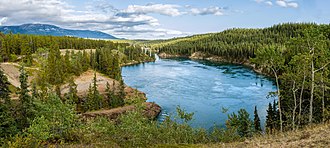
Lastly, there is a historic Liard River Suspension Bridge. This bridge, built in 1944, can be found at kilometre 798 of the Alaska Highway.
Course
The Liard River starts in southeastern Yukon near Mount Lewis and flows south and east through the Pelly Mountains. It passes through the Yukon Plateau and receives water from many smaller streams and rivers. The river continues southeast, north of the Cassiar Mountains, and flows through Upper Liard and Watson Lake before entering British Columbia.
In British Columbia, the river flows southeast and east alongside the Alaska Highway, gathering water from several creeks and rivers. It passes by Hyland River Provincial Park and continues east through the Dease Forest. The river flows through Liard River Hot Springs Provincial Park and the Liard River Corridor Provincial Park and Protected Area, receiving water from many more streams. It eventually turns north, receiving the Fort Nelson River before crossing into the Northwest Territories.
In the Northwest Territories, the Liard River flows north, receiving water from the Kotaneelee River and Petitot River. It turns around Mount Coty near Fort Liard Airfield and continues east, gathering water from several more rivers and creeks. The Liard River finally turns north and flows into the Mackenzie River near Fort Simpson, forming Truesdell Island and Franklin-Clarke Island at its mouth.
Tributaries
The Liard River has many smaller rivers and streams that flow into it. Starting from its source, some of these are Prospect Creek, Swede Creek, and the Ings River in Yukon. In the mountains of British Columbia, it receives water from the Dease River and the Kechika River, among others.
In the foothills and plains of British Columbia, tributaries include the Toad River and the Beaver River. Once it reaches the Northwest Territories, the river is joined by the Kotaneelee River and the South Nahanni River, along with many other small streams and creeks.
Communities
The Liard River flows near several small communities. Starting from where it meets the Mackenzie River and moving upstream, you can find places like Fort Simpson, Fort Liard, Lower Post, British Columbia, Watson Lake, Yukon, and Upper Liard, Yukon along its path.
Images
Related articles


This article is a child-friendly adaptation of the Wikipedia article on Liard River, available under CC BY-SA 4.0.
Images from Wikimedia Commons. Tap any image to view credits and license.