 Safekipedia
Limaysaurus
Adapted from Wikipedia · Adventurer experience
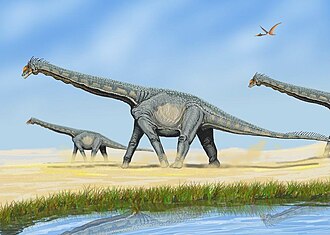
Limaysaurus ("Limay lizard") is a type of very large, long-necked dinosaur called a rebbachisaurid sauropod. These amazing creatures lived a very long time ago, during the late Cretaceous period, which was about 99.7 to 94 million years ago. Fossils of Limaysaurus were found in what we now call South America, especially in a region named northwestern Patagonia.
This dinosaur is special because scientists have only found one species of it, named L. tessonei. Like other sauropods, Limaysaurus would have been one of the biggest animals to ever walk the Earth, with a long neck and tail. Studying fossils from Limaysaurus helps scientists learn more about how these giant dinosaurs lived and what the world was like millions of years ago.
Discovery
Limaysaurus has one main type, called Limaysaurus tessonei. It was first thought to be part of another group of dinosaurs but was later given its own name in 2004. The name comes from the Río Limay, a river near where it was found, and honors Lieto Tessone, who discovered the first and most complete example.
Scientists found the first Limaysaurus fossils in 1988 in Argentina. These fossils include parts of the skull and skeleton and are some of the best examples of dinosaurs from this time found in South America. More fossils were found nearby, showing different ages of the dinosaur.
Description
Limaysaurus was a medium-sized sauropod dinosaur. It lived about 99.7 to 94 million years ago in what is now South America. Scientists think it was about fifteen meters (49 feet) long and weighed seven tonnes. It had very tall bones on its back, and its teeth were curved, unlike the straight teeth of Diplodocus.
This dinosaur lived near other dinosaurs like Andesaurus and Giganotosaurus. The area had large, shallow lagoons, and the climate was mild and humid. Scientists also found special stones called gastroliths with the fossils, which helped the dinosaur grind its food.
Classification
Scientists found that Limaysaurus is part of a group of dinosaurs called Rebbachisauridae. These dinosaurs are an early branch of a bigger group called Diplodocimorpha. Fossils of these dinosaurs have been found in rocks from the time of the dinosaurs in Europe, South America, and Africa. Studies show that Limaysaurus is closely related to other dinosaurs like the African Rebbachisaurus and Nigersaurus, as well as the South American Rayososaurus and Cathartesaura.
Images
Related articles


This article is a child-friendly adaptation of the Wikipedia article on Limaysaurus, available under CC BY-SA 4.0.
Images from Wikimedia Commons. Tap any image to view credits and license.