 Safekipedia
Local Bubble
Adapted from Wikipedia · Adventurer experience
The Local Bubble is a big, empty space in the material that fills our galaxy, the Milky Way. This space is in a part of the galaxy called the Orion Arm. It holds many of the stars closest to us, including the ones in our own Solar System.
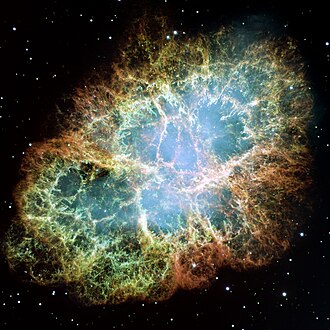
Scientists think the Local Bubble formed when many huge stars ended their lives in explosions called supernovae. These explosions happened only a few million years ago. They blew away most of the gas in this area, making it much less crowded than other parts of the galaxy.
Because there is less gas here, it is called a "bubble." This space is huge—about 1,000 light years across! It includes groups of stars that move together, like the Ursa Major moving group and the Hyades, which is the nearest group of stars to us.
Description
The Solar System has moved through an area called the Local Bubble for the past five to ten million years. Right now, it is in the Local Interstellar Cloud (LIC), a small part of the Bubble that has more material. The LIC was formed where the Local Bubble meets the Loop I Bubble. The gas in the LIC has about 0.3 atoms in each cubic centimeter.
The Local Bubble is not a perfect circle. It is narrower along the galactic plane and looks more like an egg or oval. It might be wider above and below this plane, giving it an hourglass shape. The Local Bubble touches other areas of thin space material, especially the Loop I Bubble. The Loop I Bubble was shaped by big explosions from stars and stellar winds from the Scorpius–Centaurus association, about 500 light years from the Sun. The Loop I Bubble includes the star Antares. There are also passages connecting the Local Bubble to the Loop I Bubble. Other nearby bubbles are the Loop II Bubble and the Loop III Bubble. In 2019, scientists found space iron in Antarctica that they think came from the Local Interstellar Cloud.
Observation
A small space observatory named Cosmic Hot Interstellar Plasma Spectrometer, or CHIPSat, flew in space from February 2003 to April 2008. It studied the hot gas inside the Local Bubble. Another mission called the Extreme Ultraviolet Explorer worked from 1992 to 2001 and also looked at hot sources inside the bubble. In 2019, scientists made the first 3D map of the Local Bubble using special observations. In 2020, they used star data to model the shape of the dusty area around the bubble.
Impact on star formation
In January 2022, a study found that the edges of the Local Bubble have gathered gas and dust together. This gathering helped create all the young stars near us.
These new stars are usually found in groups of gas called molecular clouds, like the Taurus molecular cloud, and in open star clusters such as the Pleiades.
Connection to radioactive isotopes on Earth
Some special materials found on Earth come from star explosions called supernovae that happened near our solar system long ago. Scientists find these materials in deep-sea layers, snow in Antarctic, and even on the Moon. One important material is iron-60. It shows two big increases—one about 1.7 to 3.2 million years ago, and another about 6.5 to 8.7 million years ago.
The older increase may have happened when our solar system passed through an area called the Orion–Eridanus Superbubble. The younger increase happened when our solar system entered the Local Bubble about 4.5 million years ago.
Images
Related articles




This article is a child-friendly adaptation of the Wikipedia article on Local Bubble, available under CC BY-SA 4.0.
Images from Wikimedia Commons. Tap any image to view credits and license.