 Safekipedia
Michelangelo
Adapted from Wikipedia · Adventurer experience
Michelangelo di Lodovico Buonarroti Simoni, known simply as Michelangelo, was an Italian artist who lived from 6 March 1475 to 18 February 1564. He was one of the greatest artists of the High Renaissance and could work as a sculptor, painter, architect, and poet. Michelangelo was born in the Republic of Florence but spent much of his career in Rome.
He became famous very early in his life. Two of his most famous sculptures, the Pietà and David, were made before he turned 30. Even though he did not think of himself as a painter, Michelangelo painted two very important frescoes: the scenes from Genesis on the ceiling of the Sistine Chapel, and The Last Judgment on the altar wall. He also designed buildings, including the Laurentian Library and St. Peter's Basilica.
Michelangelo was called "Il Divino," meaning "the divine one," because people were in awe of his art. His style influenced many other artists and helped start a new art movement called Mannerism. He is remembered as one of the most talented and well-known artists in history.
Early life and career
Michelangelo was born on March 6, 1475, in a small town near Arezzo in Tuscany, Italy. His family had once been bankers in Florence, but they had money troubles. His father was a local administrator when Michelangelo was born.
Soon after he was born, Michelangelo’s family moved back to Florence, where he grew up. After his mother passed away when he was young, he lived with a nanny and her husband, a stonecutter, in Settignano. There, he loved working with marble.
As a young boy, Michelangelo studied grammar in Florence but liked copying paintings and being with artists. Florence was a big center for art and learning during the Renaissance. He became an apprentice to a master painter, Domenico Ghirlandaio, when he was 13. Later, he went to a special academy where he met important philosophers and writers. During this time, he made early sculptures like the "Madonna of the Stairs" and the "Battle of the Centaurs."
Michelangelo’s career took him to many cities, including Bologna and Rome. In Rome, he carved the famous "Pietà," showing the Virgin Mary holding Jesus. He later went back to Florence, where he made his most famous sculpture, the statue of David.
Michelangelo also worked on a grand tomb for Pope Julius II, which took many years. During this time, he painted the ceiling of the Sistine Chapel, creating famous scenes from the Bible.
Later, Michelangelo worked on projects for the Medici family in Florence, designing buildings and making sculptures. He also helped protect Florence when it was threatened.
Moving back to Rome, Michelangelo painted "The Last Judgment" in the Sistine Chapel. He also worked on buildings, including designing the layout for Capitoline Hill and helping with St. Peter’s Basilica. His design for the dome of St. Peter’s is one of the greatest achievements of the Renaissance.
Personal life
Michelangelo believed strongly in his Catholic faith, especially as he got older. He joined a group called the Secular Franciscan Order with the artist Raphael.
He lived simply and didn’t need much, even though he was wealthy. He dressed and lived modestly. Some who knew him thought he was very private.
Michelangelo wrote many poems. He had a close friend named Tommaso dei Cavalieri, whom he met when he was older. They talked a lot about art and Michelangelo made drawings for him. Their friendship stayed strong until Michelangelo passed away.
He was also good friends with a poet named Vittoria Colonna. They shared poems about deep, spiritual ideas.
Works
Main articles: List of works by Michelangelo and Michelangelo Buonarroti catalogue raisonné
Madonna and Child
The Madonna of the Stairs is Michelangelo's first known work in marble. It shows the Virgin Mary and baby Jesus in a simple style. The Taddei Tondo from 1502 shows Jesus being surprised by a bird. The Madonna of Bruges shows Mary holding Jesus. The Doni Tondo mixes ideas from his earlier works, showing the Holy Family.
The _[Madonna of the Stairs](/wiki/Madonna_of_the_Stairs)_ (1490–1492)
The _[Taddei Tondo](/wiki/Taddei_Tondo)_ (1502)
_[Madonna of Bruges](/wiki/Madonna_of_Bruges)_ (1504)
The _[Doni Tondo](/wiki/Doni_Tondo)_ (1504–1506)
Male figure
The Angel is an early work showing a strong winged figure. Bacchus shows the god of wine with realistic details. The Dying Slave and Rebellious Slave show figures trying to break free. The Atlas Slave shows someone trying to escape from stone.
_[Angel](/wiki/Angel_\(Michelangelo\))_ by Michelangelo, early work (1494–95)
_[Bacchus](/wiki/Bacchus_\(Michelangelo\))_ by Michelangelo, early work (1496–1497)
_[Dying Slave](/wiki/Dying_Slave)_, [Louvre](/wiki/Louvre) (1513)
_[Atlas Slave](/wiki/Atlas_Slave)_ (1530–1534)
Sistine Chapel ceiling
Main article: Sistine Chapel ceiling
The Sistine Chapel ceiling was painted between 1508 and 1512. Michelangelo painted nine panels with Bible stories. He showed prophets and wise women instead of apostles. One famous image is The Creation of Adam. Michelangelo also painted supporting figures and included self-portraits.
Studies for _The Libyan Sibyl_
_The Libyan Sibyl_ (1511)
_The Prophet Jeremiah_ (1511)
_Ignudo_
Figure compositions
The Battle of the Centaurs relief shows many figures in a lively fight. The Battle of Cascina painting shows soldiers getting ready for battle. In The Last Judgment, Michelangelo shows people rising to heaven or falling down. The Crucifixion of St. Peter shows soldiers and onlookers.
_[Battle of the Centaurs](/wiki/Battle_of_the_Centaurs_\(Michelangelo\))_ (1492)
Copy of the lost _[Battle of Cascina](/wiki/Battle_of_Cascina)_ by [Bastiano da Sangallo](/wiki/Bastiano_da_Sangallo)
_[The Last Judgment](/wiki/The_Last_Judgment_\(Michelangelo\))_, detail of the Redeemed (see whole image above)
_[The Crucifixion of St. Peter](/wiki/The_Crucifixion_of_St._Peter_\(Michelangelo\))_
Architecture
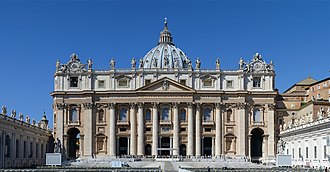
Michelangelo designed many buildings, though some were not finished. He worked on the Medici Chapel and tombs in Florence. He also designed the Laurentian Library, with a special staircase. He completed St Peter's Basilica in Rome, making it strong and unified.
Final years
In his later years, Michelangelo created several sculptures called Pietàs, showing Mary with Jesus. The Rondanini Pietà was not finished when he died. Michelangelo passed away in Rome in 1564 and was buried in Florence, as he wished.
Legacy
Michelangelo, along with Leonardo da Vinci and Raphael, is one of the greatest artists of the Florentine High Renaissance. He was younger than Leonardo and older than Raphael. He did not work closely with them and lived longer than both.
Michelangelo's art influenced many artists, sculptors, and architects. His famous statue David is well-known. Other works like Victory and the Bruges Madonna also had a big impact. His designs for buildings, such as the Laurentian Library and St. Peter's Cathedral, introduced new ways of using classical styles. The dome of St. Peter's Cathedral inspired many churches and public buildings for centuries, including Sant'Andrea della Valle in Rome and St Paul's Cathedral in London.
Artists like Raphael and Pontormo were inspired by Michelangelo's powerful styles and techniques. The Sistine Chapel ceiling, with its grand designs, became a model for many Baroque artists. It showed new ways to paint that influenced painters for a long time.
In popular culture
Michelangelo has been shown in many movies and shows. Some of these include The Agony and the Ecstasy from 1965, where Charlton Heston played Michelangelo, and A Season of Giants from 1990. Newer films like Michelangelo - Endless in 2018 and Sin in 2019 also tell stories about his life.
Images
Related articles



This article is a child-friendly adaptation of the Wikipedia article on Michelangelo, available under CC BY-SA 4.0.
Images from Wikimedia Commons. Tap any image to view credits and license.