 Safekipedia
Miguel de Cervantes
Adapted from Wikipedia · Adventurer experience
Miguel de Cervantes Saavedra was a famous Spanish writer who lived from 1547 to 1616. He is best known for writing Don Quixote, a novel many people think is one of the greatest books ever written and the first modern novel. This story has been very important in literature around the world.
Cervantes had a difficult life. He spent much of his time in poverty and was even captured and held for several years. Even with these challenges, he wrote many famous works besides Don Quixote, including La Galatea and Los trabajos de Persiles y Sigismunda.
During his life, Cervantes served in the Spanish Navy and was badly hurt in a battle. Even with these difficulties, he continued to write and work in many jobs, including as a tax collector. His writing has had a lasting impact, and the Spanish language is sometimes called "the language of Cervantes" because of his great influence.
Biography
Miguel de Cervantes was a famous Spanish writer, best known for his novel Don Quixote. Many details about his life are still unclear. He was born around 29 September 1547 in Alcalá de Henares. His father was a barber-surgeon, and the family moved often.
Cervantes served in the military and fought in the Battle of Lepanto in 1571. He was wounded and lost the use of his left arm. Later, he was captured and held for ransom for many years before returning to Madrid.
Cervantes married in 1584 and had a daughter. He worked various jobs, including as a tax collector. He joined a religious group in his later years. Cervantes died on 22 April 1616. His remains were lost but later found and reburied in 2015.
Supposed likenesses
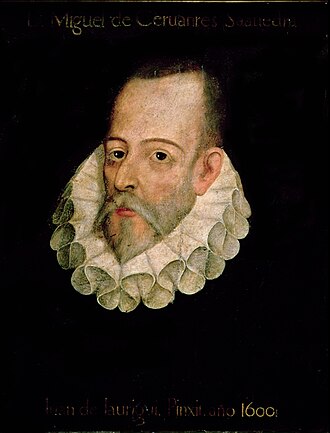
No real painting of Cervantes is known to exist. The picture most linked to him is said to be by Juan de Jáuregui, but his name was added later. The El Greco painting at the Museo del Prado, called Retrato de un caballero desconocido (Portrait of an Unknown Gentleman), is sometimes thought to show Cervantes, but there is no proof.
Another El Greco painting, The Nobleman with his Hand on his Chest, has also been suggested to show Cervantes. However, experts at The Prado think it more likely shows the Second Marquis of Montemayor, a man who lived at the same time as El Greco.
A painting from 1859 by Luis de Madraza at the Biblioteca Nacional de España was made from imagination. The face on Spanish euro coins for €0.10, €0.20 and €0.50 comes from a bust made in 1905.
In 2025, the European Central Bank said Cervantes could appear on new fifty euro banknotes if a design about "European culture" is chosen.
Literary career and legacy
Cervantes wrote many plays, such as El trato de Argel, based on his own life. In 1585, he published La Galatea, a romance story.
His most famous work, Don Quixote, was published in 1605. This book changed how stories were told by using everyday language and showing real life. It became very popular. Later, Cervantes wrote a second part to Don Quixote in 1615.
Over time, Don Quixote has been translated into many languages and is loved by readers around the world. It is often called one of the greatest books ever written. Today, Cervantes is remembered as one of the most important writers in the world.
Main article: The Dialogue of the Dogs
Works
Miguel de Cervantes wrote many famous books and plays. Some of his best-known works include La Galatea from 1585 and the first part of Don Quixote in 1605, which many people think is one of the greatest books ever written. In 1613, he published Novelas ejemplares, a collection of 12 short stories about life in Spain at the time.
Cervantes also wrote the second part of Don Quixote in 1615 and another novel called Los trabajos de Persiles y Sigismunda in 1617. He also wrote plays and short funny sketches called farces. Some of his plays include Trato de Argel, based on his own experiences, and La Numancia, a story about an old battle. His farces, like La cueva de Salamanca, show his talent for creating interesting characters and fun stories.
Influence
Miguel de Cervantes has inspired many places and shows. Towns named after him can be found in Spain, the Philippines, and Australia. He is also a character in TV shows such as El ministerio del tiempo and Sir Francis Drake.
Images
Related articles



This article is a child-friendly adaptation of the Wikipedia article on Miguel de Cervantes, available under CC BY-SA 4.0.
Images from Wikimedia Commons. Tap any image to view credits and license.