 Safekipedia
Musical acoustics
Adapted from Wikipedia · Adventurer experience
Musical acoustics or music acoustics studies how music works using ideas from science and music. It looks at how physics, our senses, how we hear, music theory, cultures, and making instruments all come together to create music.
This area of science looks at many things, like:
- How musical instruments work
- The physics of the human voice, including speech and singing
- Using computers to study melodies
- How music can help people in therapy
The person who helped start this field was Hermann von Helmholtz. He was a smart scientist from Germany who lived in the 1800s. He was good at many things, like medicine, physics, music, and math. His book talked about how we feel sounds and how this relates to music. His work gave us new ways to think about music and how instruments behave.
Methods and fields of study
Musical acoustics studies how sounds work in music. It looks at the physics of musical instruments. It also looks at how we hear different sounds in music and how we can make music with computers. It also explores how our minds understand music, called music cognition or psychoacoustics.
Physical aspects
When two different musical notes are played together, their sound waves mix and make a new sound. Our ears and brains can usually tell these notes apart and hear them clearly.
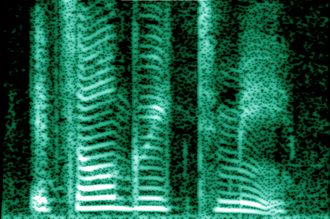
Notes that repeat perfectly are made up of several simple waves. These include the main note and its higher notes, called overtones. The main note is the lowest sound, while the overtones vibrate faster. Real musical instruments almost make these perfect repeating notes, but the overtones are not always exact.
Subjective aspects
Changes in air pressure against the ear and how our body feels these changes make what we call sound. Most sounds we think of as music come from regular vibrations, giving them a clear pitch. These sounds move through the air as waves. A simple sound wave, called a sine wave, makes the air pressure go up and down evenly, sounding like a pure tone. Things like tuning forks or whistling can make pure tones. The speed of these pressure changes is called the frequency of the tone, measured in hertz. Frequency mainly decides how high or low a pitch sounds. The frequency of musical instruments can change with altitude because of changes in air pressure.
Pitch ranges of musical instruments
This chart shows the pitch ranges of different musical instruments. Most instruments start at C0, but some very large ones, like certain pipe organs and the subcontrabass tuba, can go even lower. These low notes are very deep and hard to hear.
Harmonics, partials, and overtones
The fundamental is the main frequency of a sound wave. Overtones are extra sounds that happen at higher frequencies than the fundamental. All the frequencies in a sound wave, including the fundamental and the overtones, are called partials. Together, they make up the harmonic series.
Overtones that are exact multiples of the fundamental are called harmonics. Sometimes, overtones are almost harmonics but not exact, and they are still called harmonics. Other times, overtones may not be close to harmonics at all and are just called partials or inharmonic overtones. The fundamental frequency is the first harmonic and the first partial. The way we count partials and harmonics can change if there are inharmonic partials. Overtones are counted based on how they appear above the fundamental.
Harmonics and non-linearities
When a sound wave repeats and has only certain vibrations called odd harmonics, the wave looks the same if you turn it over. If the wave has even-numbered vibrations, it looks different on the top and bottom.
Some systems can change the shape of a wave and create extra vibrations, called harmonics. This is known as a non-linear system. If the change is the same on both sides, only odd harmonics are created. If the change is different on each side, even harmonics may appear with the odd ones.
Harmony
Main article: Harmony
When two notes are played together and their frequencies are simple fractions of each other, like 2/1, 3/2, or 5/4, they sound pleasant together. This is called harmony. For example, a note at 200 Hz and another at 300 Hz create a wave that repeats quickly.
Notes from musical instruments also have extra sounds called overtones. When two notes share some of these overtones, it adds to the pleasant feeling of harmony. If the notes are slightly off, the sound can feel unpleasant.
Scales
Main article: Musical scale
A musical composition often uses notes from a group called a scale. Since people usually can't tell the exact pitch of a note, a scale is known by how the pitches relate to each other.
Main article: Just intonation
The diatonic scale has been used for a long time. It includes seven notes within an octave. In just intonation, this scale can be made using simple ratios between notes, like the perfect fifth, perfect fourth, and the major third.
Other scales can also be made, like the minor scale. Some scales change the ratios to fit certain needs. These are called temperaments, with equal temperament being common.
For many instruments, the player mainly controls when and how hard they play a note. After that, the sound fades away on its own. The beginning of the note is usually what listeners notice most.
| C | D | E | F | G | A | B | C |
|---|---|---|---|---|---|---|---|
| 1 | 9/8 | 5/4 | 4/3 | 3/2 | 5/3 | 15/8 | 2 |
Related articles




This article is a child-friendly adaptation of the Wikipedia article on Musical acoustics, available under CC BY-SA 4.0.
Images from Wikimedia Commons. Tap any image to view credits and license.