 Safekipedia
Organ (biology)
Adapted from Wikipedia · Adventurer experience
Organ (biology)
In a multicellular organism, an organ is a group of tissues that work together to do a special job. Think of an organ as a team of different workers all helping to get something important done. In the hierarchy of life, an organ sits between smaller groups called tissues and larger groups called organ systems. Tissues are made from the same type of cells working together, and when different types of tissues combine, they form an organ with a special job to do. For example, the intestinal wall is made from epithelial tissue that lines the inside and smooth muscle tissue that helps it move things along.
Organs are made up of two main kinds of tissues: parenchyma, which does the actual work, and stroma, which supports and connects everything. For instance, in a gland, the tissue that makes hormones is the parenchyma, while the stroma includes nerves, blood vessels, and connective tissues that help it function.
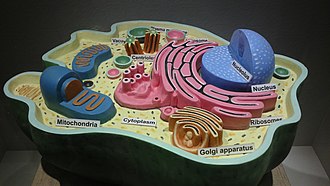
Organs are found in most living things that have more than one cell. In simpler, single-celled organisms like eukaryotes, something called an organelle acts kind of like an organ. Plants have three main organs, and the number of organs in any creature depends on how we define them.
Animals
See also: List of organs of the human body and Biological system
Except for placozoans, multicellular animals including humans have many organ systems. These are studied in human anatomy. Some systems work together. For example, the nervous and endocrine systems both use the hypothalamus, so they are often studied together as the neuroendocrine system. The musculoskeletal system is a mix of the muscular and skeletal systems.
Some important animal organ systems include:
- Cardiovascular system: pumps and moves blood with the heart, blood, and blood vessels.
- Digestive system: breaks down food using salivary glands, esophagus, stomach, liver, gallbladder, pancreas, intestines, colon, mesentery, rectum and anus.
- Endocrine system: sends messages using hormones from glands like the hypothalamus, pituitary gland, and adrenals.
- Excretory system: removes waste with kidneys, ureters, bladder and urethra.
- Lymphatic system: helps defend the body and moves lymph with nodes and immune system.
- Integumentary system: includes skin, hair and nails of mammals, plus scales of fish, reptiles, birds, and feathers of birds.
- Muscular system: allows movement with muscles.
- Nervous system: collects and processes information with brain, spinal cord and nerves.
- Reproductive system: includes sex organs such as ovaries, uterus, testicles, prostate and penis.
- Respiratory system: helps with breathing using the pharynx, larynx, trachea, bronchi, lungs and diaphragm.
- Skeletal system: gives shape and support with bones, cartilage, ligaments and tendons.
Viscera
In anatomy, viscera are the internal organs found in the abdominal, thoracic, and pelvic cavities. Abdominal organs can be solid, like the liver, pancreas, spleen, kidneys, and adrenal glands, or hollow, like the stomach, intestines, gallbladder, bladder, and rectum. The heart in the thoracic cavity is also a hollow organ. The study of these organs is called Splanchnology.
Origin and evolution
The organ level of life can be seen in simple animals like flatworms and becomes more complex in advanced animals. For example, the liver and heart evolved in certain animals around 550–500 million years ago, while the gut and brain are older, developing about 700–650 million years ago. Scientists study how organs develop by looking at newer organs like the placenta, which has evolved many times in different animals.
Plants
See also: Plant morphology, Plant anatomy, and Plant physiology
The study of plant organs is covered in plant morphology. Plant organs are divided into two main types: vegetative and reproductive. Vegetative organs include roots, stems, and leaves. These help the plant grow, take in water, and make food. Reproductive organs vary between plant types. In flowering plants, they include the flower, seed, and fruit. In conifers, reproductive structures are called cones.
Vegetative organs are essential for a plant's life, helping it stay alive and grow. While animals have many organ systems, plants have fewer, with some organs handling important tasks like photosynthesis. Reproductive organs are important for creating new plants, either through flowers or other structures depending on the plant type.
Society and culture
Many places have ways for people to give organ donation. This means a healthy organ from someone who is alive or has passed away can be transplanted into another person who needs a new one. Sometimes special medicines are needed to help the body accept the new organ.
People are very interested in making laboratory-grown or artificial organs. In the 1900s, scientists learned enough about organs to make organ transplants happen. Now, scientists are also looking at using organs from animals, called xenotransplant. This could help give more people the organs they need.
History
The word "organ" has been used since the 1100s. It started as a word for musical instruments and later came to mean a special part of the body that does a certain job.
Long ago, people looked at inside the body to learn more about nature and what might happen in the future.
Ancient thinkers like Aristotle thought of body organs as tools that help us do many things. Different cultures, such as Chinese traditional medicine, have their own ideas about organs based on their own beliefs and ways of thinking.
| Element | Yin/yang | Organ |
|---|---|---|
| Wood | yin | liver |
| yang | gall bladder | |
| Fire | yin | heart |
| yang | small intestine / san jiao | |
| Earth | yin | spleen |
| yang | stomach | |
| Metal | yin | lungs |
| yang | large intestine | |
| Water | yin | kidneys |
| yang | bladder |
Images
Related articles




This article is a child-friendly adaptation of the Wikipedia article on Organ (biology), available under CC BY-SA 4.0.
Images from Wikimedia Commons. Tap any image to view credits and license.