 Safekipedia
Qianlong Emperor
Adapted from Wikipedia · Adventurer experience
The Qianlong Emperor (25 September 1711 – 7 February 1799), also known by his temple name Emperor Gaozong of Qing, was the fifth emperor of the Qing dynasty. He ruled China proper from 1735 until he stepped down in 1796. He kept power until he passed away in 1799.
He was the favorite son of the Yongzheng Emperor. Qianlong worked hard to grow the empire. He led many armies in places like Inner Asia, Burma, Nepal, and Vietnam. One big success was bringing Xinjiang under control. At home, he loved art and writing. He helped many artists and writers. He also helped make a huge collection of important Chinese books called the Siku Quanshu.
Even after stepping down, Qianlong still helped guide the country until he died at age 87. His time as ruler was when the Qing dynasty was very strong and rich, with lots of people and a big economy. But problems like corruption began to weaken the empire later on.
Early years
Hongli was the fourth son of the Yongzheng Emperor and was born to Noble Consort Xi. He was loved by his grandfather, the Kangxi Emperor, and his father. When his father became emperor in 1722, Hongli became a qinwang (first-rank prince) with the title "Prince Bao of the First Rank." He sometimes helped his father govern and traveled to the south to take care of important matters.
Accession to the throne
Hongli became the Qianlong Emperor after the death of the Yongzheng Emperor in 1735. The Yongzheng Emperor had secretly chosen Hongli as his successor and kept his name in a sealed box. When the Yongzheng Emperor died, the box was opened, and Hongli was announced as the new emperor. He chose the era name "Qianlong," meaning "Lasting Eminence."
Later, in 1739, some princes tried to take over the throne during an imperial hunt. Their plan was discovered, and they were arrested. Some were imprisoned, while others lost their titles. Years later, in 1778, the Qianlong Emperor allowed some of these princes and their families to have their names restored, but they still did not regain their titles.
Frontier wars
See also: Ten Great Campaigns and Qing dynasty in Inner Asia
The Qianlong Emperor led many military campaigns to grow the Qing Empire’s lands. After becoming emperor, he sent soldiers to stop a rebellion by the Miao people. Through the Ten Great Campaigns, the empire grew to include much of Inner Asia, making it twice as large as before.
The emperor worked to defeat the Dzungar Khanate, which helped create Xinjiang from the lands of Dzungharia and the Tarim basin. He also handled rebellions in Tibet and conflicts with nearby states like Nepal and Burma. Though some battles were difficult, the empire grew to include many different groups of people.
Even with these successes, the military grew weaker over time. By the end of his rule, the army was not strong enough to stop new rebellions, which would challenge the empire later on.
Cultural achievements
The Qianlong Emperor cared about culture. He worked to protect the Manchu heritage, which he thought was important for the dynasty’s power. He ordered the writing down of Manchu family histories, stories, and rituals. He also built a copy of the Tibetan Potala Palace to show support for Tibetan people. He was a poet and writer, creating over 40,000 poems and 1,300 pieces of writing.
The Qianlong Emperor collected art and built big collections. He added poems to many pieces of art. He also built large libraries, gathering Chinese ideas, history, and stories into one big collection called the Complete Library of the Four Treasuries.
Burning of books and modification of texts
Main article: Literary inquisition § Qing dynasty
Some books were taken away or changed because they went against the government or made past rulers look bad. Over 3,100 books were destroyed or banned.
Literary works
In 1743, the Qianlong Emperor wrote a poem called “Ode to Mukden” about Mukden, describing its beauty and history.
Languages
The Qianlong Emperor learned several languages, including Manchu, Chinese, Mongolian, Tibetan, and Chagatai. He supported the Manchu language and made new dictionaries and translations.
Tibetan Buddhism
The Qianlong Emperor supported Tibetan Buddhist traditions and built temples. He believed in Tibetan Buddhism and supported its practices to keep peace among Mongol followers.
Anti-Islam laws
Rules about Muslims changed during the Qianlong Emperor's time. Some leaders wanted stricter treatment of Muslims. This caused problems and fights between different Muslim groups.
These problems grew over time and led to bigger conflicts later.
Christianity
The rules for Christians became stricter during the Qianlong Emperor's time.
Palaces
The Qianlong Emperor built many palaces. He made the Garden of Perfect Brightness bigger and added new buildings. He also added water features and fountains for the imperial family to enjoy.
European styles
He worked with European artists to build buildings and water features in Western styles.
Other architecture
During his time, new buildings like the Emin Minaret were built to honor leaders who helped the Qing Empire.
Descendants of the Ming dynasty's imperial family
In 1725, a descendant of the Ming imperial family was given a special title by the Yongzheng Emperor. This title was passed down through generations until the end of the Qing dynasty.
Banner system
Main article: Eight Banners
The Qianlong Emperor changed how the Eight Banner system worked. He focused on Manchu culture and skills, like archery, and made changes to how different groups were identified within the banners.
Anti-gun measures
The Qianlong Emperor asked some groups to stop using rifles and to practice traditional archery instead. He offered rewards for giving guns to the government.
Chinese political identity and frontier policy
Scholars have different ideas about what it meant to be Chinese and how the Qianlong Emperor handled lands near the borders of his empire.
One scholar, Emma Jinhua Teng, explains that before the Qing dynasty, people thought of China as separate from other groups around it. But because the Qing ruled over much larger areas, the Qianlong Emperor had a new idea. He thought of his empire as a place where five different groups—Han Chinese, Manchu, Mongols, Tibetans, and Hui Muslims—lived together under one big family. Each group had its own history and culture.
Another scholar, Zhao Gang, says the Qianlong Emperor saw his empire and China as the same thing. In official papers, he called his empire "China" or Zhongguo, meaning "Central State." He also said that China could include many different people, not just Han Chinese, because his empire had grown so large. In 1755, he spoke about how earlier dynasties thought only Han people and land could be part of China, but he believed that was not true for his dynasty. He compared his successes to those of the Han and Tang dynasties in Central Asia.
Han settlement
Han Chinese farmers were moved from north China by the Qing government to farm along the Liao River. Some Han people farmed land they did not own, while others rented land from Manchu landowners. The government allowed Han families to move into Manchuria and Inner Mongolia because of problems like hunger, floods, and dry weather. By the 1780s, Han people were farming large areas in Manchuria and Inner Mongolia. The Qianlong Emperor let Han farmers move into Manchuria even though there were rules against it. Han farmers also rented or owned land in areas called "imperial estates" and Manchu Bannerlands. Han people also settled along paths connecting places like Jinzhou, Fengtian, Tieling, Changchun, Hulun, and Ningguta. By 1800, most people in towns in Manchuria were Han. Later, the government sold land along the Songhua River to Han people to help the government's money.
Later years
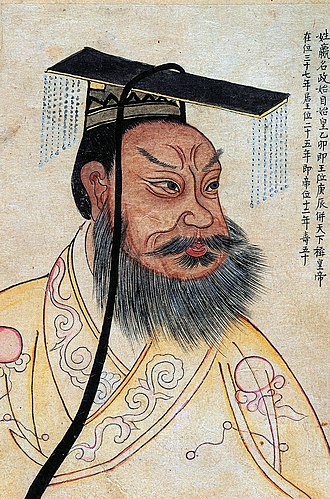
In his later years, the Qianlong Emperor was tall and slender, with a fair complexion and dark eyes. He wore elegant clothing, including a yellow silk robe and a black velvet cap.
During this time, the emperor became very attached to power and luxury. He trusted some officials who were dishonest, which caused problems for the country. While he enjoyed art and literature, important decisions were often made by others. This led to financial difficulties and the beginning of the Qing Empire's decline.
Embassies
Durrani Afghan Embassy
Main articles: Durrani-Qing relations and Ahmad Shah Durrani
Fazil Biy, the ruler of Kokand, and other Kyrgyz leaders asked Ahmad Shah Durrani, the ruler of the Durrani Empire, for help against Qing expansion. Ahmad Shah sent soldiers to areas between Tashkent and Kokand, but they left by 1764.
In 1763, Ahmad Shah sent a message to the Qing emperor Qianlong. The message talked about his recent victories and Qing expansion. The Qing emperor did not see it as a threat.
When the Afghan message arrived in Beijing, the main messenger refused to bow before the Qing emperor. This upset the Qing leaders, but the messenger later agreed to bow. This event hurt relations between the Qing and Afghans. Qianlong decided not to fight with the Afghans and focused on protecting Qing lands.
Macartney Embassy
Main article: Macartney Embassy
In 1793, King George III sent a big group to meet the Qianlong Emperor, led by George Macartney. They wanted to trade more with China and use a port other than Guangzhou. The Qianlong Emperor said no, because China did not want to change how it traded with other countries.
Macartney met the emperor twice. Qianlong sent a letter to the British king explaining why he would not agree to the British requests.
Titsingh Embassy
A Dutch message arrived at the Qianlong Emperor's court in 1795. This was the last time any European came before the Qing imperial court in the old way.
Isaac Titsingh represented Dutch interests and traveled to Beijing in 1794–95 to celebrate the 60th anniversary of the Qianlong Emperor's rule. Unlike Macartney, Titsingh agreed to bow before the emperor, which was seen as respectful by the Chinese.
Abdication
In October 1795, the Qianlong Emperor said he would stop being the ruler when he turned 85. He passed the throne to his son. Even after stepping down, he kept real power while the new emperor, the Jiaqing Emperor, ruled only in name.
The Qianlong Emperor planned to leave the Hall of Mental Cultivation in the Forbidden City. He had built a special retirement home called the Palace of Tranquil Longevity, known today as the "Qianlong Garden". However, he never moved there and passed away in 1799. The Palace is being restored by the Palace Museum in Beijing and the World Monuments Fund.
Family
The Qianlong Emperor had many wives and children. His first wife was Empress Xiaoxianchun from the Fuca clan. She had children including the crown prince Yonglian and Princess Hejing. Another wife, Empress Xiaoyichun, had children such as Princess Hejing and the future Jiaqing Emperor.
He also had many other important wives and consorts from different families. Some of their children became princes or princesses and married into other noble families. The emperor’s large family included many sons and daughters who were important in the Qing dynasty’s history.
Works by the Qianlong Emperor
The Qianlong Emperor wrote many poems and books when he was ruler. One famous work is called "The conquest of the Miao-tse." It is a poem about his experiences. The poem was translated into English by Stephen Weston and published in London, England, in 1810. You can learn more about this book from historical records.
Images
Related articles



This article is a child-friendly adaptation of the Wikipedia article on Qianlong Emperor, available under CC BY-SA 4.0.
Images from Wikimedia Commons. Tap any image to view credits and license.