 Safekipedia
Southern England
Adapted from Wikipedia · Adventurer experience
Southern England, also called the South of England or the South, is the southern part of England. It includes the areas of London, the South East, the South West, and the East. It borders the Midlands to the north and Wales to the far north-west. Many people live here, and it covers a large area.
Southern England is different from the Midlands and the North of England in culture, money, and politics. The South is often seen as wealthier and more important in politics. The area around the capital, Greater London, has a big influence. The Home Counties, East Anglia, and the West Country are also part of Southern England.
Greater London is the most crowded county in Southern England. After that come Hampshire, Kent, and Essex. Bristol is the largest city in the South besides London.
Definitions
The UK government does not group Southern England as one area. The Office for National Statistics divides the UK into twelve regions. In England, the North has places like the North West, North East and Yorkshire and the Humber. The Midlands has the West Midlands, East Midlands and Wales. The rest of England is called the South.
Most people think the South includes the South East, Greater London and the South West. Some also think the East of England is part of the South, but not everyone agrees. People in the North are more likely to include the East of England in the South than people in the South or Midlands. The Home Counties share some culture with London but feel separate from it.
Geography
Further information: Geography of England
The South of England covers about a quarter of the United Kingdom's land. It has many different landscapes: the north-east has fenlands, the south has downlands and a coastal plain, and the west follows the River Thames to the Bristol Channel and a peninsula.
This area borders Wales and the English Midlands on land, and it has sea borders with France, Belgium, and the Netherlands. The South is mostly flat with some hilly areas like the Cotswolds and the Chilterns. The highest point is High Willhays, which stands at 2,037 feet (621 meters) in Devon, inside Dartmoor National Park.
Largest cities and settlements
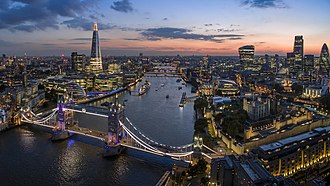
London is the biggest city in the South of England and also the capital of the United Kingdom. The area around London has many people, making it the largest city area in Europe.
The table below shows the urban areas in the region with a population of at least 250,000.
Largest cities and towns in Southern England 2021 Census | |||||||||
|---|---|---|---|---|---|---|---|---|---|
| Rank | Counties | Pop. | Rank | Counties | Pop. | ||||
| 1 | London | Greater London | 8,776,535 | 11 | Bournemouth | Dorset | 196,455 | ||
| 2 | Bristol | Bristol | 425,215 | 12 | Peterborough | Cambridgeshire | 190,605 | ||
| 3 | Brighton and Hove | East Sussex | 277,105 | 13 | Swindon | Wiltshire | 183,680 | ||
| 4 | Plymouth | Devon | 266,955 | 14 | Southend-on-Sea | Essex | 182,305 | ||
| 5 | Southampton | Hampshire | 249,620 | 15 | Oxford | Oxfordshire | 170,805 | ||
| 6 | Luton | Bedfordshire | 233,525 | 16 | Slough | Berkshire | 160,270 | ||
| 7 | Portsmouth | Hampshire | 223,305 | 17 | Cambridge | Cambridgeshire | 152,740 | ||
| 8 | Reading | Berkshire | 203,795 | 18 | Ipswich | Suffolk | 151,565 | ||
| 9 | Norwich | Norfolk | 200,770 | 19 | Poole | Dorset | 141,005 | ||
| 10 | Milton Keynes | Buckinghamshire | 197,340 | 20 | Watford | Hertfordshire | 131,325 | ||
| Rank | Area | Population | Area (km2) | Density (People/km2) | Primary settlements |
|---|---|---|---|---|---|
| 1 | Greater London | 9,787,426 | 1,737.9 | 5,630 | London boroughs and City of London, Watford, Hemel Hempstead, Harlow, Bracknell, Guildford, Woking, St Albans |
| 2 | South Hampshire | 855,569 | 192.0 | 4,455 | Southampton, Portsmouth, Eastleigh, Gosport, Horndean, Havant, Locks Heath, Fareham, Waterlooville |
| 3 | Bristol | 617,280 | 144.4 | 4,274 | Bristol, Filton, Kingswood |
| 4 | Brighton and Hove | 474,485 | 89.4 | 5,304 | Brighton, Hove, Worthing, Littlehampton, Shoreham |
| 5 | Bournemouth/Poole | 466,266 | 131.0 | 3,559 | Bournemouth, Poole, Christchurch |
| 6 | Reading | 318,014 | 83.7 | 3,800 | Reading, Wokingham, Woodley |
| 7 | Southend-on-Sea | 295,310 | 71.8 | 4,111 | Southend-on-Sea, Rayleigh |
| 8 | Plymouth | 260,203 | 59.7 | 4,356 | Plymouth |
| 9 | Luton | 258,018 | 50.7 | 5,088 | Luton, Dunstable |
| 10 | Farnborough/Aldershot | 252,397 | 78.5 | 3,217 | Farnborough, Aldershot, Camberley, Farnham |
Demographics
Wealth and class
See also: North–South divide in England
Southern England is usually richer than areas in the north. The South East has many families with good incomes, and London is very rich. Places like Surrey and Sussex are known for their wealth, with expensive homes and lovely villages. The richest area in all of Britain is part of London called the Royal Borough of Kensington and Chelsea.
But Southern England also has some poorer areas. For example, Cornwall in the far south-west is one of the poorer parts of England. Some towns, like Jaywick in Essex, are among the least well-off places in the country. Even in rich London, there are areas where people don’t have much money.
Language
English
Further information: British English in Southern England
Most people in Southern England speak English. The way people speak can change depending on where they live. The usual British way of speaking comes from the South. In places like London, Kent, and Essex, many people speak a version called Estuary English. In the south-west, people often speak West Country English, which sounds different from other areas.
Cornish
Cornish is a special language spoken in Cornwall by some people there. It is important to the history and culture of the Cornish people.
People
People in Southern England often feel more connected to their own county or city than to the idea of “the South” as a whole. For example, someone from Essex might not feel much in common with someone from Oxfordshire. There are also big differences between people living in the south-west and those in the south-east.
Health
People in Southern England are usually healthier than people in Northern England. People in the South tend to live longer. However, health differences between the North and South are getting smaller over time. Some richer towns in the North now have longer average lifespans than some poorer areas in the South.
Education
The South of England has some very famous universities. Two of the oldest are Oxford and Cambridge. There are also many important universities like Imperial College London, University of Exeter, and the London School of Economics.
Sport
Football
The South Coast Derby is a name for football games between Portsmouth Football Club and Southampton Football Club. When Portsmouth is not playing in the top league, AFC Bournemouth and Brighton and Hove Albion play in the Premier League, and some people also call their games a South Coast derby.
Other important rival games in Southern England include West Country derbies and London derbies.
Rugby
See also: History of rugby union
Rugby union is the main kind of rugby played in the south, with a smaller amount of rugby league. One of the biggest rival games is the West Country derby between Bath and Gloucester.
Divisions
Southern England has four main regions and 22 counties. These regions are the East of England, London, South East, and South West.
Some areas work together, like Cambridgeshire and Peterborough and West of England. Others have their own ways of doing things, such as London and Oxfordshire. There are also names for parts of Southern England, like the Home Counties, which are the areas close to London.
Images
Related articles




This article is a child-friendly adaptation of the Wikipedia article on Southern England, available under CC BY-SA 4.0.
Images from Wikimedia Commons. Tap any image to view credits and license.