 Safekipedia
String section
Adapted from Wikipedia · Adventurer experience
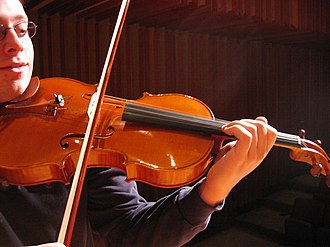
The string section of an orchestra is made up of special musical instruments called the violin family. This group usually includes first and second violins, violas, cellos, and double basses. It is the largest part of a regular orchestra. When people talk about the instruments in a piece of music, they might say "the strings" to mean this group of instruments.
An orchestra that only has a string section is known as a string orchestra. Smaller groups of string instruments are also used in jazz, pop, rock music, and in the pit orchestras that play for musical theatre. The string section adds beautiful sounds to all kinds of music.
Seating arrangement
In modern orchestras, string players usually sit in a circle around the conductor. The first violins and second violins, violas, and cellos sit facing clockwise, with double basses behind the cellos. Each group has a leader who plays special solos and helps decide how to play certain parts. These leaders sit at the front of their group, closest to the conductor and the audience.
In the past, violins often sat on opposite sides. Sometimes, the composer decides the seating, like in special pieces where strings are split on each side of the stage. Players share stands, with the leader usually sitting closest to the audience. When music needs more players, they split into smaller groups to play different parts.
Numbers and proportions
The size of a string section can be shown with a formula like 10–10–8–10–6. This tells how many first violins, second violins, violas, cellos, and basses there are. These numbers can change a lot. For example, Wagner in Die Walküre asked for 16–16–12–12–8, while the band orchestra in Darius Milhaud’s La création du monde used just 1–1–0–1–1.
Music from the Baroque and Classical periods usually had smaller string sections. But during the Romantic period, string sections got bigger to be louder and match the big brass sections. In more recent times, some composers asked for smaller string sections again. In smaller orchestras, like youth orchestras, the string sections might be smaller because it can be hard to find enough players.
The double bass section changed a lot in the 1800s. In older works, the bass and cello often played the same music, with the bass playing an octave lower. Later, composers started writing separate parts for both instruments.
Variants
Some famous pieces of music have string sections that do not use certain instruments. For example, in Haydn's The Creation, the music uses only divided viola and cello sections without violins. Other well-known works without violins include the 6th of the Brandenburg Concerti by Bach, Second Serenade of Brahms, and Philip Glass's opera Akhnaten.
There are also pieces without violas, like Darius Milhaud's La crèation du monde, and works without both violins and violas, such as Stravinsky's Symphony of Psalms. Some compositions divide the violin section into three parts, like in Richard Strauss's Elektra.
In other musical genres
The term "string section" can also mean a group of bowed string instruments in rock, pop, jazz, and commercial music. In these styles, the size and types of instruments in the string section can change more and are often smaller than in classical music.
Related articles




This article is a child-friendly adaptation of the Wikipedia article on String section, available under CC BY-SA 4.0.
Images from Wikimedia Commons. Tap any image to view credits and license.