 Safekipedia
Swahili
Adapted from Wikipedia · Adventurer experience
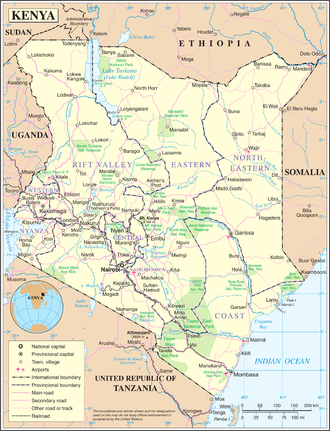
Swahili, also called Kiswahili, is a Bantu language. People mainly speak it in Tanzania, Kenya, and Mozambique. Many people use Swahili, both as their first language and as a second language.
Swahili has many words from Arabic. This happened when traders from Arabia visited the East African coast. Swahili also includes words from Portuguese, English, and German. Because of support from the governments of Tanzania and Kenya, Swahili is an official language in several East African countries. It is also used by the African Union and other groups.
In 2022, the United Nations chose July 7 as Swahili Language Day. Many African countries now teach Swahili in schools to help people talk to each other.
Classification
Swahili is a Bantu language from the Sabaki branch. It is part of Bantu zone G, which is different from other Sabaki languages. Many Swahili words come from Arabic. Originally, Swahili was spoken along the East African coast.
History
The word "Swahili" comes from an Arabic name for the area, meaning "coasts".
The Swahili language started from the Bantu languages spoken along the coast of East Africa. Many words in Swahili are similar to those in Unguja, Pemba, and Mijikenda languages, as well as other East African Bantu languages. Over time, Swahili borrowed many words, mostly from Arabic, but also from Persian, Hindustani, Portuguese, and Malay. The grammar and most everyday words in Swahili come from the Sabaki language.
During colonial times in East Africa, Swahili grew and spread. Arabs used Swahili for trade and teaching Islam. Later, Germans made it the official language in schools. After World War I, the British continued to support Swahili in areas like Kenya, Tanganyika, Uganda, and Zanzibar. In 1928, leaders from these places met in Mombasa and chose the Zanzibar dialect as the standard form of Swahili.
| سَاحِل | → | سَوَاحِل | → | سَوَاحِلِيّ |
| sāḥil | sawāḥil | sawāḥilī | ||
| "coast" | "coasts" (broken plural) | "coastal" or "coastal inhabitant" |
| Source languages | Percentage |
|---|---|
| Arabic (mainly Omani Arabic) | 40% |
| English | 4.6% |
| Portuguese | 0.9–1.0% |
| Hindustani | 0.7–3.9% |
| Persian (mainly Iranian Persian) | 0.4–3.4% |
| Malagasy | 0.2–0.4% |
Current status
Many people speak Swahili. About 60 million to 150 million people use it, either as their first language or as a second language. Swahili is very common in five countries around the African Great Lakes: Kenya, DR Congo, Rwanda, Uganda, and Tanzania. It is an official or national language in these places. In Tanzania, especially along the coast, many people speak Swahili as their first language. In other parts of Tanzania, people often mix Swahili with local languages.
Swahili is also spoken by smaller groups in Burundi, Comoros, Malawi, Mozambique, and Zambia. In 2015, the East African Community created the East African Kiswahili Commission to support the language. Swahili is used in technology too, with tools like spelling checkers, language learning apps, and translation programs to help people use it.
Religious and political identity
Swahili helped spread Christianity and Islam in East Africa. When Arabs arrived, they brought Islam and taught it in Swahili. Many local people learned Islam and Swahili gained some Arabic words.
When Europeans arrived, they brought Christianity. They used Swahili to share their beliefs. Swahili became important for spreading Christianity and for teaching people.
In Tanganyika’s struggle for independence, the Tanganyika African National Union used Swahili to unite people. After independence, Swahili became Tanzania’s national language. It helps bring together many different tribes and is a source of pride for Tanzanians.
Phonology
For help with Swahili sounds, see Help:IPA/Swahili.
Vowels
Swahili has five main vowel sounds: /ɑ/, /ɛ/, /i/, /ɔ/, and /u/. These sounds can change a little depending on where they appear in a word. For example, some sounds are pronounced a bit differently when they are not stressed or when certain letters come before them.
Consonants
Swahili also has some special sounds, like aspirated consonants, which are not written differently in the alphabet. The letter /r/ can be pronounced in two ways by most speakers. Swahili does not use tones to change meaning like some other languages do.
| Labial | Dental | Alveolar | Postalveolar / Palatal | Velar | Glottal | ||
|---|---|---|---|---|---|---|---|
| Nasal | m | n | ɲ ⟨ny⟩ | ŋ ⟨ng'⟩ | |||
| Stop | prenasalized | ᵐb̥ ⟨mb⟩ | ⁿd̥ ⟨nd⟩ | ⁿd̥ʒ̊ ⟨nj⟩ | ᵑɡ̊ ⟨ng⟩ | ||
| implosive / voiced | ɓ ~ b ⟨b⟩ | ɗ ~ d ⟨d⟩ | ʄ ~ dʒ ⟨j⟩ | ɠ ~ ɡ ⟨g⟩ | |||
| voiceless | p | t | tʃ ⟨ch⟩ | k | |||
| aspirated | (pʰ ⟨p⟩) | (tʰ ⟨t⟩) | (tʃʰ ⟨ch⟩) | (kʰ ⟨k⟩) | |||
| Fricative | prenasalized | ᶬv̥ ⟨mv⟩ | ⁿz̥ ⟨nz⟩ | ||||
| voiced | v | (ð ⟨dh⟩) | z | (ɣ ⟨gh⟩) | |||
| voiceless | f | (θ ⟨th⟩) | s | ʃ ⟨sh⟩ | (x ⟨kh⟩) | h | |
| Approximant | l | j ⟨y⟩ | w | ||||
| Rhotic | r | ||||||
Orthography
See also: Swahili Ajami
Swahili is now written with the Latin alphabet. Some pairs of letters, like ch, sh, ng' and ny, make special sounds. Letters like q and x are not used, and c is only used in special cases.
In the past, Swahili was written with a special version of the Arabic alphabet called Ajami. Many books were made this way. When the Latin alphabet was introduced, using Ajami became less common. But some people still like to write Swahili this way. Over time, people tried to make the Arabic alphabet work better for Swahili. This started in the late 1800s and continued for many years. Even when European countries took control of East Africa, many people in rural areas kept using it into the 1900s. There were also different ways people wrote Swahili, which sometimes made it hard to understand. But efforts to create a standard way to write Swahili with Arabic letters continued for many years.
Grammar
Swahili nouns are grouped into classes, similar to genders in other languages. These classes help organize words into groups with similar meanings or functions. For example, the prefix m- can mean a single person, like mtoto meaning "child," while wa- can mean many people, like watoto meaning "children."
In Swahili, words that describe or relate to nouns must match the noun's class. This includes adjectives, pronouns, and verbs. This matching system helps make sentences clear and correct.
One interesting class is ki-/vi-, which includes words like tools and small things. For example, kisu means "knife," and kitoto means "infant." This class can also describe things that are a bit like something else or have a small amount of a quality.
Another class is m-/mi-, often called the "tree" class because it includes words like mti meaning "tree." But it also covers many other things like plants, natural forces, and active body parts like moyo meaning "heart."
Swahili also uses agreement, where words in a sentence must match the noun they relate to. This makes communication clear and helps avoid confusion.
| NC | Semantic field | Noun -C, -V | Subj. | Obj. | -a | Adjective -C, -i, -e |
|---|---|---|---|---|---|---|
| – | I | (mimi) | ni- | |||
| – | we | (sisi) | tu- | |||
| – | thou | (wewe) | u- | ku- | ||
| – | you | (ninyi) | m- | wa- | ||
| 1 | person | m-, mw- | a- | m- | wa | m-, mwi-, mwe- |
| 2 | people | wa-, w- | wa- | wa | wa-, we-, we- | |
| 3 | tree | m-, mw- | u- | wa | m-, mwi-, mwe- | |
| 4 | trees | mi- | i- | ya | mi-, mi-, mye- | |
| 5 | group, AUG | ji-/Ø, j- | li- | la | ji-/Ø, ji-, je- | |
| 6 | groups, AUG | ma- | ya- | ya | ma-, me-, me- | |
| 7 | tool, DIM | ki-, ch- | ki- | cha | ki-, ki-, che- | |
| 8 | tools, DIM | vi-, vy- | vi- | vya | vi-, vi-, vye- | |
| 9 | animals, 'other', loanwords | N- | i- | ya | N-, nyi-, nye- | |
| 10 | zi- | za | ||||
| 11 | 'extension' | u-, w-/uw- | u- | wa | m-, mwi-, mwe- | |
| 10 | (plural of 11) | N- | zi- | za | N-, nyi-, nye- | |
| 14 | abstraction | u-, w-/uw- | u- | wa | m-, mwi-, mwe- or u-, wi-, we- | |
| 15 | infinitives | ku-, kw- | ku- | kwa- | ku-, kwi-, kwe- | |
| 16 | precise position | -ni, mahali | pa- | pa | pa-, pe-, pe- | |
| 17 | imprecise position | -ni | ku- | kwa | ku-, kwi-, kwe- | |
| 18 | internal position | -ni | m(u)- | mwa | mu-, mwi-, mwe- | |
Dialects and closely related languages
Modern standard Swahili comes from a dialect called Kiunguja, spoken in Zanzibar City.
Swahili has many different dialects. Some dialects are very different from each other. For example, Kimwani is spoken in parts of Mozambique, and Chimwiini is spoken in parts of Somalia. There are also dialects like Kiamu, used in literature and poetry from the island of Lamu.
Swahili dialects are grouped in different ways by experts. Some are grouped as Mombasa–Lamu Swahili, which includes dialects from areas like Mombasa and Lamu. Others are grouped as Pemba Swahili, spoken on islands like Pemba and Zanzibar. There are also Swahili-based pidgins and creoles, such as Engsh in Nairobi and Sheng slang used by young people in Nairobi.
Swahili poets
Swahili poets have written beautiful and meaningful works. Famous Swahili poets include Dada Masiti, a Kenyan poet from the 1810s, and Shaaban bin Robert, a Tanzanian poet who lived from 1909 to 1962. Other well-known poets are Euphrase Kezilahabi from Tanzania, known for his novels and poetry, and Mathias E. Mnyampala, a Tanzanian writer and poet. Many more talented poets have shared their stories in the Swahili language.
Oral literature
In 1870, a person named Edward Steere shared 23 Swahili stories with English translations. These stories included tales like "Kisa cha Punda wa Dobi", which means "The Story of the Washerman's Donkey," also called "The Heart of a Monkey." There was also a story named "Mwalimu Goso", meaning "Goso the Teacher," and "Sungura na Simba", meaning "The Hare and the Lion."
Steere also collected many wise sayings and puzzles in Swahili. Some of these sayings include:
- "Mbio za sakafuni hwishia ukingoni." which means "Running on a roof ends at the edge of it."
- "Angurumapo simba, mteza nani?" which means "Who will dance to a lion's roaring?"
- "Mlevi wa mvinyo hulevuka, mlevi wa mali halevuki." which means "He that is drunk with wine gets sober, he that is drunk with wealth does not."
Some of the puzzles he shared were:
- "Nyumba yangu kubwa, haina mlango (yayi)." which means "My house is large; it has no door (egg)."
- "Kuku wangu akazalia miibani (nanasi)." which means "My hen has laid among thorns (pineapple)."
- "Popo mbili zavuka mto (macho)." which means "Two nuts cross a river (eyes)."
Another book from 1881 included more Swahili stories with English translations, along with additional wise sayings and puzzles. Some of these sayings included:
- "Tulingane sawasawa, kama sahani na kawa." which means "We match together, like a dish and a cover."
- "Samaki mmoja akioza, wameoza wote." which means "If one fish is bad, they are all bad."
- "Wa kuume haukati wa kushoto." which means "The right hand does not cut the left."
- "Paka akiondoka, panya hutawala." which means "When the cat goes away, the rat is king."
The puzzles in this book included:
- "Gumugumu huzaa teketeke, gumugumu teketeke huzaa (mahindi)." which means "The hard is the parent of the soft, and the soft of the hard (maize)."
- "Mtoto wangu killa mwaka hulala chini (boga)." which means "My child each year lies on the ground (pumpkin)."
- "Nyumba vangu kubwa haina taa (kaburi)." which means "My great house has no lamp (grave)."
- "Nimetupa mshale wangu, mchana kwenda mbali nikitupa usiku hauendi mbali (macho)." which means "I cast my arrow in the day time, it went far off; it I cast it at night, it does not go far (eyes)."
There are also many other wise sayings in Swahili, like:
- Fuata nyuki ule asali. Which means "Follow the bee so that you may eat honey."
- Baada ya dhiki faraja. Which means "After hardship comes relief."
- Mgaagaa na upwa hali wali mkavu. Which means "The one who busies himself with work will not miss a meal."
- Mwacha mila ni mtumwa. Which means "The person who abandons his culture is a slave."
There are also sayings that tell us when powerful people fight, it is the ordinary people who suffer:
- Wapiganapo tembo nyasi huumia. Which means "Fighting elephants damage the grass."
- Ndovu wawili wakisongana, ziumiazo ni nyika. Which means "Where two elephants argue, the grassland is damaged."
Sample text
Swahili, also called Kiswahili, is a language spoken by the Swahili people. These people live mainly in Tanzania, Kenya, and Mozambique along the East African coast and nearby islands. Many people speak Swahili. Most native speakers are in Tanzania and Kenya.
| Swahili | English |
|---|---|
| Kifungu cha 26. 1) Kila mtu ana haki ya kuelimishwa. Elimu yapasa itolewe bure hasa ile ya madarasa ya chini. Elimu ya madarasa ya chini ihudhuriwe kwa lazima. Elimu ya ufundi na ustadi iwe wazi kwa wote. Na elimu ya juu iwe wazi kwa wote kwa kutegemea sifa ya mtu. 2) Elimu itolewe kwa madhumuni ya kuendeleza barabara hali ya binadamu, na kwa shabaha ya kukuza haki za binadamu na uhuru wake wa asili. Elimu ni wajibu ikuze hali ya kueleana, kuvumiliana na ya urafiki kati ya mataifa na kati ya watu wa rangi na dini mbali-mbali. Kadhalika ni wajibu iendeleze shughuli za Umoja wa Mataifa za kudumisha amani. 3) Ni haki ya wazazi kuchagua aina ya elimu ya kufunzwa watoto wao. | Article 26 1. Everyone has the right to education. Education shall be free, at least in the elementary and fundamental stages. Elementary education shall be compulsory. Technical and professional education shall be made generally available and higher education shall be equally accessible to all on the basis of merit. 2. Education shall be directed to the full development of the human personality and to the strengthening of respect for human rights and fundamental freedoms. It shall promote understanding, tolerance and friendship among all nations, racial or religious groups, and shall further the activities of the United Nations for the maintenance of peace. 3. Parents have a prior right to choose the kind of education that shall be given to their children. |
Images
Related articles


This article is a child-friendly adaptation of the Wikipedia article on Swahili, available under CC BY-SA 4.0.
Images from Wikimedia Commons. Tap any image to view credits and license.