 Safekipedia
Temple of Artemis
Adapted from Wikipedia · Adventurer experience
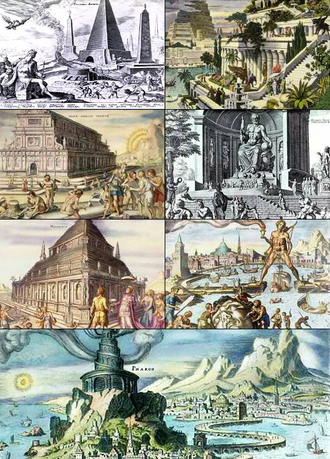
The Temple of Artemis or Artemision was a Greek temple for the goddess Artemis, who the Romans called Diana. It was in Ephesus, near today’s Selçuk in Turkey. This amazing building was one of the famous Seven Wonders of the World.
The first temple was built long ago but was destroyed by a flood. Later, around 550 BCE, a new, bigger temple was built. This new temple was designed by an architect named Chersiphron and paid for by a rich king called Croesus from Lydia.
Sadly, the temple did not last forever. In 356 BCE, it was burned down. After this, the people of Ephesus built the temple again, but it was finally destroyed in 401 CE. Today, only some old pieces and the base of the temple can still be seen. The temple was very important to the people of Ephesus, and the goddess Artemis was special to them.
Location and history
The Temple of Artemis was near the ancient city of Ephesus, about 75 kilometres south of the modern port city of İzmir, in Turkey. Today, the site is close to the modern town of Selçuk.
The sacred site was older than the temple. Some ancient writers thought it was even older than a famous shrine of Apollo at Didyma. Before World War I, excavations showed people lived there as early as the Bronze Age. A simple temple was built there in the 8th century BCE. In the 7th century BCE, a flood destroyed that temple, but people kept using the same spot for their ceremonies.
Second phase
The new temple was built with help from Croesus, the ruler of Lydia. Architects Chersiphron and his son Metagenes started building it around 550 BCE. The temple was made of marble. It was 115 meters long and 46 meters wide. It had tall columns that made a wide path around the inner room. This room held a special statue of the goddess Artemis.
Many people visited the temple. They included merchants, kings, and tourists. Visitors showed respect to Artemis by leaving gifts like jewelry. The temple was also a safe place for people who needed to escape trouble. This tradition came from stories about the Amazons.
In 356 BCE, a fire destroyed the temple. Some think a man named Herostratus started the fire to become famous, but historians debate this. The fire happened on the same day Alexander the Great was born.
Third phase
Alexander the Great offered to pay for rebuilding the temple, but the people of Ephesus said no, because it wasn’t right for one god to build a temple for another. After Alexander died, they started rebuilding it themselves in 323 BCE. This new temple was much bigger than the old one. It was 137 meters long, 69 meters wide, and 18 meters high, with over 127 columns.
The temple was admired for its beautiful sculptures and artwork. Writers from long ago talked about statues and paintings inside, made by famous artists. Even hundreds of years later, people still remembered this amazing building. Sadly, the temple had hard times. Some stories say that in 268 CE, a group called the Goths attacked the area and damaged the temple, though it’s not clear how much it was hurt. Over time, as more people followed Christianity, the temple was closed and its stones were used in other buildings.
Rediscovery of the temple
The place where the temple once stood was found again in 1869 after a six-year search. A group led by John Turtle Wood and supported by the British Museum did this work, and they kept searching until 1874.
During this time, many special items were found, including carved columns showing important women from stories, like Artemis. More pieces of carvings were found later between 1904 and 1906. These pieces, from when the temple was rebuilt in the 4th century and from an older temple, are now shown in a special room at the British Museum.
The museum also has some very old coins, maybe the oldest group of coins in the world, from 600 BCE. These coins were hidden under the old temple.
Today, near Selçuk, you can see one column made from pieces found at the temple site.
Cult and influence
The Temple of Artemis was very important to the people of Ephesus. They believed it showed the power of the goddess Artemis Ephesia. Many people visited Ephesus in March and May for big celebrations honoring Artemis. The temple had priests, and women called Melissonomoi helped serve the goddess.
Artemis had many temples, but the one in Ephesus was special to the people there. They were proud of it and did not like others claiming to protect Artemis. Even when different rulers controlled the area, the festivals and games in Artemis's honor continued. These events were important for the Greek world and helped bring people together. The festivals included games, contests, and performances, and they were very popular.
Ephesian Artemis
The Ephesian Artemis was a special version of the goddess Artemis worshipped in the city of Ephesus. Unlike the typical Greek image of Artemis as a huntress, the Ephesian version had a very different look. Ancient writers described an early wooden statue covered in gold and silver. Later statues made of bronze have survived and show the goddess with a pillar-like shape for her body, with her feet showing.
The upper part of these statues often had oval shapes. Some people in the past thought these looked like many breasts. However, modern scholars believe these shapes were likely decorations, perhaps eggs, or special items hung on the original wooden statue. On coins, the goddess is shown with a crown shaped like city walls and sometimes holding a staff with snakes.
Over time, both Greeks and Romans connected this goddess with their own deities, including Artemis and Apollo. Even after Christianity spread, some people still remembered the old goddess.
Panorama
A 360 degree panoramic view shows the place where the temple once stood. The temple was an important building in ancient Greece, dedicated to the goddess Artemis.
Images
Related articles




This article is a child-friendly adaptation of the Wikipedia article on Temple of Artemis, available under CC BY-SA 4.0.
Images from Wikimedia Commons. Tap any image to view credits and license.