 Safekipedia
Type II supernova
Adapted from Wikipedia · Adventurer experience
A Type II supernova is a big explosion that happens when a very large star runs out of energy and collapses quickly. For a star to explode this way, it must be at least 8 but no more than 40 to 50 times heavier than the mass of the Sun. These explosions are special because they show hydrogen in their light, which helps scientists identify them. We usually see them in the spinning parts of galaxies and in areas full of young, massive stars.
Big stars shine by mixing together smaller parts of atoms in a process called nuclear fusion. These stars can mix heavier elements, but this needs very high temperatures and pressures, so they live shorter lives. They keep mixing heavier and heavier elements until they make a core of iron and nickel. Mixing iron or nickel does not give off energy, so the core can no longer stay stable and starts to collapse.
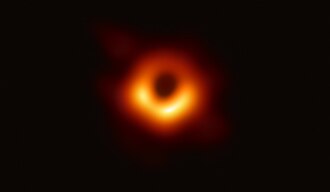
When the collapsing core gets heavier, it crushes inward very fast. This creates huge temperatures and forms particles called neutrons and neutrinos. The collapse stops suddenly, sending a powerful wave outward that blows the star apart in a bright explosion. What is left behind can become either a neutron star or a black hole, depending on how heavy the original star was. These explosions help create some of the heaviest elements in the universe.
Formation
Big stars, much larger than the Sun, change a lot during their lives. In the middle of a star, tiny particles called hydrogen come together to make helium. This makes heat that holds the star up.
As time passes, helium builds up in the center of the star.
When the hydrogen runs out, the center of the star gets smaller. This makes it hotter, and the helium can make new particles called carbon and oxygen.
Very big stars keep changing their centers like this, making heavier and heavier particles until something amazing happens.
| Process | Main fuel | Main products | 25 M☉ star | ||
|---|---|---|---|---|---|
| Temperature (K) | Density (g/cm3) | Duration | |||
| hydrogen burning | hydrogen | helium | 7×10⁷ | 10 | 107 years |
| triple-alpha process | helium | carbon, oxygen | 2×10⁸ | 2000 | 106 years |
| carbon-burning process | carbon | Ne, Na, Mg, Al | 8×10⁸ | 106 | 1000 years |
| neon-burning process | neon | O, Mg | 1.6×10⁹ | 107 | 3 years |
| oxygen-burning process | oxygen | Si, S, Ar, Ca | 1.8×10⁹ | 107 | 0.3 years |
| silicon-burning process | silicon | nickel (decays into iron) | 2.5×10⁹ | 108 | 5 days |
Core collapse
When a big star runs out of fuel, its center collapses very quickly. This is because the star can no longer make energy by combining atoms. The collapse happens so fast that it creates huge amounts of energy. This energy makes the star explode in what we call a supernova.
In a Type II supernova, the explosion happens because the core of the star collapses and then pushes back. This creates a wave that pushes the outer parts of the star away. The explosion releases a lot of energy, mostly in a type of particle called a neutrino. If the star is not too heavy, what is left after the explosion is a tiny, very dense object called a neutron star. If the star is heavier, it might form a black hole instead.
Theoretical models
The Standard Model of particle physics helps us learn about tiny parts of things, called elementary particles. It can show us what happens to these particles in a supernova, a giant explosion of a star. Even though the energy per particle is small, the conditions inside can be very dense, which might change how particles normally act.
One big question scientists still have is how the burst of neutrinos gives enough energy to make the star explode. Only a tiny bit of this energy needs to move to the rest of the star, but it’s hard to explain how this happens. Some ideas suggest that movements inside the star, called convective overturn, help finish the explosion. During this explosion, heavier elements are made, and the explosion sends out gas and dust that contains these heavier elements.
Learning how neutrino physics and the movements of the star’s material work together is important to solving these mysteries. Some models also look at special patterns in the stalled shock wave that might help restart it. Scientists use computer models to predict what happens after the explosion starts, including what elements are made and how bright the supernova will look.
Light curves for Type II-L and Type II-P supernovae
When scientists study the light from a Type II supernova, they notice patterns that show hydrogen is present. This helps them identify Type II supernovae.
The brightness of a Type II supernova changes over time. It gets brighter until it reaches a peak, then it starts to dim. There are two main types based on how the brightness changes. One type, called Type II-L, dims steadily after the peak. The other type, called Type II-P, has a period where the brightness stays almost the same before continuing to dim. This difference is due to how the outer parts of the exploding star act.
Type IIn supernovae
The "n" stands for narrow. These supernovae show thin lines of a certain element in their light. This happens when the explosion pushes into gas around the star. Scientists think these stars lose a lot of material before they explode.
Some of these supernovae heat up dust around them. This makes them glow very bright in a certain kind of light. This glow can last a long time. These special supernovae are named after a famous example. They were found using space telescopes.
Type IIb supernovae
A Type IIb supernova has a little bit of hydrogen at first, which is why it is called a Type II. But later, the hydrogen goes away, and its light pattern looks more like a Type Ib supernova. This kind of supernova may come from a big star that lost most of its outer layers, or from a star that lost its hydrogen because of a nearby star. As the material from the explosion spreads out, the hydrogen fades away. A well-known example of a Type IIb supernova is SN 1993J, and another example is Cassiopeia A. The idea of a Type IIb supernova was first suggested in 1987.
Images
Related articles




This article is a child-friendly adaptation of the Wikipedia article on Type II supernova, available under CC BY-SA 4.0.
Images from Wikimedia Commons. Tap any image to view credits and license.