 Safekipedia
U.S. state
Adapted from Wikipedia · Adventurer experience
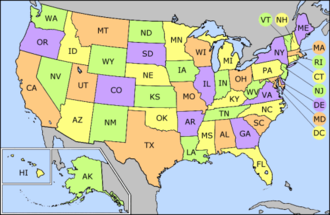
A state in the United States is one of the 50 parts that make up the country. Each state has its own government, and people living there are citizens of both the United States and their state. Moving between states is usually easy.
Each state has its own government with three parts: one that makes rules, one that carries them out, and one that makes sure they are fair. States are divided into smaller areas called counties.
States have important rights under the United States Constitution. They help choose leaders for the country and can agree to changes in the Constitution. The United States started with 13 states and now has 50, all with the same rights.
List
Further information on each U.S. state: List of states and territories of the United States
See also: List of U.S. state and territory abbreviations
The 50 states, in alphabetical order, along with each state's flag:
- Alabama
- Alaska
- Arizona
- Arkansas
- California
- Colorado
- Connecticut
- Delaware
- Florida
- Georgia
- Hawaii
- Idaho
- Illinois
- Indiana
- Iowa
- Kansas
- Kentucky
- Louisiana
- Maine
- Maryland
- Massachusetts
- Michigan
- Minnesota
- Mississippi
- Missouri
- Montana
- Nebraska
- Nevada
- New Hampshire
- New Jersey
- New Mexico
- New York
- North Carolina
- North Dakota
- Ohio
- Oklahoma
- Oregon
- Pennsylvania
- Rhode Island
- South Carolina
- South Dakota
- Tennessee
- Texas
- Utah
- Vermont
- Virginia
- Washington
- West Virginia
- Wisconsin
- Wyoming
Background
The 13 original states began in July 1776 during the American Revolutionary War. They agreed to the Lee Resolution and signed the United States Declaration of Independence. Before this, each was a British colony.
These states joined the first Union of states between 1777 and 1781 by approving the Articles of Confederation, the first U.S. constitution. During this time, the states made their own state constitutions. These were some of the earliest written rules for governments.
These early rules shared similar ideas, like being a republican government and splitting power into three parts. Many states had two groups making laws and promised to protect people’s rights. Between 1787 and 1790, all the states agreed to a new national set of rules in the Constitution of the United States. This new constitution helped explain how the country and the states would share power through federalism.
Governments
Main article: State governments of the United States
Further information: Comparison of U.S. state governments
In the United States, each of the 50 states has its own government. These state governments share power with the federal government but also have their own rights. The U.S. Constitution gives states many powers that are not given to the federal government.
Each state has its own constitution that sets up its government. Most states have three parts: a leader called a governor, a group that makes laws, and courts that explain the laws. Governors are chosen by voters and can approve or reject new laws. The groups that make laws usually have two parts, but one state has just one part. These law-makers are also chosen by voters.
State courts handle most legal cases in the United States. They are organized differently in each state but always protect important rights for citizens. Most states use rules from English law, but one state uses rules from French law.
Local governments, like cities and towns, get their powers from the state governments. The states decide what powers local areas can have.
Relationships
Interstate
Since 1789, every new state has been treated the same as the first states. States can make agreements, called compacts, to share things like water or roads.
Each state must respect the laws and court decisions of other states. This means they recognize most contracts and legal judgments. States cannot treat people from other states unfairly.
With the federal government
Each state has a government where the people choose their leaders. The U.S. Constitution and federal laws are the most important laws, and state laws cannot go against them.
The U.S. Congress has powers like declaring war and regulating trade between states. Over time, the federal government has taken on more powers that states used to handle.
Each state has two senators in the U.S. Senate and at least one representative in the House of Representatives. Senators serve six-year terms, and representatives serve two-year terms. The number of representatives a state has depends on its population.
With other countries
U.S. states are not independent countries and do not have their own international relations. The federal government handles relationships with other countries, but state leaders sometimes visit other nations to build economic and cultural ties.
Admission into the Union
Main article: Admission to the Union
Since the United States began in 1776, it has grown from 13 states to 50. Each new state joins with the same rights as the others. Congress can allow new states, but cannot create them from parts of existing states without permission.
Many states formed from areas called territories. These territories were ruled by Congress. People in a territory can ask to become a state. If Congress agrees, they can write a state constitution and hold elections before joining the United States. Some states joined without being territories first, like California, which came from land given to the United States by Mexico, and Texas, which was its own country before joining.
Proposed additions
Further information: 51st state
Guam
Guam is a territory of the United States in the western Pacific Ocean. People in Guam have talked a lot about whether it should become a U.S. state.
Puerto Rico
Main articles: Political status of Puerto Rico and Proposed political status for Puerto Rico
Puerto Rico is a U.S. territory. It calls itself the "Commonwealth of Puerto Rico" in English and "Estado Libre Asociado" in Spanish. People there do not have full voting rights in the U.S. Congress. They have a special representative in the U.S. House of Representatives who can speak but cannot vote fully.
In votes over the years, most people in Puerto Rico have chosen to become a state. The U.S. government still needs to decide what to do about Puerto Rico's status.
Washington, D.C.
Main article: District of Columbia statehood movement
Washington, D.C. is the U.S. capital. It was created to be a neutral place for the government, not part of any state. It does not have voting rights in the Senate or a full representative in the House. Today, most people in Washington, D.C. want to become a state, and they voted for it in 2016. But Congress still needs to approve it.
Secession from the Union
Main article: Secession in the United States
The U.S. Constitution talks about a "union" but does not say if a state can leave it. Earlier, the Articles of Confederation said the union would be forever. Whether states could leave on their own was a big question in the country's early years and stayed a hard topic until the American Civil War.
In 1860 and 1861, 11 southern states decided to leave and formed the Confederate States of America. After the Civil War ended in 1865, these states joined the United States again during the Reconstruction era. The federal government did not accept the Confederate states as independent.
Later, the U.S. Supreme Court decided in Texas v. White (1869) that states cannot leave the Union and that any attempt to do so is not legal. The Court said the union is meant to last forever and that states do not have the right to leave on their own.
Name origins
Further information: List of state and territory name etymologies of the United States
The names of the 50 states in the United States come from many different languages. Twenty-four state names come from Native American languages. Hawaii's name comes from the Polynesian Hawaiian language.
The other 22 state names come from European languages. Some are from Latin, and others are from English, Spanish, and French. Eleven states are named after people, including some named after royalty and one after a President of the United States. The origins of some state names are not fully known.
Geography
Main article: Geography of the United States
Borders
The borders of the first 13 states were set by old documents called colonial charters. Later, as new states joined, their borders were often decided by leaders in Congress. These borders sometimes followed natural features like rivers or mountain peaks, and were also shaped by where people chose to settle or travel.
Over time, most state borders have stayed the same. Only a few states, like Missouri (Platte Purchase) and Nevada, grew larger after becoming states. Some early states gave up land to the federal government, which later became new areas like the Northwest Territory, Southwest Territory, and Mississippi Territory. In 1791, Maryland and Virginia gave land to create the District of Columbia. Small changes to borders have happened now and then to fix mistakes or make things easier to manage.
Regional grouping
Further information: List of regions of the United States
States can be grouped into regions in many different ways. The United States Census Bureau uses four main regions—Northeast, Midwest, South, and West—for collecting and studying data. Other ways to group states are based on geography or culture rather than official rules.
Images
Related articles




This article is a child-friendly adaptation of the Wikipedia article on U.S. state, available under CC BY-SA 4.0.
Images from Wikimedia Commons. Tap any image to view credits and license.