 Safekipedia
United States Congress
Adapted from Wikipedia · Adventurer experience
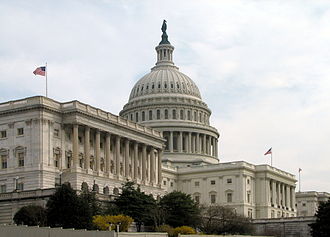
The United States Congress is the legislative branch of the federal government of the United States. It has two parts: the U.S. House of Representatives and the U.S. Senate. Together, they make laws for the country and meet in the United States Capitol in Washington, D.C..
There are 535 voting members in Congress: 100 senators and 435 representatives. Senators are elected for six-year terms, and representatives are elected for two-year terms. Elections for Congress happen every even-numbered year. Each state has two senators, no matter its size, and the number of representatives from each state depends on its population.
Members of Congress must be at least 25 years old to be in the House and 30 years old to be in the Senate. They must also be U.S. citizens for a certain number of years and live in the state they represent. Most members belong to one of the two major political parties, the Democratic Party or the Republican Party.
Overview
Article One of the United States Constitution says that making laws is the job of the United States Congress. Congress has two parts: a Senate and a House of Representatives. Both parts must agree before a new law can be made.
The Senate approves important agreements and people chosen for jobs by the president. The House can start bills about money.
The House can begin steps to remove a leader from office. Then the Senate decides if the leader should be removed. To remove someone, two-thirds of the Senate must agree.
The word “Congress” can also mean a specific meeting of these two groups. Each meeting, called a Congress, lasts two years. The current one, the 119th Congress, started on January 3, 2025, and will finish on January 3, 2027. Senators represent whole states, while representatives stand for specific areas called districts.
Congress changes over time. Recently, more people from the American South and West have joined, along with more women and minorities. Most members try to keep their jobs, and they often succeed.
History
Main article: History of the United States Congress
The First Continental Congress was a meeting of leaders from twelve of the Thirteen Colonies. On July 4, 1776, the Second Continental Congress approved the Declaration of Independence, naming the new country the "United States of America". The Articles of Confederation in 1781 set up the Congress of the Confederation. This Congress could not collect taxes or enforce laws.
A meeting in 1787 created a new plan for a Congress with two groups, called a bicameral Congress. The new plan, known as the Connecticut Compromise, gave each state two leaders called senators, and more leaders called representatives based on population.
The new government started in 1789. Over time, different groups and leaders gained power in Congress. In the early years, two big groups, Federalists and anti-federalists, competed for control.
The Civil War from 1861 to 1865 ended debates about slavery and made the national government stronger. Later, in the late 1800s, leaders from one group, the Republicans, often controlled Congress.
In the 1900s, leaders who had been in Congress longer gained more power. Senators were chosen by popular vote starting in 1913. Big changes happened during hard times like the Great Depression, when new government programs were created.
In more recent years, Congress has faced challenges, including disagreements.
Women in Congress
For many years, it was hard for women to join Congress. In the early 1900s, women were mostly expected to stay at home and couldn’t even vote. This made it nearly impossible for them to run for office.
Things started to change in the later 1900s. New groups formed to help women run for office. More people began to see how few women were in Congress. This led to more support and training for women candidates. Important events helped more women get elected.
Women of different racial backgrounds faced even bigger challenges. Before 1965, laws made it very difficult for women of color to run for Congress. But after laws changed, more women of color were able to join Congress. It took until 1993 for the first woman of color to become a Senator. More have followed since then.
In 2021, Kamala Harris made history as the first woman to serve as President of the Senate and Vice President of the United States.
Role
Powers
Main article: Powers of the United States Congress
Article One of the Constitution sets up Congress and gives it many important jobs. It helps make laws, control money, and watch over the government. Congress can collect taxes, borrow money, and decide how to spend it. It also has the power to declare war and create rules for the armed forces.
Congress can make post offices, issue patents, and create courts. It can also add new states to the country. One big job of Congress is to check on the other parts of the government to make sure they are doing their jobs right.
Checks and balances
Main article: U.S. Congress in relation to the president and Supreme Court
Congress works with the president and the courts to keep balance in the government. The Constitution gives each part some power to stop the others from doing too much. For example, Congress can approve or reject the president’s choices for important jobs. It can also start steps to remove a president or judge if they do something wrong. The courts can decide if laws made by Congress are allowed by the Constitution.
Congress also helps make sure the president follows the rules. It can hold meetings to ask questions and get information. This helps keep everyone honest and doing their best work.
Structure
Main article: Structure of the United States Congress
Congress is divided into two parts: the House and the Senate. They work together to make laws for the country. They also have special groups called committees. These committees look at different issues and suggest new laws.
Some important services help Congress. The Library of Congress has many books and information. There are also groups that help with research, budgeting, and checking government work. People called lobbyists share ideas with Congress about different topics.
Procedures
Main article: Procedures of the United States Congress
Sessions
A term of Congress has two "sessions", one for each year. Sometimes Congress meets in an extra or special session. A new session starts on January 3 each year unless Congress decides otherwise. The Constitution says Congress must meet at least once a year and that both houses cannot meet outside the Capitol without the other house's permission.
Joint sessions
Main article: Joint session of the United States Congress
Joint sessions of Congress happen on special occasions that need a resolution from both the House and Senate. These include counting electoral votes after a presidential election and the president's State of the Union address. This report is usually given as a speech each year, based on Britain's Speech from the Throne. It was mostly written by presidents after Jefferson but started being spoken by Wilson in 1913. Joint Sessions are usually led by the speaker of the House, except when counting electoral votes, when the vice president leads.[citation needed]
Bills and resolutions
See also: Act of Congress and List of United States federal legislation
Ideas for new laws can come from Congress members, lobbyists, state legislatures, people, legislative staff, or government agencies. Anyone can write a bill, but only Congress members can introduce it. Most bills are not written by Congress members but come from the President or interest groups. The next step is for the idea to go to a committee for review. Bills can be in different forms:
- Bills are laws waiting to happen. A bill from the House starts with "H.R." for "House of Representatives", followed by a number.
- Joint resolutions are similar to bills. A joint resolution from the House starts with "H.J.Res." followed by a number.
- Concurrent Resolutions only affect the House and Senate and do not go to the president. In the House, they start with "H.Con.Res."
- Simple resolutions only concern one house and start with "H.Res." or "S.Res."
Representatives introduce a bill by placing it in a special place called the hopper on the Clerk's desk. It gets a number and goes to a committee for study. Writing laws takes skill and can take a year or more. Sometimes, lobbyists write bills and give them to a member to introduce. Joint resolutions are used to suggest changes to the Constitution or to declare war. Concurrent and simple resolutions do not become law but show what Congress thinks or set rules for how Congress works. Bills can be introduced by any member of either house. The Constitution says that bills about money must start in the House of Representatives. The Senate cannot start these bills but can change or reject them. Congress tries to find the right level for spending.
Each house makes its own rules unless the Constitution or laws say otherwise. In the House, a Rules Committee helps guide bills; in the Senate, a Standing Rules committee does this. The Senate often uses "unanimous consent" for simple matters. Rules in both houses can be complicated, sometimes taking hundreds of steps before a bill becomes a law. Members sometimes ask experts about the right way to do things.
A bill goes through several steps in each house, including being looked at by a committee and getting advice from the Government Accountability Office. Most bills are handled by standing committees that focus on certain topics like Agriculture or Money. The House has twenty standing committees; the Senate has sixteen. These committees meet at least once a month. Most meetings are open to the public unless the committee decides to close it. A committee may have public hearings on important bills. Each committee has a chair from the majority party and a ranking member from the minority party. Experts can speak for or against a bill. Then, the committee may change the bill and vote to send it to the full house. If a bill is tabled, it is rejected. If changes are big, a new bill with the changes is made. Both houses can skip or override committees, but this is rare. Longer-serving members usually have more power.
When a bill reaches the full house, it starts with words like "Be it enacted by the Senate and House of Representatives of the United States of America in Congress assembled ..." Discussion needs a quorum, usually half the members, to start. The house can change the bill and then vote on it.
Once a bill is approved by one house, it goes to the other house, which can pass it, reject it, or change it. For the bill to become a law, both houses must agree on the exact same version. If the second house changes it, the differences must be worked out in a conference committee, a special group with senators and representatives. Both houses use a rule called pay-as-you-go or paygo to avoid increasing the budget deficit. If both houses agree on the version from the conference committee, the bill passes; otherwise, it fails.[citation needed]
The Constitution says that a majority of members (a quorum) must be present before each house can do business. Each house assumes a quorum is present unless a quorum call shows otherwise, and discussion often continues even without a majority.
Voting in Congress can be done in many ways, including using lights, bells, and electronic voting. Both houses usually use voice voting, where members shout "aye" or "no" and the leader says the result. The Constitution needs a recorded vote if one-fifth of the members ask for it or when overriding a presidential veto. If the voice vote is not clear or the issue is important, a recorded vote happens. The Senate uses roll-call voting, where a clerk calls each senator's name and they say "aye" or "no". In the Senate, the Vice President can break a tie. The House uses roll-call votes for very important matters because it takes a long time for all 435 representatives. Most votes in the House are done electronically, where members use a device to vote yea or nay or present or open. Members can change their votes in the last five minutes if they want; paper ballots are sometimes used (yea is green and nay is red). One member cannot vote for another. Congressional votes are recorded online.
After both houses pass a bill, it is enrolled and sent to the president. The president can sign it to make it law or veto it, sending it back to Congress with reasons. A vetoed bill can still become law if both houses vote to override the veto with a two-thirds majority. The president may also do nothing — not sign or veto the bill — and then it becomes law after ten days (not counting Sundays). But if Congress ends during this time, the president can veto the bill by doing nothing; this is called a pocket veto, and Congress cannot override it.[citation needed]
Public interaction
Main article: U.S. Congress and citizens
Members of Congress face elections often. Senators are elected every six years, and representatives every two years. This means they must often ask people for votes again. Some say this keeps them busy with travel and asking for money instead of focusing on their work. But others think it helps them stay connected to the people they represent.
Current members of Congress usually have an advantage when running for reelection. They often have more money for their campaigns because people believe they are more likely to win. They also have special rules that can help them stay in office. Some say this makes them too comfortable and out of touch with everyday people. Campaigns for Congress can be very expensive, especially for television ads. This means members spend a lot of time asking for money instead of working on laws. Some people worry that this makes them more interested in people who give a lot of money than in everyday citizens.
Public opinion of Congress has often been low. Many people feel that Congress does not do a good job. Some say that Congress is necessary for the country, but it can be hard to understand and sometimes seems messy. Others believe that despite its problems, Congress plays an important role in American democracy.
Congress works to help the people who live in their areas. They try to solve problems that people bring to them. This help can be important for members to get reelected. Some experts say that lawmakers are motivated by different things: wanting to be reelected, making good laws, or gaining power among their fellow lawmakers.
Privileges
Members of Congress have special rules to help them do their jobs. For example, they cannot be arrested for most reasons when they are at meetings or traveling to and from them. They can also speak freely during debates without worrying about being sued for what they say.
There have been talks about how much members of Congress are paid and whether some might use their jobs for personal benefit. Some have taken trips paid for by groups outside of Congress, and there have been questions about whether these trips are needed for their work. There are also rules about how their pay can be changed, making sure any changes don’t happen until after the next election.
Images
Related articles




This article is a child-friendly adaptation of the Wikipedia article on United States Congress, available under CC BY-SA 4.0.
Images from Wikimedia Commons. Tap any image to view credits and license.