 Safekipedia
United States Navy
Adapted from Wikipedia · Adventurer experience
The United States Navy (USN) is the maritime service branch of the United States Armed Forces. It is the navy of the United States.
The Navy has a long history, starting from the Continental Navy during the American Revolutionary War. It has helped protect the United States in many important times.
Today, the Navy is a powerful force that helps keep peace and security around the world. It operates in important areas such as the Western Pacific, the Mediterranean, and the Indian Ocean.
The Navy is part of the Department of the Navy, which also includes the United States Marine Corps. It has many ships, aircraft, and people ready to help when needed.
Mission
The United States Navy prepares, trains, and supplies its forces to protect the country and keep peace. Its main jobs are getting ready for war, caring for airplanes, and making new tools and plans for Navy fights.
The Navy also helps control the seas, show strength, keep the oceans safe, move supplies by sea, and support other military actions when needed.
History
Main article: History of the United States Navy
Origins
The United States Navy began with a tradition of seafaring. During the early days of the American Revolutionary War, Massachusetts had its own naval group. The idea of creating a national navy was discussed in the Continental Congress. Supporters believed a navy would protect shipping, defend the coast, and help gain support from other countries. Commander in Chief George Washington helped start the navy by commissioning the schooner USS Hannah. On October 13, 1775, Congress approved the purchase of two armed ships, creating the Continental Navy, which is considered the start of the U.S. Navy. After the Revolutionary War, the last ship of the Continental Navy was sold in 1785.
In 1972, the Navy began celebrating its birthday on October 13.
From re-establishment to the Civil War
The United States did not have a navy for almost ten years after the Revolutionary War. The U.S. Revenue-Marine, a predecessor of the U.S. Coast Guard, was the only armed sea force until the U.S. Navy’s first ships were launched in 1797. Congress passed the Naval Act of 1794, establishing a permanent navy and ordering the construction of six frigates. The first three were launched by 1797. John Adams is often called the father of the American Navy for his strong support of a standing navy.
The Navy fought in the Quasi-War with France and the First Barbary War, defending American ships.
The Navy saw action in the War of 1812, fighting with the British Royal Navy. After the war, the Navy focused on protecting American shipping. From 1819 until the Civil War, the Africa Squadron worked to stop the slave trade.
During the Mexican–American War, the Navy blockaded Mexican ports and helped capture cities. It also conducted the first large-scale amphibious operation in U.S. history.
Naval power was important during the American Civil War. The Union had a strong advantage at sea, and its blockade shut down many Confederate ports. The war saw the first combat between ironclad warships in 1862.
20th century
A modernization program in the 1880s led to the creation of steel-hulled warships, and the U.S. Navy gained respect after defeating the Spanish Navy in 1898. The Navy built many new ships, and in 1907, most of its battleships sailed around the world.
During World War I, the Navy protected soldiers and supplies crossing the Atlantic.
World War II
The U.S. Navy grew strongly in the years before World War II. Japan tried to weaken the Navy with a surprise attack on Pearl Harbor in 1941, but the U.S. entered the war and the Navy grew greatly. It played a key role in the Pacific Theater. The Navy fought in many important battles. By the end of the war in 1945, the U.S. Navy had hundreds of new ships and was the largest navy in the world.
Cold War and 1990s
See also: 1989 United States Navy order of battle and American naval ballistic systems
During the Cold War, the Navy focused on new technology and strategies. It took part in wars in Korea and Vietnam, helped block Cuba during the Cuban Missile Crisis, and used submarines as part of the nation’s nuclear defense. The Navy was involved in many operations in the Persian Gulf.
21st century
The U.S. Navy continues to support U.S. interests around the world. Since the end of the Cold War, it has focused on special operations and regional conflicts. The Navy has been part of operations like Operation Enduring Freedom and Operation Iraqi Freedom. It is modernizing with new ships and weapons. The Navy works to keep global trade safe and support allied nations.
In 2007, the Navy, Marine Corps, and Coast Guard adopted a new strategy focused on preventing conflicts. In 2010, leaders noted that the Navy’s demands have grown while its size has shrunk. The Navy’s 2016 plan calls for a future fleet of 350 ships. A 2018 law aims to grow the fleet to 355 ships.
Organization
Main article: Structure of the United States Navy
The U.S. Navy is part of the Department of the Navy. It is led by the Secretary of the Navy. The top officer is the Chief of Naval Operations, a four-star admiral. This admiral reports to the Secretary and is part of the Joint Chiefs of Staff. Together, they organize, train, and prepare the Navy for missions.
The Navy has ten main groups, including the United States Fleet Forces Command, United States Pacific Fleet, and the Navy Reserve. There are seven active numbered fleets, each led by senior officers. These fleets are grouped under larger commands.
On land, shore establishments support the Navy through facilities and services. These include training, cyber command, space command, and more, helping to keep the Navy ready.
Operating forces
Main article: List of units of the United States Navy
Further information: Structure of the United States Navy § Numbered fleets
The U.S. Navy has ten main groups that help it carry out its duties around the world.
- The United States Fleet Forces Command
- The United States Pacific Fleet
- The United States Naval Forces Central Command
- The United States Naval Forces Europe and Africa
- The United States Naval Forces Southern Command
- The Naval Network Warfare Command
- The Navy Reserve
- The United States Naval Special Warfare Command
- The Operational Test and Evaluation Force
- The Military Sealift Command
Fleet Forces Command manages special teams and information forces. The Navy has seven active numbered fleets, each led by senior officers. These fleets work under larger commands.
Shore establishments
Shore establishments support the Navy with land-based facilities and services. These include the Naval Education and Training Command, the U.S. Fleet Cyber Command, the Navy Space Command, and many others that help keep the Navy running smoothly.
Relationships with other service branches
United States Marine Corps
Main article: United States Marine Corps
The United States Marine Corps has been part of the Department of the Navy since 1834. The Navy and Marine Corps work closely together because they both focus on sea operations. The Marine Corps depends on the Navy for medical and religious support. Navy personnel often join Marine units on missions.
Marines often travel on Navy ships to carry out operations far from shore. While they have their own chain of command, they sometimes coordinate with Navy leaders. Some Marine pilots train and fly with Navy pilots.
United States Coast Guard
Main article: United States Coast Guard
The United States Coast Guard helps with law enforcement and rescue at sea. It can send teams to Navy ships to help with arrests and other duties. In times of war, the Coast Guard may operate under the Navy. Coast Guard units also help protect ports and coastal areas around the world.
Personnel
Main article: Personnel of the United States Navy
The United States Navy has more than 400,000 people. Some are ready reserves. Most active sailors are not officers. About fifteen percent are officers. Others are students learning to become officers at the United States Naval Academy.
Sailors start with basic training at boot camp. Then they train for their specific jobs. They show they have learned well by finishing tasks and tests called Personnel Qualification Standards. One important test is the "warfare qualification." This test shows they are good at their job, whether on ships, in airplanes, with information, or in special duties.
See also: Uniforms of the United States Navy
The uniforms of the U.S. Navy have changed over time since 1802. They are mostly navy blue and white, similar to uniforms from the Royal Navy.
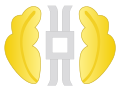
Navy officers can be line officers or staff corps officers. Line officers wear a gold star on their uniform. Staff officers wear special signs that show what they do.
Main article: Warrant officer (United States)
Warrant officers are experts who help run important parts of a ship. They come from sailors who have been in service for many years.
See also: List of United States Navy enlisted rates, Ranks and insignia of NATO navies enlisted, and List of United States Navy ratings
Sailors who are new are called apprentices. As they move up, they become Petty Officers, who help lead other sailors. The highest enlisted sailors can become Master Chief Petty Officers. Some may become Command Master Chief Petty Officers. These help the officer in charge of a ship or group.
See also: Badges of the United States Navy
The Navy gives special signs to sailors for things they have done well. These signs can be worn on uniforms. Some signs are for being a pilot, working on submarines, or serving on ships.





Bases
Main article: List of United States Navy installations
The United States Navy needs many places to support its work around the world. Most of these places are in the United States, but the Navy also has important spots in other countries.
Eastern United States
Many Navy places are in Hampton Roads, Virginia. This area has land for the Navy. It includes Naval Station Norfolk, where many ships stay, and other important centers for training and working.
Maryland has a place called NAS Patuxent River, where the Navy tests new airplanes. The United States Naval Academy is in Annapolis, Maryland. In Rhode Island, NS Newport has schools for future Navy officers.
Florida has several Navy bases, including NS Mayport in Jacksonville and NAS Pensacola, where many Navy pilots learn to fly. In Connecticut, Naval Submarine Base New London is a main place for submarines. NSB Kings Bay in Georgia is another important submarine base.
Western United States and Hawaii
The biggest Navy area in the Western United States is Naval Air Weapons Station China Lake in California, covering a large part of the land. Naval Base San Diego is where many Pacific Fleet ships are home. NAS North Island in Coronado, California, is important for helicopter squadrons and part of the West Coast aircraft carrier fleet.
In Washington state, NS Everett is a modern base. NAS Fallon in Nevada is where many Navy pilots train. Hawaii’s NS Pearl Harbor is the headquarters of the Pacific Fleet.
United States territories
Guam, an island in the Western Pacific, has a Navy base that can hold big ships. Puerto Rico once had a Navy base, but it closed in 2004.
Foreign countries
The Navy has a large base in Yokosuka, Japan, which is important for operations in the Western Pacific. In Europe, the Navy has bases in Italy, Spain, and Greece. In the Middle East, there are bases near the Persian Gulf, with NSA Bahrain serving as a key headquarters. NS Guantanamo Bay in Cuba is one of the oldest overseas bases.
Equipment
Main article: List of equipment of the United States Navy
The navy has many ships, aircraft, and vehicles. It also owns many buildings.
Ships
See also: List of equipment of the United States Navy, List of current ships of the United States Navy, List of currently active United States military watercraft, and United States ship naming conventions
Ships in the U.S. Navy start with "USS" for "United States Ship". Other ships start with "USNS", for "United States Naval Ship". Ships are named by the navy secretary, often after important people or places. Each ship has a special letter code to show its type and number. All ships are listed in the Naval Vessel Register. The navy also has a reserve fleet of ships that can be used when needed.
The U.S. Navy was one of the first to use nuclear reactors aboard naval vessels. Today, nuclear energy powers all active U.S. aircraft carriers and submarines.
The U.S. Navy has around 296 ships, but it needs more to meet its goals.
Aircraft carriers
Main article: List of aircraft carriers of the United States Navy
Aircraft carriers are big ships that serve as airbases for carrier-based aircraft. They are the largest ships in the Navy and are powered by nuclear energy. Aircraft carriers travel with other ships to protect them. These ships include cruisers, destroyers, a frigate, and submarines. Modern carriers are named after famous American leaders.
The Navy needs at least 11 aircraft carriers. All 11 are active now, with ten Nimitz-class and one Gerald R. Ford-class.
Amphibious warfare ships
Main article: List of United States Navy amphibious warfare ships
Amphibious assault ships are important for moving troops and vehicles from ships to land. They can carry a large group of Marines and their equipment. These ships can also operate helicopters and other aircraft. They are named after World War II aircraft carriers.
Amphibious transport docks carry Marines and supplies. They can also support helicopters and other aircraft. These ships are named after U.S. cities.
The dock landing ship helps with amphibious missions. It is named after important places in U.S. history.
The Navy has 32 amphibious warfare ships.
Cruisers
Main article: List of cruisers of the United States Navy
Cruisers are big warships that can fight in many ways, including against aircraft, missiles, and other ships. They can work alone or with a group of ships. The Ticonderoga-class is the only active class of cruiser. These ships are named after battles.
Destroyers
Main article: List of destroyers of the United States Navy
Destroyers are medium-sized ships that can fight in many ways. They protect larger ships and can also attack other ships. Destroyers are named after heroes from the U.S. Navy, Marine Corps, and Coast Guard.
The U.S. Navy has 75 destroyers.
Frigates and Littoral combat ships
Main articles: List of frigates of the United States Navy and Littoral combat ship
Modern U.S. frigates protect larger ships from submarines. They can also help with other missions. Frigates are named after U.S. heroes.
The U.S. Navy has 23 littoral combat ships.
Mine countermeasures ships
Main article: List of mine warfare vessels of the United States Navy
Mine countermeasures vessels find and remove naval mines. These ships are named after previous U.S. Navy ships.
The Navy operates eight Avenger-class mine countermeasures ships.
Submarines
Main article: Submarines in the United States Navy
The U.S. Navy has three types of submarines: attack submarines, ballistic missile submarines, and guided missile submarines. All are powered by nuclear energy.
Attack submarines often work with aircraft carriers. Guided missile submarines operate alone and carry many missiles. Ballistic missile submarines carry special missiles for very important missions.
The Navy operates 69 submarines.
Other
A special ship is the USS Constitution, one of the first U.S. Navy ships. It is still in service today.
The Navy also operates small tugboats called barrier boats.
Aircraft
Main article: List of active United States naval aircraft
See also: List of United States Navy aircraft squadrons and List of United States Navy aircraft designations (pre-1962)
Carrier-based aircraft can attack targets far from the ship and protect the ship from enemy forces. Aircraft also help with saving people, special operations, and finding enemy submarines.
The U.S. Navy started using aircraft in the 1910s. Aircraft carriers became very important during World War II. Today, the navy uses many different aircraft, including the F/A-18E/F Super Hornet.
Weapons
Main article: List of United States Navy weapons
The U.S. Navy uses many missiles for fighting. Missiles can attack targets far away and protect ships from enemy attacks. The navy also uses torpedoes and mines.
Naval aircraft use weapons similar to those used by the United States Air Force. These include missiles and bombs for fighting in the air and on the ground.
Helicopters mainly fight submarines and small boats. They use torpedoes and missiles for this work.
The navy also has nuclear weapons carried by submarines and aircraft.
Naval jack
The United States Navy uses a special flag called the Union Jack. It is a small blue flag with the stars of all 50 states. From 2002 to 2019, Navy ships flew a different flag called the First Navy Jack to honor the memory of the September 11, 2001 attacks. The Union Jack was used again starting on June 4, 2019, to remember a big naval battle from 1942. When a ship is tied up at a dock, the Union Jack is shown at the front, called the bow, while another flag called the ensign is shown at the back, called the stern. When the ship is moving, the ensign is raised on the tallest pole on the ship. Before 2019, only the oldest active Navy ship, the USS Blue Ridge, used the First Navy Jack.
Notable sailors
For a more comprehensive list, see List of United States Navy people.
Many important people in American history have served in the U.S. Navy. Some famous officers include John P. Jones, John Barry, James Lawrence, Stephen Decatur Jr., David Farragut, and George Dewey.
Several U.S. Presidents also served in the Navy, including John F. Kennedy, who commanded a boat during World War II. Other notable Navy veterans include astronauts, entertainers, authors, musicians, athletes, business leaders, and computer scientists.
Naval post offices
During World War I, the U.S. government set up the first post offices on Navy ships. These were run by a Navy postal clerk. Before this, mail from crew members was collected and dropped off at the nearest port, where it was processed at a US Post Office. Before email and the internet, handwritten mail was the main way Navy crew could talk to their families and friends while at sea. Mail was very important to the crew, almost as important as food and ammunition.
Letters and other mail sent by commanders, officers, and crew members often include names, ranks, signatures, addresses, and ship postmarks. This information can help naval historians and biographers learn about dates and locations of naval ships and crew during battles or operations. One famous example is mail sent from the USS Arizona before and on December 7, 1941.
Images
Related articles


This article is a child-friendly adaptation of the Wikipedia article on United States Navy, available under CC BY-SA 4.0.
Images from Wikimedia Commons. Tap any image to view credits and license.