 Safekipedia
Zulfikar Ali Bhutto
Adapted from Wikipedia · Adventurer experience
Zulfikar Ali Bhutto
Zulfikar Ali Bhutto (5 January 1928 – 4 April 1979) was a Pakistani politician. He served as the fourth president of Pakistan from 1971 to 1973 and later as the ninth prime minister of Pakistan from 1973 until his overthrow in 1977. He was the founder and first chairman of the Pakistan People's Party (PPP).
Bhutto was born in Sindh. He studied at the University of Southern California, University of California, Berkeley and the University of Oxford. He trained as a lawyer before entering politics. He became foreign minister in 1963 and founded the PPP in 1967. The PPP focused on left-wing and socialist ideas.
After a difficult time for Pakistan that led to the creation of Bangladesh, Bhutto became president in 1971. He worked to improve relations with other countries and supported the country's nuclear program. He also helped create Pakistan’s current constitution in 1973. Although he won elections in 1977, his government was taken over by the military.
Today, Bhutto is remembered as an important leader in Pakistan’s democratic history. His party remains influential. His daughter Benazir Bhutto later served as prime minister.
Early life and education
Zulfikar Ali Bhutto came from a Sindhi family. His family had a long history, starting with a Rajput prince from the Bhati clan who lived in a town called Tanot in what is now Rajasthan, India. His family later moved to Sindh and became Muslims.
Bhutto was born to Shah Nawaz Bhutto and Khursheed Begum near Larkana. His father was an important leader in the princely state of Junagadh during the time of the British Raj. His mother, originally named Lakhi Bai, came from a Hindu family and became Muslim when she married Shah Nawaz. Bhutto went to school in Bombay and later joined the movement to create Pakistan.
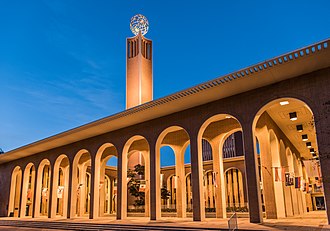
He studied political science at the University of Southern California and then went to the University of California, Berkeley, where he earned his degree. He later studied law at Christ Church, Oxford and became a lawyer. Bhutto also taught international law at the University of Southampton and was trained as a barrister at Lincoln's Inn.
Political career
In 1957, Bhutto became the youngest member of Pakistan’s team at the United Nations. He spoke about important issues there and later led Pakistan’s team at a big meeting about sea laws in 1958. That same year, he became a young minister in charge of trade and commerce.
Bhutto became Pakistan’s foreign minister in 1963. He believed strongly in being friendly with China, even when others did not. He helped make agreements between Pakistan and China for trade and defense. Bhutto also worked to make Pakistan more independent in its foreign policies, not just following the United States. He visited many countries to build relationships and support Pakistan’s place in the world.
Creation of the Pakistan People's Party
After leaving his job, Zulfikar Ali Bhutto spoke to many people in Lahore on June 21, 1967. He traveled around Pakistan, giving speeches and sharing his ideas. In October 1966, he described the beliefs of his new party: "Islam is our faith, democracy is our policy, socialism is our economy. All power to the people."
On November 30, 1967, Bhutto and some friends founded the Pakistan Peoples Party (PPP) in Lahore. The party grew quickly in Punjab, Sindh, and among the Muhajirs. Mubashir Hassan, a teacher, helped the party succeed. The PPP joined other groups working for democracy in Pakistan. They held big protests and strikes to push for change.
After General Yahya Khan took over, he promised elections. Under Bhutto’s leadership, many groups joined together. Bhutto’s party worked hard to get support from people in West Pakistan. But another party, the Awami League, won more votes. Bhutto did not agree with their plans.
When talks between Bhutto and the leader of the Awami League broke down, there was trouble. Bhutto criticized how the situation was handled and was arrested. Later, East Pakistan became independent as Bangladesh, and Bhutto became the new president of Pakistan. For the first time, leftists and democratic socialists had a chance to lead the country with support from many people.
Leader of Pakistan (1971–1977)
Presidency (1971-1973)
Zulfikar Ali Bhutto returned to Pakistan in December 1971 after talking with world leaders about problems in East Pakistan. He became president and led a country that felt alone and troubled. As president, Bhutto worked to bring the country together and made changes to improve Pakistan’s economy and education.
Bhutto focused on building up Pakistan’s nuclear program for the country’s safety. He also worked to improve relations with other countries, especially China and Arab nations. His government made big changes to the economy, including taking control of big industries and banks to help workers and reduce inequality.
Prime Minister (1973-1977)
In 1973, Bhutto became prime minister and kept working to improve Pakistan. He helped create a new constitution and made changes in education, land use, and labor laws. Bhutto also worked to strengthen Pakistan’s relations with other countries, especially China and the Arab world.
Bhutto’s time in office was marked by efforts to make Pakistan more independent and strong. He faced many challenges, including conflicts in Balochistan. Despite these difficulties, Bhutto remained committed to building a better future for Pakistan.
Downfall and overthrow
Popular unrest
Main article: Hyderabad tribunal
Further information: Federal Security Force
Zulfikar Ali Bhutto became less popular while he was in power. He first opposed leader Abdul Wali Khan and his National Awami Party, but tensions rose among many groups. The government acted against the NAP in Balochistan, leading to arrests and new leaders.
Many of Bhutto's supporters left him over time. Political fights grew worse, and there were claims of bad actions by the government. In early 1977, opposition groups joined together against Bhutto's government. Even though there were calls for new elections, fights over the results caused more trouble.
Military coup
See also: Operation Fair Play
In July 1977, talks failed and a military coup happened. General Zia-ul-Haq took control, declaring martial law and stopping the constitution. Bhutto was arrested, and many of his supporters were arrested too. He was released for a short time but arrested again and faced hard times in politics.
Trial and execution
General Muhammad Zia-ul-Haq took control of Pakistan in July 1977, removing Zulfikar Ali Bhutto from power. Bhutto was arrested and charged with a serious crime from 1974. Many thought the charges were unfair.
Bhutto had a quick trial that lasted several months. In March 1978, he was found guilty and given the worst punishment. Efforts to change this went on for months, but in February 1979, the highest court in Pakistan agreed. Sadly, Bhutto was executed in April 1979. While in jail, his family and leaders from around the world tried to save him.
Many years later, in 2024, Pakistan’s highest court said Bhutto did not have a fair trial.
Personal life
Zulfikar Ali Bhutto married Shireen Amir Begum in 1943, but they separated later. He then married Nusrat Ispahani, also called Begum Nusrat Bhutto, on September 8, 1951. She was from Iranian Kurdish origin and they lived in Karachi. They had four children: Benazir, born in 1953, Murtaza in 1954, Sanam in 1957, and Shahnawaz in 1958.
Reception and legacy
See also: Category:Cultural depictions of Zulfikar Ali Bhutto
Zulfikar Ali Bhutto is remembered as an important leader in Pakistan. Some people liked his strong support for the country, while others thought he was too hard on his opponents. He became leader in 1971, after a tough time for Pakistan. Some say his economic plans caused problems, but he thought he was making things fairer.
Bhutto believed in working with other countries. Many people in Pakistan have mixed feelings about him, but he is often seen as one of the country’s most liked leaders. He helped create Pakistan’s constitution in 1973 and worked on building nuclear weapons, earning him the title of the father of Pakistan’s nuclear program.
Even though people argue about his legacy, Bhutto is still respected in Pakistan. His family stayed involved in politics. Sadly, some of them faced tragic ends. Despite this, Bhutto remains an important symbol in Pakistan’s history. Today, his family continues in politics, with Bilawal Bhutto Zardari serving as the Foreign Minister of Pakistan from April 2022 to August 2023.
Honours
Zulfikar Ali Bhutto was honored by Pakistan after his death. In March 2025, he received the country's highest award, the Grand Cross with Collar of the Order of Pakistan.
Eponyms
Several places and schools remember Bhutto’s work:
- Shaheed Zulfiqar Ali Bhutto Institute of Science and Technology, in Karachi, Sindh.
- ZA Bhutto Agricultural College, in Larkana, Sindh.
- Zulfiqarabad, a city being built in Larkana District, named for Bhutto.
Books
Zulfikar Ali Bhutto wrote many books about politics and history. Some of his famous works include The Myth of Independence and The Third World: New Directions. He also shared his thoughts in speeches and articles, like in Marching Towards Democracy and Politics of the People. Other books such as My Pakistan and If I Am Assassinated talk about his views on Pakistan and his own experiences.
Images
Related articles


This article is a child-friendly adaptation of the Wikipedia article on Zulfikar Ali Bhutto, available under CC BY-SA 4.0.
Images from Wikimedia Commons. Tap any image to view credits and license.