 Safekipedia
Adolf Hitler
Adapted from Wikipedia · Discoverer experience
Adolf Hitler was an Austrian-born German politician who became the dictator of Germany from 1933 until his death in 1945. He was the leader of the Nazi Party and became the chancellor of Germany in 1933. Under his leadership, Germany invaded Poland in 1939, which started the Second World War.
Hitler was born in Braunau am Inn in Austria-Hungary and later moved to Germany. He served in the German Army during the First World War and joined the German Workers' Party in 1919, which later became the Nazi Party. In 1923, he tried to take power in a failed coup in Munich but was imprisoned for a short time. During this time, he wrote his book Mein Kampf.
After becoming chancellor, Hitler turned Germany into a totalitarian dictatorship. He implemented racist policies and sought to expand German territory into Eastern Europe. His aggressive actions led to World War II, which caused millions of deaths. In 1945, as Allied forces closed in, Hitler married his partner Eva Braun and then died to avoid capture.
Ancestry
See also: Hitler family
Adolf Hitler's father was Aloys Hitler. Alois was born to Maria Schicklgruber, but his father was not known at first. Later, Johann Georg Hiedler married Alois’s mother and was listed as his father. Alois worked for the government for many years and later changed his last name to "Hitler."
Some people claimed Alois might have had a different father, but there was no proof of this. In fact, later tests showed that Adolf Hitler did not have any Jewish ancestors through his father’s side.
Early life
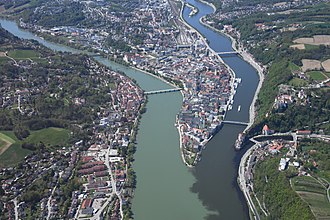
Adolf Hitler was born on 20 April 1889 in Braunau am Inn, a town in Austria-Hungary (present-day Austria), close to the border with Germany. He was one of six children in his family. His family later moved to Passau, Germany, and then to Linz, Austria. Hitler spoke with a distinct lower Bavarian dialect.
As a child, Hitler often clashed with his father, who wanted him to follow a traditional career path. Hitler preferred to pursue his artistic interests instead. After his father passed away, Hitler was allowed to leave school and moved to Vienna to study art.
In 1907, Hitler moved to Vienna to study art. He applied to the Academy of Fine Arts but was not accepted. After his mother passed away, Hitler lived on his own, working odd jobs and selling paintings. He developed a strong interest in architecture and music during this time.
When World War I began in 1914, Hitler volunteered to join the Bavarian Army. He served as a messenger on the Western Front and was awarded for his bravery. Hitler was wounded during the war but recovered and continued to serve. After the war ended, he was deeply disappointed by Germany’s defeat and began to form strong nationalistic views.
Entry into politics
Main article: Political views of Adolf Hitler
After the war, Hitler returned to Munich. He stayed in the army but had no clear career path. In 1919, he began working for an army unit that watched over other soldiers. During this time, he joined a small group called the German Workers' Party. He quickly became a well-known speaker for the group.
Hitler started making speeches about his strong beliefs. He joined the party officially and soon became a key member. The group later changed its name to the National Socialist German Workers' Party, which people called the Nazi Party. Hitler designed their flag, which had a special symbol on it.
Hitler left the army in 1920 and worked full-time for the Nazi Party. The party's main office was in Munich, where many people felt unhappy with the government at the time.
Beer Hall Putsch and Landsberg Prison
Main article: Beer Hall Putsch
In 1923, Hitler tried to take control of the government in a event known as the Beer Hall Putsch. He and his supporters took over a big meeting in Munich but were stopped by the police. The attempt failed, and Hitler was arrested.
He was put on trial and sent to prison for a short time. While in prison, he wrote a book called Mein Kampf. After he left prison, he worked to rebuild the Nazi Party. The party had been banned, but Hitler promised to work within the law.
The economy in Germany got very bad after the stock market crashed in the United States in 1929. Many people lost their jobs, and Hitler used this situation to gain more supporters for the Nazi Party. He promised to help improve the economy and support workers.
Rise to power
The Great Depression created chances for Hitler to gain support. Many Germans were unsure about their government, which faced challenges from both right- and left-wing groups. Moderate parties struggled to handle these problems. In 1930, Hitler's Nazi Party grew from a small group to win nearly 18% of the vote, becoming one of the largest parties in Germany.
Hitler appeared in court when two military officers were charged with supporting the Nazi Party, which was not allowed at the time. Hitler promised to seek power only through elections, which helped him gain support among military leaders.
Hitler ran against the current leader, Hindenburg, in 1932 but lost. However, he gained many votes and became a major figure in German politics.
In 1933, after elections did not produce a clear winner, President Hindenburg appointed Hitler as chancellor. On January 30, 1933, Hitler became the leader of Germany. Soon after, a fire damaged the German parliament building. Hitler used this event to convince Hindenburg to give him special powers, which he used to arrest people who opposed him.
Hitler and his supporters worked hard to gain full control. They passed a law, called the Enabling Act, which let Hitler’s government create laws without approval from parliament. This helped Hitler turn Germany into a dictatorship where he had almost complete power.
Hitler continued to strengthen his control. He banned other political parties and took over worker organizations. By 1934, Hitler had eliminated nearly all opposition and became the sole leader of Germany, taking the title of Führer. He also became the commander of the military, changing soldiers’ oaths to promise loyalty directly to him.
| Election | Total votes | % votes | Reichstag seats |
|---|---|---|---|
| May 1924 | 1,918,300 | 6.5 | 32 |
| December 1924 | 907,300 | 3.0 | 14 |
| May 1928 | 810,100 | 2.6 | 12 |
| September 1930 | 6,409,600 | 18.3 | 107 |
| July 1932 | 13,745,000 | 37.3 | 230 |
| November 1932 | 11,737,000 | 33.1 | 196 |
| March 1933 | 17,277,180 | 43.9 | 288 |
Nazi Germany
Main article: Nazi Germany
Economy and culture
Main article: Economy of Nazi Germany
Adolf Hitler worked hard to improve Germany’s economy. He helped create jobs, and many big building projects were started, like roads and dams, to give people work. Even though people had to work longer hours, many felt better because there was less unemployment.
Hitler’s government also supported big building plans and even hosted the Olympic Games in 1936. He attended both the Winter and Summer Games, showing support for sports.
Rearmament and new alliances
Main articles: Axis powers, Tripartite Pact, and German re-armament
Hitler wanted Germany to become strong again and made many plans to build up the military. He pulled Germany out of international groups that limited its power and started building a bigger army and navy. He made agreements with other countries like Italy but also prepared for possible wars. His goals included taking land from other places to give Germans more space to live.
World War II
Early diplomatic successes
In February 1938, Hitler ended a partnership with China to form an alliance with Japan. This change meant Germany recognized a new state created by Japan and gave up claims to old territories in the Pacific.
Hitler also united Austria with Germany on March 12, 1938. He then focused on a part of Czechoslovakia called the Sudetenland, where many German-speaking people lived. He made demands that led to tension and prepared Germany for possible war.
Start of World War II
Hitler saw Poland as a key target to weaken Britain and gain more land. After Poland refused to agree to Germany’s demands, Hitler invaded on September 1, 1939. This action led Britain and France to declare war on Germany, starting World War II.
The early part of the war saw Germany invading several countries quickly, including Denmark, Norway, France, the Netherlands, Belgium, and Luxembourg. Germany also began bombing British cities. Later, Germany formed alliances with Italy and Japan, creating the Axis powers.
Path to defeat
In June 1941, Germany broke its agreement with the Soviet Union and invaded, aiming to conquer large areas. Despite early successes, the Soviet Union pushed back. Germany also faced difficulties in North Africa and after losing key battles such as Stalingrad and Kursk, its position weakened.
As the war continued, Allied forces from many countries pushed back against Germany. By 1944, battles were happening across Europe, and many German leaders began to realize defeat was coming.
Defeat and death
By early 1945, Soviet and Allied forces were closing in on Germany. Hitler remained in his bunker in Berlin as the city was attacked. On April 30, 1945, Hitler passed away along with his wife, Eva Braun, in the bunker. Germany officially surrendered shortly after.
The Holocaust
Main articles: The Holocaust and Final Solution
The Holocaust was a terrible time when Adolf Hitler and his followers believed that some groups of people were their enemies. Hitler wanted to take over land in Eastern Europe and thought some groups, like Jewish people and others, should be removed. Many terrible things happened during this time, organized by leaders under Hitler.
Hitler never talked about these actions in public and did not visit the places where people were hurt. His ideas about race led to unfair laws and many people being treated very badly. Many innocent people suffered and died because of these beliefs and actions.
Leadership style
Hitler led the Nazi Party in a very strict way, insisting that everyone follow his orders exactly. He believed he was the only true leader and expected complete loyalty from everyone below him. He often gave confusing orders and placed people in jobs where they had to work closely with others, creating competition and distrust. This helped him stay in full control.
During World War II, Hitler took charge of Germany's military decisions more than any other leader. He made big choices about where to attack, sometimes against his generals' advice. Later in the war, he directed battles himself, especially against the Soviet Union. Even as things got harder for Germany, he kept making decisions and refused to give up, believing only his leadership could bring victory.
Personal life
Family
Main article: Hitler family
Hitler made himself seem like a man who was completely focused on his work and his country, without any personal life. He had a private relationship with a woman named Eva Braun starting in 1929, and they married just before the end of his life. Sadly, his half-niece, Geli Raubal, died in his apartment in 1931. Hitler’s sister, Paula, was the last member of his family to live, passing away in 1960.
Views on religion
Main article: Religious views of Adolf Hitler
Hitler grew up with a mother who practiced Catholic religion and a father who did not like churches. As he grew older, Hitler stopped going to church and did not follow religious practices. He did not believe in God and did not like Christian teachings, thinking they were weak. He had mixed feelings about churches, sometimes seeing them as helpful for controlling people, but he did not agree with many Christian ideas.
Health
See also: Health of Adolf Hitler and Psychopathography of Adolf Hitler
Historians and doctors have thought that Hitler had many health problems, like stomach pain, shaking hands, and heart issues. He stopped eating meat and stopped drinking alcohol, choosing instead to eat mostly vegetables and fruits. He also used many different medicines, which some think affected his behaviour. Doctors who saw him near the end of his life believed he may have had a disease that caused shaking and movement problems.
Legacy
Further information: Historiography of Adolf Hitler, Consequences of Nazism, and Neo-Nazism
Adolf Hitler led Germany during a very difficult time. His actions started World War II, which caused great suffering and loss of life for many people. Many historians think his ideas and actions caused terrible harm and are remembered as very bad for the world.
Hitler used films to share his messages and gain support from people. Some of his most famous films were made by a filmmaker named Leni Riefenstahl. These films include Der Sieg des Glaubens, Triumph des Willens, Tag der Freiheit: Unsere Wehrmacht, and Olympia.
Images
Related articles




This article is a child-friendly adaptation of the Wikipedia article on Adolf Hitler, available under CC BY-SA 4.0.
Images from Wikimedia Commons. Tap any image to view credits and license.