 Safekipedia
Alborz
Adapted from Wikipedia · Discoverer experience
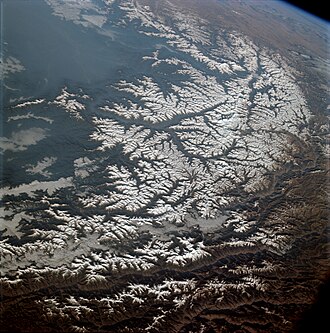
The Alborz (Persian: البرز) is a grand mountain range in northern Iran. It stretches from the border of Azerbaijan along the western and southern coast of the Caspian Sea, then runs northeast and joins the smaller Aladagh Mountains. These mountains are all part of a much larger system called the Alpide belt.
The Alborz range is split into three parts: the Western, Central, and Eastern Alborz Mountains. The Western Alborz, often called the Talysh, runs close to the western coast of the Caspian Sea. The Central Alborz runs along the entire southern coast of the Caspian Sea, and the Eastern Alborz heads northeast toward the northern parts of Khorasan.
One of the most famous peaks in the Central Alborz is Mount Damavand, the highest mountain in Iran, standing at 5,610 meters (18,405 feet). It is also the 12th most prominent peak in the world and the second most prominent in Asia after Mount Everest. The Alborz mountains are important for their natural beauty, rich wildlife, and as a place where people enjoy hiking and exploring.
Etymology
The name Alborz comes from Harā Barazaitī, a famous mountain in the Avesta, which is the main book of Zoroastrianism. The word Harā Barazaitī has ancient roots and means "Mountain Rampart". Over time, this name changed and became Alborz in modern Persian. This name is related to Elbrus, the tallest mountain in the Caucasus.
Mythology
Zoroastrians believe the Alborz mountains are connected to the home of Peshyotan. A Zoroastrian group called Ilm-e-Kshnoom thinks Mount Damavand is where special leaders lived. The famous poet Ferdowsi wrote about these mountains in his epic Shahnameh, comparing them to mountains in India. This idea might come from older times when many tall peaks had similar names. Some of these names are still used today, like Mount Elbrus in the Caucasus Mountains and Mount Elbariz in the Kerman area near the Strait of Hormuz. All these names come from the same old Iranian language and have sometimes been linked to a legendary mountain called Hara Berezaiti mentioned in the Avesta.
Geology
The Alborz mountain range acts as a barrier between the area south of the Caspian Sea and the Iranian plateau. It is narrow, only 60 to 130 kilometers wide, and made up of layers of rock from different times, mostly from the Devonian to the Oligocene periods. These layers include limestone sitting on top of a granite core.
The mountains formed when big pieces of the Earth’s crust, called plates, moved and crashed into each other. This pushing and folding of rocks created the Alborz Mountains mainly during the Miocene period. The area includes different types of rocks such as sandstones, shales, and volcanic tuffs, showing both land and sea conditions from long ago.
Ecoregions, flora and fauna
The Alborz Mountains have very different plants and animals on their northern and southern sides. The southern slopes are dry with few trees, while the northern slopes are wet and full of forests.
In the lower areas of the north, you can find tall forests. Middle heights have beech trees, and higher areas have oak trees. Some valleys have wild cypress, and near the Sefidrud River, there are olive trees. The mountains are home to many animals, including foxes, deer, wild boar, bears, leopards, wolves, and birds like buzzards, geese, woodpeckers, griffon vultures, and eagles. The Caspian tiger used to live here but is no longer found.
Prehistory
Archaeological evidence from the Alborz mountains shows that early human groups lived in the area a very long time ago, during the late Lower Paleolithic period. The Darband Cave in Gilan Province has remains of bears and some stone tools, but these mostly show that bears used the cave naturally.
Later, during the Middle Paleolithic period, Neanderthals likely lived in the region, as their fossils and tools have been found in nearby caves. Evidence of modern humans appears around 30,000 years ago at a site called Garm Roud in Mazandaran Province.
Ski resorts
Because the Alborz Mountains have snowy winters, there are many ski resorts spread across the range. Some people who love skiing think these resorts are some of the best in the world.
Mounts, summits, alpine lakes and attractions
The Alborz mountains have many tall peaks and beautiful places to visit. Some of the highest peaks in the Alborz include:
- Mount Damavand Amol Mazandaran
- Tochal mount and summit
- Tangeh Savashi, a popular attraction
- Alam Kuh, a mountain in Alborz mountain range
- Alamut
- Dizin
- Ovan lake
| Name | Height (m) | Prominence (m) | |
|---|---|---|---|
| 1 | Damavand | 5610 | 4661 |
| 2 | Alam-Kuh | 4850 | 1848 |
| 3 | Kalahoo | 4412 | 345 |
| 4 | Azad Kuh | 4398 | 980 |
| 5 | Kholeno | 4375 | 746 |
| 6 | Do Khaharan | 4310 | 644 |
| 7 | Avidar | 4286 | 503 |
| 8 | Great Nazer | 4260 | 510 |
| 9 | Kaman-Kuh | 4234 | 533 |
| 10 | Zarrin-Kuh | 4198 | 451 |
| 11 | Sarakchal | 4194 | 317 |
| 12 | Sialan | 4160 | 1160 |
| 13 | Kolunbastak | 4156 | 359 |
| 14 | Shah Alborz | 4125 | 931 |
| 15 | Naz | 4108 | 1018 |
| 16 | Do Berar | 4082 | 1352 |
| 17 | Kahoun | 4075 | 342 |
| 18 | Varavašt | 4025 | 852 |
| 19 | Korma-Kuh | 4020 | 359 |
| 20 | Parchenan | 4015 | 1144 |
| 21 | Saat | 4003 | 428 |
| Name | Height (m) | Prominence (m) | |
|---|---|---|---|
| 1 | Mishineh Marg | 3990 | 562 |
| 2 | Tochal | 3964 | 1164 |
| 3 | Karkas Neshin | 3950 | 537 |
| 4 | Khashechal | 3945 | 645 |
| 5 | Vantar | 3944 | 544 |
| South Kharsang | 3940 | 293 | |
| 6 | Sechal | 3936 | 436 |
| 7 | Sineza | 3933 | 336 |
| 8 | Shahvar | 3932 | 1923 |
| 9 | Mehrchal | 3912 | 759 |
| 10 | Keyoonchal | 3910 | 390 |
| 11 | Pashooreh | 3896 | 814 |
| 12 | Small Nazer | 3881 | 444 |
| 13 | Gavingchal | 3880 | 344 |
| 14 | Deev Asiab (Alarm) | 3880 | 421 |
| 15 | Zarrin-Kuh | 3850 | 858 |
| Kushgak (Sorkhak) | 3843 | 299 | |
| 16 | Gavkoshan | 3840 | 1160 |
| 17 | Khozanak | 3840 | 402 |
| 18 | Asemankuh | 3819 | 499 |
| 19 | Lake Tar | 3200 | 500 |
Images
Related articles



This article is a child-friendly adaptation of the Wikipedia article on Alborz, available under CC BY-SA 4.0.
Images from Wikimedia Commons. Tap any image to view credits and license.