 Safekipedia
Archaeology
Adapted from Wikipedia · Discoverer experience
Archaeology is the study of human activity by looking at things people made and used long ago. Archaeologists examine old objects, buildings, places, and even natural materials to learn about the past. They use these clues to understand how people lived, what they believed, and how their lives changed over time.
This field is important because it helps us learn about times when people did not write things down. Most of human history happened before writing existed, and archaeology gives us a way to explore those ancient days. Archaeologists study everything from the very first stone tools made in East Africa over three million years ago to more recent history.
Archaeology began in Europe in the 1800s and has grown into a worldwide activity. Different kinds of archaeology have developed, like studying shipwrecks or looking at how ancient people understood the stars. Even today, archaeologists face challenges, such as protecting important discoveries from being taken and helping people understand why the past matters.
History
Main article: History of archaeology
First instances of archaeology
In ancient times, people began studying the past through what they found. King Nabonidus, who lived around 550 BC, is considered one of the earliest examples. He looked for and studied old items left behind by earlier rulers, such as Naram-Sin of Akkad, who ruled around 2200 BC. Nabonidus tried to figure out when these items were made, even though he was not always exact.
Antiquarians
The study of old things grew from a broader interest called antiquarianism. Antiquarians looked at old objects, writings, and places to learn about history. They believed in studying facts instead of just theories. This way of thinking became more organized during the Enlightenment in Europe in the 1600s and 1700s.
In China, during the Song dynasty (960–1279), scholars like Ouyang Xiu and Zhao Mingcheng studied and preserved old writings carved on bronze from earlier times. In Europe, during the Renaissance, people became very interested in learning about ancient Greek and Roman cultures.
First excavations
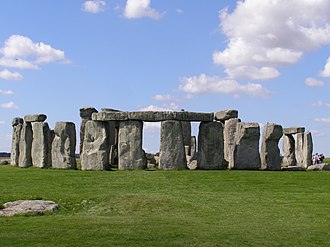
Some of the first places to be dug up by scientists were Stonehenge and other big stone structures in England. John Aubrey was one of the first to carefully record these sites in the 1600s. Later, in the 1700s, people began digging in the ancient cities of Pompeii and Herculaneum, which were covered by ash from a volcano. Finding whole towns, along with everyday items and even shapes left by people, amazed many in Europe.
Development of archaeological method
In the 1800s, William Cunnington began careful digging in England, recording what he found. Future President Thomas Jefferson also dug up old mounds built by Native Americans in Virginia, trying to understand who made them.
One big step was learning to use layers of soil to tell the order of old things. This idea came from studying rocks and fossils. Scientists like Augustus Pitt Rivers and William Flinders Petrie helped make archaeology more scientific. They carefully recorded every item and organized them by type and time.
Famous digs, like at the site believed to be ancient Troy, showed how many cities had been built on the same spot over time. As archaeology grew, it became a profession people could study in schools. New kinds of archaeology, like studying ships and cities, also developed.
Purpose
The purpose of archaeology is to learn more about past societies and the development of humans. Most of human history happened before people could write, so we have no written records to study. This means archaeology is our main way to understand these early times. Archaeology studies things like old tools, buildings, and other objects to learn about how people lived long ago.
Archaeology helps us understand important events in human history, such as how people first learned to use fire, make tools, and grow crops. It also helps us learn about ancient societies that had writing, like Ancient Greece and Mesopotamia, by studying objects they left behind. These objects can tell us about everyday life, even for people who were not rich or powerful, which written records often do not include.
Theory
Main article: Archaeological theory
Over time, different ideas about how to study archaeology have developed. In the past, many archaeologists focused on describing how cultures changed over time. Later, some archaeologists wanted to use scientific methods to test ideas and understand why changes happened. More recently, other archaeologists have emphasized being more self-aware and critical in their studies. Today, archaeology draws on many different ideas and theories to better understand the past.
Methods
An archaeological investigation usually has several steps. First, a clear goal is set for what the archaeologists want to find. Then, a site is surveyed to learn more about it and its area. Next, an excavation might be done to uncover hidden features. Finally, the information gathered is studied to meet the original research goals. It is good practice to share this information so other archaeologists and historians can learn from it.
Remote sensing
Before starting to dig, remote sensing can help find where sites are located in a large area. There are two types of remote sensing tools—passive and active. Passive tools detect natural energy reflected or given off by an object. Active tools send out energy and record the reflections. Satellite imagery is an example of passive remote sensing. Here are three active remote sensing tools:
-
Lidar: Lidar uses a laser to send out a light pulse and measures the reflected light to determine distances. Lidars can also study atmospheric conditions.
-
Laser altimeter: This tool uses lidar to measure the height of the instrument above the surface, helping to determine the landscape below.
- Drones: Archaeologists use drones to speed up surveys and protect sites. In Peru, drones helped create three-dimensional models of sites much faster than traditional methods. Drones have been used to map sites like the Greek city of Aphrodisias.
Field survey
Main article: Archaeological survey
The next step is a field survey, which can help locate unknown sites in a region or find features like houses within a site. Surveys were not common in early archaeology, but they became important later. Surveys save time and money because they do not require digging up large amounts of soil. They also avoid ethical issues related to destroying a site. Surveys can gather information about settlement patterns and create maps showing surface features and artifact distributions.
The simplest survey is a surface survey, where researchers walk over an area to look for visible features or artifacts. This cannot find buried sites. Surface surveys may also use small digs like augers or shovel test pits. If nothing is found, the area is considered sterile.
Aerial survey uses cameras on airplanes, balloons, UAVs, or Kites to get a bird’s-eye view of large or complex sites. Aerial photos can show changes in plant growth that hint at buried structures. Different lighting times can also reveal hidden outlines. Aerial surveys use various tools like ultraviolet, infrared, ground-penetrating radar, Lidar, and thermography.
Geophysical survey can see beneath the ground using tools like magnetometers that detect changes in the Earth's magnetic field caused by iron objects or stone structures. Other tools measure the electrical resistivity of soil to find archaeological features.
Although some think using metal detectors is like treasure hunting, others find them useful in archaeology. They have been used to study battlefields, ship wrecks, and locate cables. In the UK, metal detector users help archaeology by recording their findings.
Regional survey in underwater archaeology uses tools like a marine magnetometer, side-scan sonar, or sub-bottom sonar.
Excavation
Main article: Archaeological excavation
Archaeological excavation has been a main source of data even in the early days of the field. It can reveal information not accessible through surveys, like layers of occupation and three-dimensional structures.
Modern excavation requires recording the exact locations of objects and features, known as their provenance. This includes their horizontal and sometimes vertical positions, as well as their association with nearby objects and features. This helps archaeologists understand which items were used together and from different time periods. For example, excavation shows layers of occupation, with newer artifacts above older ones.
Excavation is expensive and destructive, so only a small part of a site is usually dug up. Sampling is important here. Large machines like backhoes may be used to remove top soil, but this is done carefully. The area is then cleaned by hand to make sure all features are visible.
The next step is to create a site plan to decide how to excavate. Features dug into the natural soil are excavated in sections to record their shape. Each feature, like a pit or ditch, has a cut (the edge where it meets the soil) and a fill (what it is filled with). These are numbered for records. Plans, photos, and recording sheets are made to document everything.
Analysis
Main article: Post-excavation analysis
After artifacts and structures are excavated or collected, they need to be studied. This is called post-excavation analysis and is often the most time-consuming part. Artifacts are cleaned, catalogued, and compared to other collections. They can also be dated and their materials examined using scientific methods.
Bones, plants, and pollen from a site can be studied using zooarchaeology, paleoethnobotany, palynology, and stable isotopes. Any texts found can usually be deciphered.
These methods often reveal new information that helps us understand the site better.
Subfields
Main article: Subfields of archaeology
Archaeology has many different areas of study. These can focus on special ways of studying old objects, places in certain parts of the world or from certain times, or even types of activities like studying old battles or underwater ruins. Some areas focus on particular cultures or civilizations, like the study of ancient Egypt or China.
Historical archaeology
Main article: Historical archaeology
Historical archaeology looks at cultures that had writing. It studies objects and questions from the past. Archaeologists have studied old burial places in Europe and remains from old cities in New York.
Ethnoarchaeology
Main article: Ethnoarchaeology
Ethnoarchaeology studies how people live today to help us understand ancient people. This way of studying became important in the 1960s and is still used today. It looks at many kinds of human behavior, not just hunter-gatherer societies.
Experimental archaeology
Main article: Experimental archaeology
Experimental archaeology uses experiments to learn more about how things happened in the past. This helps make archaeological studies more scientific. Experiments are important for understanding old processes better.
Archaeometry
Main article: Archaeological science
Archaeometry is about measuring things in archaeology. It uses science and engineering to study old objects. This can include looking at the chemical makeup of old items or using computer tools to study old places.
Digital archaeology
Main article: Digital archeology
See also: Computational archaeology and Virtual archaeology
Digital archaeology uses computers and technology to study old places and things. This can include making 3D models of ancient sites or using computers to understand how people lived long ago.
Cultural resources management
Main article: Cultural resource management
Archaeology is often part of managing cultural resources. This means looking after important historical places, especially when new buildings or roads might affect them. In the US, laws help protect these places. In the UK, similar rules make sure archaeologists check areas before building starts. This work helps save important history from being lost when new projects are built.
Protection
The protection of important old objects for everyone is becoming more common around the world. This is done through international agreements and groups that watch over and help protect these places. The United Nations, UNESCO, and Blue Shield International work to protect cultural places, including old sites important to history. Their work includes helping during difficult times in places like Libya, Syria, Egypt, and Lebanon.
These old places are important for people's sense of belonging, for tourism, and for helping communities grow in a healthy way. During a mission in Lebanon in 2019, the leader of Blue Shield International explained that when culture is destroyed, it takes away people's sense of who they are. This can make life harder for many, and sometimes people have to leave their homes.
Popular views of archaeology
Early archaeology focused on finding amazing artifacts and exploring mysterious, abandoned cities. It was mostly done by wealthy, educated men, which shaped how many people see archaeology today. Many still think of archaeologists as adventure seekers, more like hobbyists than serious scientists. Movies and stories often show archaeologists working in faraway lands, searching for priceless treasures, which isn’t the full picture.
In reality, archaeologists do important work all over the world, not just in exciting places like Copán and the Valley of the Kings. Much of their time is spent on careful surveys, excavations, and analyzing data, which doesn’t always make for exciting stories. Because of these misunderstandings, some call these inaccurate portrayals "pseudoarchaeology." Archaeologists depend on support from the public, and they often discuss who their work is really for.
Current issues and controversy
Public archaeology
Archaeologists work to protect important places from being damaged or lost. They teach people why these places matter and help everyone understand the past better. They share their discoveries through schools, videos, and websites so more people can learn.
Archaeologists know that many people are interested in learning about history. They work with communities, schools, and even volunteers to help everyone take part in discovering the past. For example, some programs let people help with real excavations under the guidance of experts.
Pseudoarchaeology
Some people create stories that sound like archaeology but are not based on real evidence or science. These ideas often ignore facts and use theories that cannot be proven. One famous example is the idea that ancient astronauts visited Earth long ago, which is not supported by real archaeological research.
Looting
Looting hurts our chances to learn about the past. When people take artifacts from archaeological sites without care, they damage the sites and destroy important information. This is especially hard for communities who lose touch with their history. Laws and efforts are in place to stop looting and protect these valuable sites.
Descendant peoples
Working with communities whose ancestors lived at archaeological sites is very important. Sometimes, these communities have special feelings about certain places, like burial grounds, that archaeologists need to respect. Laws like the Native American Graves Protection and Repatriation Act help ensure that these communities have a say in what happens to their ancestors' remains and artifacts.
African diaspora archaeology
Studying the history of people who were forced away from their homes during the slave trades is a special part of archaeology. This work helps us understand the experiences of these communities and their descendants. It also highlights the need to include these communities in decisions about their history and heritage.
Climate change and archaeology
Climate change can affect archaeological sites in many ways, such as changing weather patterns or melting ice. These changes can damage sites or even create new discoveries, like artifacts hidden in ice for centuries. Archaeologists help society understand and prepare for these changes.
AI in archaeology
New technology, like artificial intelligence, is being used to help archaeologists. For example, AI can help find hidden sites or translate old texts. However, it’s important to use these tools carefully to avoid oversimplifying complex information or repeating old, incorrect ideas.
Images
Related articles




This article is a child-friendly adaptation of the Wikipedia article on Archaeology, available under CC BY-SA 4.0.
Images from Wikimedia Commons. Tap any image to view credits and license.