 Safekipedia
Babylon
Adapted from Wikipedia · Discoverer experience
Babylon was an ancient city located on the lower Euphrates river in southern Mesopotamia, within modern-day Hillah, Iraq, about 85 kilometres (53 miles) south of modern-day Baghdad. It was the main cultural and political centre of the Akkadian-speaking region of Babylonia. Babylon played an important role in history, being home to two major empires: the Old Babylonian Empire from the 19th to 16th century BC, and the Neo-Babylonian Empire from the 7th to 6th century BC. At its height, Babylon was one of the largest and most important cities in the ancient world.
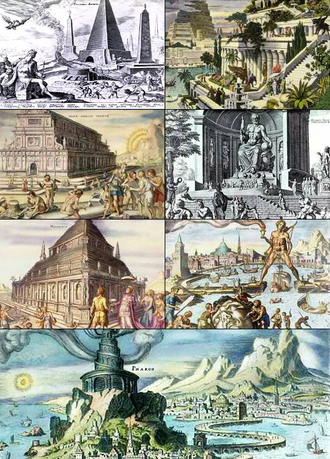
The city began as a small town and grew under the rule of Hammurabi, who made it a major centre. Babylon was known for its grand structures, like the famous Walls of Babylon, one of the Seven Wonders of the Ancient World. Over time, the city was ruled by many empires, including the Achaemenid Empire. Today, the ruins of Babylon are a World Heritage Site and attract many visitors each year.
Names
The name Babylon comes from the Akkadian word Bābilim, which means "gate of the god(s)". The ancient people wrote it in cuneiform as KÁ.DIG̃IR.RAKI. Over time, the meaning of the name changed and was interpreted in different ways.
The city’s name appears in many languages and scripts. In the Hebrew Bible, it is called Babel, which means "confusion". Even today, the word "babble" comes from this idea of confusion. Babylon’s name was also sometimes used for other nearby cities.
Archaeology
The ancient city of Babylon covered a large area of about 1,000 hectares (nearly 4 square miles). Within this area, about 450 hectares (about 1.75 square miles) were enclosed by long city walls. The site includes several important mounds, such as Kasr, Merkes, Homera, Ishin-Aswad, Sahn, Amran, and Babil. The Euphrates river runs nearby, though its path has changed slightly over time.
Excavations at Babylon began in the early 1800s. Many explorers and archaeologists have studied the site, uncovering important structures and artifacts. Some early excavations led to the loss of many valuable items. Later, more careful scientific methods were used to preserve what remained of this ancient city.
Images
Related articles


This article is a child-friendly adaptation of the Wikipedia article on Babylon, available under CC BY-SA 4.0.
Images from Wikimedia Commons. Tap any image to view credits and license.