 Safekipedia
Barnum Brown
Adapted from Wikipedia · Discoverer experience
Barnum Brown, often called Mr. Bones, was an American scientist who studied fossils. He lived from February 12, 1873, until February 5, 1963. During his long career, he became very famous for finding important dinosaur bones.
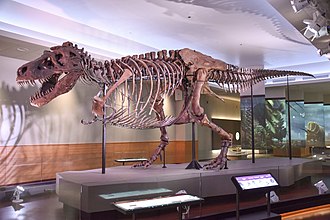
One of his biggest discoveries was the first set of bones from a Tyrannosaurus. This helped scientists learn more about these giant, powerful dinosaurs that lived long ago. His work made him one of the most well-known fossil hunters from the late Victorian era through the early 1900s.
Family and early life
Barnum Brown was born in Carbondale, Kansas on February 12, 1873, to William and Clara Silver Brown. His parents moved to Kansas in 1859, traveling by covered wagon with their daughter, Melissa. They built a one-room cabin on top of a coal seam.
As a young boy, Brown helped with chores on the farm and started collecting fossils, finding pieces like coral and Native American arrowheads. His parents noticed his interest in science and sent him to school in Carbondale. He finished school there at age 16 and later went to the University of Kansas in 1893 after a trip to Montana with his father.
University of Kansas
After finishing high school, Barnum Brown went to the University of Kansas. He quickly became interested in studying old bones and fossils. In his first year, he had a class taught by Samuel Wendell Williston. Williston liked Brown’s enthusiasm and invited him, along with two other students, Ermine Cowles Case and Elmer S. Riggs, to join a trip to collect fossils in Nebraska and South Dakota during the summer of 1894. Williston became Brown’s main teacher at the university and took him on another trip to Wyoming to find more fossils in 1895.
American Museum of Natural History career
Barnum Brown began working with the American Museum of Natural History in 1894. He quickly impressed the museum’s leaders with his discovery of a nearly complete Coryphodon skeleton. In 1897, he was offered a job as an assistant curator and a scholarship to study at Columbia University.
Brown traveled across the country, collecting and trading for fossils. His most famous discovery was the first documented remains of Tyrannosaurus rex, found in Montana in 1902. He also made important finds in Wyoming and Canada, often competing in a friendly way with another famous fossil hunting family, the Sternbergs. Brown continued working until he was 83 years old, discovering many important fossils that helped scientists learn more about ancient life on Earth.
Earliest anthropoid discovery
In early 1923, Barnum Brown traveled with his wife Lilian to Yangon, the capital of what was then Burma. He searched for fossils near Pondaung Sandstone and found a jaw with three teeth near the town of Mogaung. He didn’t realize how important this discovery was until 14 years later. A scientist named Edwin H. Colbert identified the fossil as a new type of primate and the oldest known anthropoid in the world. He named it Amphipithecus mogaungensis, meaning “ape-like creature of Mogaung,” but there is still discussion about whether it truly was a primate, especially since more fossils have not been found.
Public persona
Barnum Brown lived during a time of great scientific discovery and was known for his colorful personality. He was often photographed at dig sites in Canada wearing a large fur coat.
During World War I and World War II, he worked for the Office of Strategic Services and the Bureau of Economic Warfare. On his trips abroad, he sometimes earned extra money by working as a corporate spy for oil companies. Sinclair Oil supported many of Brown's expeditions, especially during the Great Depression, and still uses the Diplodocus, which he discovered, as its logo.
Personal life and death
Barnum Brown married school teacher Marion Raymond in 1904. She joined him on many adventures, including a trip where he found more Tyrannosaurus rex fossils. They had a daughter named Frances in 1908. Sadly, Marion passed away from an illness in 1910, and Frances was raised by her grandparents. She later became a leader at several colleges and wrote a book about her father.
In 1920, Brown met Lillian MacLaughlin Brown while they were in Egypt, and they married in India in 1922. Lillian wrote books about their adventures together. In 1963, Brown suddenly fell very ill and passed away. He was buried in River View Cemetery in Oxford, New York. A movie released in 1998 honored his life and work.
Related articles


This article is a child-friendly adaptation of the Wikipedia article on Barnum Brown, available under CC BY-SA 4.0.
Images from Wikimedia Commons. Tap any image to view credits and license.