 Safekipedia
Battle of Lechfeld
Adapted from Wikipedia · Discoverer experience
The Battle of Lechfeld was a very important fight that happened a long time ago, from August 10 to 12 in the year 955. It was also called the Second Battle of Lechfeld. During this battle, the soldiers from the Kingdom of Germany, led by King Otto I the Great, faced off against soldiers from Hungary. The Hungarian army was led by leaders named Harka Bulcsú, Lél, and Súr.
The Hungarians wanted to attack the area called the Duchy of Bavaria. They had many horse riders and other soldiers, and they even tried to capture a city named Augsburg, which sits near the river Lech. King Otto I brought his own soldiers to help protect Augsburg.
When the two armies met, the German soldiers, who were very strong and wore heavy armor, fought well against the Hungarian soldiers. Even though the Hungarians tried to surprise the Germans, the Germans fought back and won. After the battle, many Hungarian soldiers tried to run away, but heavy rains made it hard for them to escape. Many of them were caught and could not get back home. The leaders of the Hungarians were captured and punished.
Because of this big win, the Kingdom of Germany stayed safe, and there were no more big attacks from groups of travelers moving into Western Europe. King Otto became very famous for this victory and was later named Holy Roman Emperor because of how strong he had become.
Historical sources
The main source about the battle is a book asked for by Ulrich of Augsburg. It tells the story from the German side. Another important source is from a writer named Widukind of Corvey, who adds more details.
Background
Main article: Hungarian invasions of Europe
See also: Battle of Pressburg
In 947, a strong leader named Berthold, who ruled Bavaria, passed away. His brother Henry, who was also the brother of King Otto I, took over. Some believe this is why Hungarian forces attacked Bavaria, but they could not move far into Germany. Over the next few years, German forces began pushing back, causing fights near the Enns River. By 952, Otto had placed Italy under Bavarian protection, which stopped Hungarian attacks from the west for a time.
However, in 953, some German leaders rebelled against Otto, asking the Hungarians for help. In 954, the Hungarians attacked and caused damage in areas like the Rhineland and parts of France before safely returning home through Burgundy and Northern Italy.
In 955, King Otto faced many challenges. Some important leaders turned against him, and there were battles and sieges, such as at Regensburg. Despite these difficulties, Otto learned that the Hungarians had invaded again. They had destroyed lands from the Danube to the Black Forest. Otto quickly gathered his troops and marched to meet the enemy. The battle happened about six weeks after the first reports of the invasion. Otto planned his strategy carefully, choosing a good location to face the Hungarians and prevent their escape. The battle took place in a flat area near the river Lech, south of Augsburg. This was known as the second Battle of Augsburg in Hungarian history, with a first battle having happened there forty-five years earlier.
Prelude
The Hungarian forces moved across the river Lech towards the river Iller and caused damage to the land in between. They then moved back and began surrounding the city of Augsburg, which was a border town in Swabia. Augsburg had already been hurt during a rebellion against King Otto I in 954. The city was protected by Bishop Ulrich. He told his soldiers not to fight the Hungarians out in the open but to strengthen the main southern gate of the fortress. He inspired them with words from the 23rd Psalm.
The Hungarians tried many attacks on Augsburg day and night. Later, they tried to break into the city through the eastern gate, thinking it might be less guarded. Bishop Ulrich led his soldiers to fight back. Amazingly, he says he was not armed and was only wearing a special garment called a stola while riding his horse, yet he was not hurt. The Hungarians lost their leader in this fight and went back to their camp. The people of Augsburg first thought the Hungarians were winning and coming back to attack again, but they were actually leaving.
That night, the defenders of Augsburg prepared for more attacks by placing soldiers in all the towers. The Hungarians set up their siege tools and surrounded the city. The next day, they were told by someone named Berchtold that Otto I’s army was nearby. Because of this, the Hungarians stopped their attack and went to discuss their next move. While they were away, a count named Dietpald took soldiers to join Otto I’s army during the night.
Opposing forces
King Otto I of Germany led an army made up of troops from different regions. His forces included soldiers from Bavaria, Swabia, Franconia, Bohemia, Thuringia, and his own guard. Altogether, Otto’s army may have had between 7,000 and 9,000 soldiers.
The Hungarian army, also called the Magyars, fought differently. They were expert horse riders who attacked from a distance with bows and arrows. They wore lighter armor than Otto’s soldiers. However, their horses needed lots of space to graze and training, which made it hard to have many riders. Also, their bows did not work well in rainy weather.
Battle
On August 10, 955, King Otto I of Germany prepared his army to face the Hungarian forces near Lechfeld. The Hungarians had invaded Bavaria, hoping to defeat Otto's army in an open battle. Otto’s troops marched through forests to protect themselves from Hungarian arrows.
The main battle took place the next day. The Hungarian army tried to surround Otto’s forces, but Duke Conrad led a surprise attack that turned the tide. Otto rallied his soldiers and led them into battle against the Hungarian main force. Though the fight was tough, Otto’s army pushed back the Hungarians. The Hungarians retreated across a river, but many were caught and killed over the next two days. The battle ended with a big victory for Otto’s army, stopping further invasions into Western Europe by the Hungarians.
Aftermath
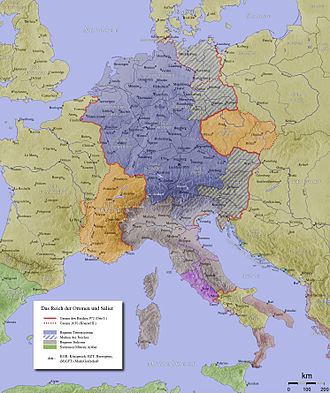
After the battle, the German army called King Otto I the father of their country and wanted him to be their emperor. In 962, Otto went to Rome and was crowned Holy Roman Emperor by Pope John XII. Many people started calling him "Otto the Great" after this.
The leaders of the Hungarian army, Bulcsú, Lehel and Súr, were captured and punished by the Germans. The defeat of the Hungarian army stopped their attacks on Western Europe forever. One of Otto's friends, the bishop of Cremona, said that after this battle, the Hungarians were so scared that they would not even speak up. A Hungarian historian, Gyula Kristó, called it a big loss for them. After this battle, the Hungarians stopped attacking areas west of them. Otto also stopped attacking them. Their leader, Fajsz, lost his power and was replaced by Taksony as Grand Prince of the Hungarians.
This battle showed the strength of the knightly cavalry, which later became very important in European battles during the High Middle Ages. It ended over 90 years of attacks by the Hungarians on Western Europe and encouraged them to settle down, which helped create the country of Hungary.
In popular culture
The battle was shown in the first episode of the first season of the German documentary series Die Deutschen, called "Otto und das Reich" which means "Otto and the Empire".
Images
Related articles


This article is a child-friendly adaptation of the Wikipedia article on Battle of Lechfeld, available under CC BY-SA 4.0.
Images from Wikimedia Commons. Tap any image to view credits and license.