 Safekipedia
Blackheath, London
Adapted from Wikipedia · Discoverer experience
Blackheath is an area in Southeast London, right between the Royal Borough of Greenwich and the London Borough of Lewisham. It used to belong to the county of Kent. You can find it just 1 mile (1.6 km) northeast of Lewisham, 1.5 miles (2.4 km) south of Greenwich, and about 6.4 miles (10.3 km) southeast of Charing Cross, which is considered the center of London.
Southwest of the train station in Blackheath is an area called Lee Park. To the north is Vanbrugh Park, also known as St John’s Blackheath. This neighborhood reaches out beyond its usual borders and has some special places named after the heath. On the west side of Blackheath is a big green space called the heath, and next to it is Greenwich Park. This park holds famous sights like the Greenwich Observatory and the Greenwich Prime Meridian. The Blackheath railway station sits in the southern part of the area.
History
Etymology
The name "Blackheath" comes from old English words meaning "dark, or black heath field." It was first recorded in 1166 as Blachehedfeld, which means a dark field or clearing. The name might refer to the color of the soil or the open, bleak landscape. Over time, Blackheath grew from an open space used for meetings to a place with many homes and buildings.
Archaeology
Ancient paths, like a Celtic trackway that later became a Roman road, passed through the area. Archaeological finds, such as Roman urns discovered in the gardens of the Earl of Dartmouth, show that people lived here long ago, likely connected to trade near royal palaces.
Royal setting
Important historical figures, including monarchs and their courtiers, lived or visited nearby. For example, Ranger's House, a beautiful mansion, has been used by royal officials and now houses an art collection. The Pagoda, built in 1760, was once a summer home for royalty.
Meeting point
Blackheath has been an important meeting place throughout history. It was used during revolts and rebellions, such as the Peasants' Revolt in 1381 and Jack Cade’s rebellion in 1450. Kings and important visitors also met here. For example, in 1400, King Henry IV met with a Byzantine emperor, and in 1415, King Henry V returned from battle and was greeted by citizens of London.
Mineral extraction
The Vanbrugh Pits, also called the Dips, were places where gravel was dug up. Now, nature has taken over, and the area is especially beautiful in spring when the gorse flowers bloom.
Vanbrugh Park
Vanbrugh Park, named after the architect Sir John Vanbrugh, includes the remains of old gravel pits. Vanbrugh had a large house in the area, and parts of it still stand today. The park also has a church and a high school.
Blackheath Park
Blackheath Park was built on the grounds of an old house and has many large, elegant homes from the 18th and 19th centuries. It includes a famous church known for its tall spire and a Catholic church with beautiful stained glass windows.
Other churches
The Church of the Ascension was founded in the late 1600s and was rebuilt several times. It still stands as a place of worship today.
Ownership and management of the heath
The heath is managed for public use. It was transferred to different authorities over time, and today it is looked after by the boroughs of Greenwich and Lewisham. The land has been used for grazing and gravel extraction, but it is now preserved for everyone to enjoy.
Sport
In 1608, Blackheath is said to be where golf was first brought to England. The Royal Blackheath Golf Club, located nearby in Eltham since 1923, was one of the earliest golf clubs outside Scotland.
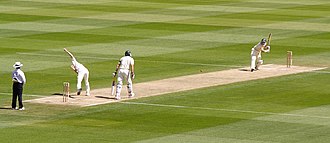
Blackheath was also the home of Greenwich Cricket Club in the 1700s and hosted cricket matches, including the earliest known senior match in 1730 between Kent and London.
Blackheath Rugby Club, founded in 1858, is one of the oldest rugby clubs in the world. It helped organize the first international rugby match in 1871 between England and Scotland.
Today, Blackheath is a starting point for the London Marathon, linking to its long history with athletics. The area is also famous for kite flying.
Geography
Blackheath is one of the largest areas of shared land in Greater London, covering 85.58 hectares (211.5 acres). It is cared for by Lewisham and Greenwich councils. On the Greenwich side, there is a pond called Long Pond near the main entrance of Greenwich Park. On the Lewisham side, there are three ponds, with Hare and Billet pond being the most natural and a good home for wildlife. Lewisham also has special areas with rare wild plants.
Long ago, scientists loved this area. In the 1700s, a famous scientist named Carl Linnaeus is said to have been very happy when he saw plants growing there. The area was home to many animals like toads, hares, lizards, bats, and birds. Today, bats still live there, and sometimes you might see special birds in the spring.
In the past, people took away gravel, sand, and chalk from the area, leaving big holes. After World War II, these holes were filled with broken pieces from bombs, covered with soil, and planted with grass. These areas look different today because of the special grass that grows there.
Politics and government
Blackheath is part of three areas that vote for representatives in the House of Commons of the United Kingdom. These areas are called Lewisham North, Greenwich and Woolwich, and Eltham and Chislehurst.
For local voting, Blackheath belongs to the Blackheath Westcombe ward in Greenwich Borough Council and the Blackheath ward in Lewisham Borough Council.
Culture and community
Blackheath has two main areas for shopping and fun: the "Village" near Blackheath railway station and the "Standard" in the north, named after a famous pub in Greenwich. The northern part of the area is in the Westcombe Park neighborhood, which has its own train stop.
The area has a lovely green space that used to be called Sheepgate Green. In the 1800s, a kind man named William Fox Batley helped fix it up, and it was renamed Batley Green or Batley Park.
Near the train station, there is the Blackheath Conservatoire of Music and the Arts close to Blackheath Halls, a place where people can enjoy concerts. In Tranquil Vale, north of the station, there is All Saints' Parish Hall, a special building made in the Arts and Crafts style in 1928. Since 1988, it has held the Mary Evans Picture Library.
Every year around Guy Fawkes Night, there used to be a big fireworks show. But the London Borough of Greenwich stopped paying for it in 2010, and it was paused during the COVID-19 pandemic.
In 2014, a new festival called On Blackheath started, featuring famous bands and singers like Massive Attack and Frank Turner. The festival happened each year until it was stopped during the COVID-19 pandemic in 2020 and 2021. It returned in 2025 and will continue for many years.
Transport
Rail
Blackheath station offers train services to London Victoria, London Charing Cross, London Cannon Street, Slade Green through Bexleyheath, Dartford through Bexleyheath or Woolwich Arsenal, and Gravesend.
Westcombe Park station also serves the northern part of Blackheath, with trains going to Luton through London Blackfriars, London Cannon Street, Barnehurst through Woolwich Arsenal, Crayford through Woolwich Arsenal, and Rainham through Woolwich Arsenal.
Buses
Blackheath has many bus routes (London Buses) like routes 53, 54, 89, 108, 178, 202, 286, 335, 380, 386, 422, SL4, N53, and N89. These buses go to places such as Bexleyheath, Bow, Canary Wharf, Catford, Charlton, Crystal Palace, Deptford, Elephant & Castle, Elmers End, Eltham, Greenwich, Kidbrooke, Lee, Lewisham, New Cross, Plumstead, North Greenwich, Sidcup, Slade Green, Stratford, Sydenham, Welling, and Woolwich.
Images
Related articles


This article is a child-friendly adaptation of the Wikipedia article on Blackheath, London, available under CC BY-SA 4.0.
Images from Wikimedia Commons. Tap any image to view credits and license.