 Safekipedia
Cosmic microwave background
Adapted from Wikipedia · Discoverer experience
The cosmic microwave background (CMB, CMBR), or relic radiation, is microwave radiation that fills all space in the observable universe. With a standard optical telescope, the space between stars and galaxies looks almost completely dark. But a sensitive radio telescope can detect a faint glow that comes from everywhere and is not linked to any star, galaxy, or other object. This glow is strongest in the microwave part of the electromagnetic spectrum and has more energy than all the light ever emitted by stars.
The CMB provides strong support for the Big Bang theory about how the universe began. In the very early universe, it was filled with a hot, dense plasma of tiny particles. As the universe expanded and cooled, protons and electrons joined to form neutral atoms, mostly hydrogen. This made the universe transparent for the first time, allowing light to travel freely. This moment is called the recombination epoch.
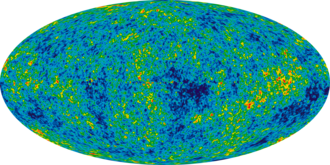
Although the CMB looks very smooth, sensitive instruments have found tiny temperature differences. Experiments like COBE, WMAP, and Planck measured these differences. They show a pattern of small ripples that tell us about the conditions in the early universe, such as its shape and the amount of normal and dark matter. Studying the CMB helps scientists understand how the universe began and how it has changed over time.
Features
The cosmic microwave background radiation is a steady glow of energy coming from every direction in space. It has a very even temperature, measured in kelvin, and stays almost the same no matter where you look. Scientists have found tiny changes in this temperature, which helps us learn more about how the universe began.
The radiation also shows a special kind of light called polarization, which gives us more clues about the early universe. Even though these changes are very small, they are important for understanding how everything started. The cosmic microwave background contains most of the light particles, or photons, in the universe, and without the universe expanding and cooling, the night sky would be as bright as the Sun.
History
Early speculations
In 1931, Georges Lemaître thought that old parts of the universe might look like radiation. Later, in 1948, Ralph Alpher and Robert Herman guessed that we might find this kind of radiation everywhere in space. They thought it might be about 5 times colder than freezing.
Discovery
In 1964, two scientists named Arno Penzias and Robert Wilson found a strange glow coming from everywhere in the sky while they were working with a radio telescope. This glow was the same everywhere and came from long ago, when the universe was very young. They won a big prize for finding it.
Cosmic origin
At first, people weren't sure where this glow came from. But by the 1970s, scientists showed that the glow matched what we expect from the very early universe. They also showed that it looks almost the same in every direction, which helped prove it came from everywhere.
Progress on theory
In the 1970s, scientists realized that tiny changes in this glow could tell us about what happened right after the universe began.
COBE
In the 1990s, a satellite called COBE measured these tiny changes very carefully. It helped scientists understand how the universe grew and changed.
Precision cosmology
After COBE, many more experiments looked at these changes in even more detail. These helped scientists figure out that the universe is flat, not curved, and gave more support to the idea that the universe expanded very quickly right after it began.
Observations after COBE
More experiments followed COBE, measuring these changes on even smaller scales. These helped scientists learn more about the shape and contents of the universe.
Wilkinson Microwave Anisotropy Probe
In 2001, NASA launched a new satellite called WMAP. It made very careful maps of the sky and helped scientists understand the universe even better.
Planck Surveyor
In 2009, a European satellite called Planck made even more detailed maps of this ancient glow. It helped scientists learn that the universe is a little older than they thought and told us more about what the universe is made of.
Theoretical models
The cosmic microwave background radiation and how it relates to the distance of objects are strong evidence for the Big Bang. Studies of this radiation support the idea that the universe began with a Big Bang and has been expanding since.
According to the Big Bang model, after a very short time following the beginning of the universe, it went through a rapid growth phase. This growth smoothed out most differences, but some small differences remained due to quantum effects. Before stars and planets formed, the universe was smaller, much hotter, and filled with a bright glow from a mix of particles and energy.
As the universe expanded, it cooled. Eventually, electrons and protons combined to form hydrogen atoms. When this happened, about 380,000 years after the Big Bang, the universe became transparent, and the light from that time has been traveling through space ever since. This light, now cooled to a very low temperature, is what we call the cosmic microwave background. It gives us a picture of the early universe and supports the Big Bang theory.
Polarization
The cosmic microwave background has a special kind of glow called polarization. There are two types of this polarization: E-mode and B-mode. These names come from ideas used to describe electric and magnetic fields.
E-modes
E-modes come from tiny particles bouncing around in the early universe. Scientists first saw these in 2002 using a special telescope.
B-modes
B-modes are much weaker than E-modes. They might be created by special waves from right after the Big Bang. However, they can also come from the bending effect of stronger E-modes. Finding the original B-modes needs careful study to remove the effect of the stronger E-modes.
Primordial gravitational waves
Some ideas about the very early universe predict special waves that would leave a pattern in the B-mode polarization. Finding this pattern would help prove these ideas. Early reports of this pattern were later found to be affected by dust in space. More recent studies have looked at this more carefully.
Gravitational lensing
In 2013, scientists found the second type of B-modes using telescopes at the South Pole and in space. In 2014, another team measured this B-mode polarization and showed it came from the universe itself, not just from dust, with very high confidence.
Multipole analysis
The cosmic microwave background (CMB) shows tiny temperature differences across the sky. Scientists study these differences by breaking them into parts called multipoles, which help us understand the early universe.
The simplest part, called the monopole (ℓ = 0), shows the average temperature of the CMB, which is about 2.7255 Kelvin. The next part, the dipole (ℓ = 1), shows how the Earth moves through space and is not related to the early universe.
Higher multipoles (ℓ ≥ 2) show tiny temperature changes that started in the very early universe. These changes happened when the universe was very hot and dense, and they give us clues about how the universe began.
Some patterns in the CMB are still being studied, like unusual alignments, but scientists are working to understand if these are real or just chances in the data.
Future evolution
If the universe keeps getting bigger and does not end in a big collapse or tear, the cosmic microwave background will keep changing. It will move to longer wavelengths until we can no longer detect it. After that, the faint glow we see today will be replaced first by light from stars. Much later, other processes in the far future universe might create new kinds of background radiation.
Timeline of prediction, discovery and interpretation
See also: Timeline of cosmological theories
Thermal (non-microwave background) temperature predictions
- In 1896, Charles Édouard Guillaume estimated the heat from stars to be between 5–6 K.
- In 1926, Sir Arthur Eddington estimated the energy from starlight in the galaxy to be about 3 K.
- In the 1930s, cosmologist Erich Regener calculated that energy from space rays in the galaxy had a temperature of 2.8 K.
- In 1931, the word microwave was first used in writing.
- In 1934, Richard Tolman showed that energy in space stays the same even as the universe expands.
- In 1946, Robert Dicke predicted we might find energy from the universe at about 2.7 K.
- In 1955, Émile Le Roux reported finding energy in space at about 3 K, but did not know its importance.
- In 1957, Tigran Shmaonov reported finding energy in space at about 4 K.
- In 1964, A. G. Doroshkevich and Igor Dmitrievich Novikov suggested looking for this energy with telescopes.
- In 1964–65, Arno Penzias and Robert Woodrow Wilson measured the temperature to be about 3 K. Robert Dicke, James Peebles, P. G. Roll, and D. T. Wilkinson explained this as evidence of the Big Bang.
- In 1966, Rainer K. Sachs and Arthur M. Wolfe predicted how the energy would look based on gravity.
- In 1968, Martin Rees and Dennis Sciama also predicted how the energy would look.
- In 1969, R. A. Sunyaev and Yakov Zel'dovich studied how very hot material changes the energy.
- In 1983, researchers first saw this change in energy from groups of galaxies.
- In 1983, the RELIKT-1 Soviet experiment to study the energy was launched.
- In 1990, the Cosmic Background Explorer satellite measured the energy very precisely.
- In January 1992, scientists reported finding small differences in the energy.
- In 1992, scientists using COBE data reported finding small differences in the energy.
- In 1995, the Cosmic Anisotropy Telescope made detailed observations of the energy.
- In 1999, experiments measured sound waves in the energy.
- In 2002, scientists found a special kind of energy pattern called polarization.
- In 2003, the Wilkinson Microwave Anisotropy Probe created a detailed map of the whole sky.
- In 2006, two scientists from COBE won a Nobel Prize for their work.
- In 2010, the first map of the whole sky from the Planck telescope was released.
- In 2013, an improved map from the Planck telescope was released.
- In 2014, scientists thought they found evidence of the universe’s fastest growth, but later found it was caused by dust.
- In 2018, the final data from the Planck telescope was released.
In popular culture
The cosmic microwave background has appeared in several stories and shows. In the TV series Stargate Universe, an ancient spaceship named Destiny studied patterns in the cosmic microwave background, which was described as a message from the beginning of time. In the novel Wheelers by Ian Stewart & Jack Cohen, the cosmic microwave background was shown as hidden messages from an ancient civilization. In the book The Three-Body Problem by Liu Cixin, an alien probe was said to interfere with instruments that monitor the cosmic microwave background. The Swiss 20 francs bill from 2017 lists several space objects and their distances, including the cosmic microwave background, which is about 430 · 1015 light-seconds away. In the 2021 Marvel series WandaVision, a strange television broadcast was found within the cosmic microwave background.
Images
Related articles


This article is a child-friendly adaptation of the Wikipedia article on Cosmic microwave background, available under CC BY-SA 4.0.
Images from Wikimedia Commons. Tap any image to view credits and license.