 Safekipedia
Energy development
Adapted from Wikipedia · Discoverer experience
Energy development is all about finding ways to get energy from nature. This includes making energy from fossil fuels, nuclear power, and renewable sources like sunlight and wind. It also means finding ways to reuse energy that might otherwise be lost. Using energy more wisely and saving energy helps reduce the need for new energy sources and can make the environment healthier.
We use energy for many things in our daily lives, like talking on the phone, keeping our homes warm, lighting up rooms, making things in factories, and moving around in cars, trucks, and buses. Energy can come directly from nature, like coal or wind, or it might need to be changed into a form that is easier to use, like electricity.
Many people work in the energy industry. The traditional energy industry includes making and selling oil, natural gas, electricity, and nuclear power. There are also new energy industries that focus on renewable energy, like solar and wind power, and making and selling alternative fuels.
Classification of resources
Further information: World energy supply and consumption
See also: Energy industry, Energy planning, and Energy policy
Energy resources can be grouped in different ways. Some resources, called primary resources, can be used directly without changing them. Examples include wind power, solar power, wood, coal, oil, natural gas, and uranium. Other resources, called secondary resources, need to be changed before we can use them. Examples are electricity and hydrogen.
We also classify resources by how long it takes for them to renew. Renewable resources can recover quickly enough to meet our needs. Examples are hydroelectric power and wind power. Non-renewable resources take so long to form that we will run out of them. Coal is an example of a non-renewable resource.
Fossil fuels
Main articles: Fossil fuel and Peak oil
Fossil fuels are made from the remains of ancient plants and animals. The three main types are coal, petroleum, and natural gas. We burn these fuels to get heat, power vehicles, and create electricity. They store energy from the sun that we can use.
Fossil fuels have been very important for a long time. They powered big changes in how we live and work during the 18th and 19th centuries. Today, most of the world's energy still comes from fossil fuels. However, they cause pollution and can harm the environment. Because we use them faster than they can form naturally, they will eventually run out. This makes it important to find better ways to get energy.
Nuclear
Fission
Nuclear power uses a process called fission to create heat and electricity. Most nuclear power comes from splitting uranium atoms. A small part of nuclear energy comes from special tools used in space.
In 2012, nuclear power plants provided about 5.7% of the world's energy and 13% of its electricity. There are many nuclear power plants around the world, and some ships also use nuclear power.
There is a lot of discussion about nuclear power. Some people think it is safe and helps reduce pollution. Others worry about risks to people and nature.
Some famous nuclear accidents have happened, like the Chernobyl disaster in 1986 and the Fukushima accident in 2011. These accidents showed that nuclear power can be dangerous, but studies show that nuclear power causes fewer accidents than other energy sources like coal or oil.
Scientists are working on new ways to get uranium from the ocean, which could provide a lot of energy.
Nuclear power does not create much pollution, and it has helped reduce the amount of carbon dioxide in the air since the 1970s.
Nuclear power phase-out and pull-backs
After the Fukushima accident in Japan in 2011, many countries looked again at how safe nuclear power is. Germany decided to close all its nuclear reactors by 2022, and Italy banned nuclear power.
Fukushima
The Fukushima accident in 2011 was a big problem. It caused many people to leave their homes, and some food and fish from the area could not be sold because of radiation.
Fission economics
Main article: Economics of nuclear power plants
The cost of building new nuclear power plants is a big debate. Building them costs a lot of money at first, but the fuel is cheap. In some places, it is hard to get money for these big projects.
When looking at the cost of nuclear power, it matters who takes the risk. In the past, the risks were paid for by everyone who uses electricity. Now, in places where electricity markets are open, the risks are paid by the companies building the plants.
Costs
Costs for nuclear power plants are going up because of new rules for managing old fuel and making plants safer. Some new plants are taking longer to build and costing more than planned. For example, plants in Finland and France are behind schedule and over budget. But plants in South Korea and the United Arab Emirates are doing better.
Renewable sources
Main article: Renewable energy commercialization
The countries that use the most fossil fuels for electricity differ in how much of that electricity comes from renewable sources, which means the potential for growing renewable energy varies widely.
Renewable energy comes from resources that naturally replenish, such as sunlight, wind, rain, tides, waves, and geothermal heat. It replaces traditional fuels in four main areas: electricity generation, hot water/space heating, motor fuels, and rural (off-grid) energy needs.
Including traditional uses of biomass, about 19% of the world's energy use comes from renewable sources. Wind power is becoming a major renewable energy source, with global wind power capacity increasing by 12% in 2021. In many countries, using renewable energy has been linked to positive economic growth. At least 30 nations already get more than 20% of their energy from renewable sources, and these markets are expected to keep growing strongly in the future.
Unlike other energy sources, renewable energy is not limited by geography. Using renewable energy brings economic benefits and helps fight climate change. Research shows that renewable energy helps communities use electricity more effectively. The growth of renewable energy in many countries is driven by high electricity use. International support for renewable sources like solar and wind continues to grow.
While many renewable energy projects are large, these technologies also work well in rural and remote areas and developing countries, where energy is often important for human development. To make sure development continues in a sustainable way, governments are researching how to add renewable sources to their countries and economies. For example, the UK Government's Department for Energy and Climate Change created a mapping tool to show people how land can be used for energy production.
Hydroelectricity
Hydroelectricity is electricity made by hydropower, which uses the force of falling or flowing water. In 2015, hydropower provided 16.6% of the world's electricity and 70% of all renewable electricity, and it was expected to grow by about 3.1% each year for the next 25 years.
Hydropower is used in 150 countries, with the Asia-Pacific region producing 32% of the world's hydropower in 2010. China leads in hydroelectricity production. There are now three very large hydroelectric plants: the Three Gorges Dam in China, Itaipu Dam between Brazil and Paraguay, and Guri Dam in Venezuela.
Hydroelectricity is relatively inexpensive and can quickly adjust to meet changing energy needs. However, building dams can disrupt rivers and harm local ecosystems, and it often means moving people and wildlife. Once built, hydroelectric plants do not create waste and produce less greenhouse gas than fossil fuel plants.
Wind
Global growth of wind power capacity
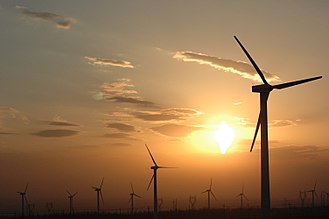
Wind power uses wind to turn the blades of wind turbines, which creates electricity. Wind farms can be built on land or at sea. Global wind power capacity grew quickly to 336 GW by June 2014, and wind energy made up about 4% of the world's electricity use, with rapid growth.
Wind power is widely used in Europe, Asia, and the United States. Several countries get a large share of their electricity from wind, such as 21% in Denmark, 18% in Portugal, 16% in Spain, 14% in Ireland, and 9% in Germany in 2010. By 2011, wind and solar power sometimes provided over 50% of electricity in Germany and Spain. As of 2011, 83 countries use wind power commercially.
Many of the world's largest onshore wind farms are in the United States, China, and India. Most of the world's largest offshore wind farms are in Denmark, Germany, and the United Kingdom. The two largest offshore wind farms are the 630 MW London Array and Gwynt y Môr.
Solar
Biofuels
Main articles: Biofuel and Sustainable biofuel
A bus fueled by biodiesel
Information on pump regarding ethanol fuel blend up to 10%, California
A biofuel is fuel made from recently living organisms, such as plants and microalgae. These fuels are created through processes like heating, chemical reactions, and biological changes. Biofuels can be used in solid, liquid, or gas form and are popular because oil prices are rising and there is a need for energy security.
Bioethanol is an alcohol made from sugars or starches in crops like corn or sugarcane. It is used in vehicles and as an additive to gasoline. Biodiesel is made from vegetable oils and animal fats and used as a diesel additive. Biodiesel is common in Europe.
In 2010, biofuel production reached 105 billion liters worldwide, providing 2.7% of the world's transportation fuels. The United States and Brazil are the top producers of ethanol, and the European Union leads in biodiesel production. By 2011, many countries and regions had rules requiring biofuels to be mixed into vehicle fuels.
Geothermal
Main article: Geothermal energy
Geothermal energy comes from the heat stored inside the Earth. This heat comes from when the Earth formed and from the decay of radioactive minerals. Geothermal energy has been used for bathing since ancient times and for heating since Roman times, but it is now also used for generating electricity.
In 2012, 11,400 megawatts of geothermal power were operating in 24 countries, with an additional 28 gigawatts used for heating. Geothermal power is reliable and environmentally friendly, but it was mostly limited to areas near tectonic plate boundaries. New technology now allows geothermal energy to be used more widely, though it can still release some greenhouse gases.
The Earth's geothermal resources could meet all our energy needs, but only a small part can be used profitably. Drilling for deep resources is expensive. The cost of geothermal power has dropped by 25% over the past two decades.
Oceanic
Main article: Marine energy
Marine Renewable Energy (MRE) or marine power comes from the energy in ocean waves, currents, and tides, as well as changes in salinity and ocean temperature differences. This energy can be used to generate electricity for homes, transport, and industries.
Marine energy includes wave power and tidal power. While offshore wind power is not marine energy, the oceans offer a lot of energy close to many populations. Marine energy is still in its early stages, and countries are creating strategies to support its growth.
Research shows that marine energy can help coastal communities move away from fossil fuels, but there are concerns about its effects on marine life and ocean currents. Marine energy devices might provide homes for sea creatures and create areas that help sea life thrive. However, the number of devices is still low, so more research is needed to understand their full impact.
100% renewable energy
Main article: 100% renewable energy
Using 100% renewable energy for electricity, transport, or all energy globally is driven by concerns about climate change and other environmental and economic issues. Renewable energy use has grown faster than expected. There are few technological limits to using renewable energy to meet most of the world's energy needs.
At least 30 nations already get more than 20% of their energy from renewable sources. Some experts believe we can replace all energy with wind, solar power, and hydropower by 2050. They say the main barriers are social and political, not technological or economic.
In the United States, renewable resources could supply much more electricity than current or future demand. Some critics worry about the variable output of solar and wind power, but others believe the electricity grid can manage these changes. Google spent money on a project to make renewable energy cheaper than coal but stopped after finding it would still be behind fossil fuel emissions by 2050.
| Wind farm | Current capacity (MW) | Country |
|---|---|---|
| Alta (Oak Creek-Mojave) | 1,320 |  USA USA |
| Jaisalmer Wind Park | 1,064 |  India India |
| Roscoe Wind Farm | 781 | USA |
| Horse Hollow Wind Energy Center | 735 | USA |
| Capricorn Ridge Wind Farm | 662 | USA |
| Fântânele-Cogealac Wind Farm | 600 |  Romania Romania |
| Fowler Ridge Wind Farm | 599 | USA |
Increased energy efficiency
Main article: Efficient energy use
Using energy more wisely helps us do more with less. When we make things like homes, lights, and machines work better, we use less energy for the same results. For example, adding insulation to a home keeps it warmer in winter and cooler in summer without using as much energy. Switching from regular light bulbs to energy-saving lights uses much less energy and lasts longer.
Improving how we use energy can save money and help protect our planet. Experts believe that by using energy more efficiently, we could need less energy overall, even as more people use more things. This is important for keeping our world safe and healthy.
Transmission
New ways to get energy are not found often, but ways to move energy keep getting better. For example, cars might one day use special fuel cells to get power. This part talks about the different ways we move energy from where it is made to where it is used. All these ways depend on the energy sources we talked about before.
Shipping and pipelines
See also: Pipeline transport
We can move coal, petroleum, and similar fuels by boat, rail, or road. We can also move petroleum and natural gas through pipelines, and coal can travel through special Slurry pipeline pipelines. Fuels like gasoline and LPG can even be moved by aircraft. Natural gas pipelines need to keep the right pressure to work well. Moving ethanol can be expensive.
Wired energy transfer
Main article: Electrical grid
Electricity grids are like big networks that move power from where it is made to where it is used, even if those places are far apart. They use power plants like nuclear reactor or coal-burning plants. They have special stations and wires to keep electricity flowing smoothly. Sometimes, bad weather can cause power to stop for a little while. Big areas like California, Texas, and parts of the US use a lot of electricity because they have good systems to move it. Places with smaller systems, like some in Africa, use less electricity.
Wireless energy transfer
Wireless power transfer is a way to send electricity without using wires. Right now, this only works for short distances and small amounts of power. Some ideas, like collecting solar power from space, would need to send electricity to Earth without wires, but this is very hard to do safely and in a way that works well.
Storage
Main articles: Energy storage and List of energy storage power plants
Energy storage means saving energy in a device or material so it can be used later when needed. These devices are sometimes called accumulators.
Energy can be stored in many ways, like as potential energy (such as in chemicals, gravity, electricity, or temperature differences) or kinetic energy (like movement). Some storage methods work for short times, while others can save energy for very long periods, like turning electricity into gas using hydrogen or storing heat from one season to use in another. Examples include wind-up clocks that save mechanical energy, batteries that save chemical energy to power phones, and dams that save water’s gravitational energy. Ice can also be stored at night to help cool buildings during the day. Fossil fuels like coal and gasoline are ancient energy from sunlight stored in chemical form, and even food is a type of stored chemical energy.
History
Humans have always looked for ways to get energy. Long ago, people discovered fire to keep warm and cook food. Later, they built windmills to grind wheat. Today, we can get electricity from splitting atoms. People have been searching for energy sources for a very long time.
Most energy we use today comes from the sun or from old plants and animals that lived long ago. Solar energy comes from the Sun's nuclear fusion. Other energy sources, like geothermal and nuclear power, come from radioactive materials deep inside the Earth. These materials were made in explosions called supernovas before our solar system was formed.
Since the Industrial Revolution, people have worried about running out of energy. Experts have made predictions about when we might use up our oil and coal. Some think we have limits on how much energy we can use, and others look for new ways to get energy from the sun and space.
Sustainability
Main article: Sustainable energy
It is important to use energy in a way that does not harm the environment. Renewable energy, like wind and solar power, will not run out because there is always more available. Using energy wisely, called energy conservation, helps us need less energy and protects our planet.
Present and future
Thinking about the future, we can choose different paths for our energy. Some ways might lead to problems, so we need to find better strategies. Energy production often needs energy to start, like drilling for oil or building wind farms. As we use harder-to-reach energy sources, we need more energy to get them. New technology can help, but there are limits to what we can do.
In the past, farming used a lot of energy from fossil fuels. If we keep using oil and gas, we might need new ways to grow food. Some people imagine a future where buildings and roads help us get energy from the sun. With space travel growing, we might also collect solar power from space to use here on Earth. This idea has been studied since the 1970s and would need building special structures in space to catch the sun's energy.
Energy technology
Energy technology is the study of using science and engineering to get energy from natural resources in a way that is safe, good for the environment, and saves money. It looks at how to get energy, change it into useful forms, move it around, store it, and use it without harming people or nature.
Energy is very important for everyone because we need it for lighting, heating, cooking, moving around, and many other things. There are two main types of energy sources: ones we can use again (like wind and sunlight) and ones we can use only once (like coal and oil). Working with energy can sometimes hurt the places where we find it, but scientists and engineers are always finding better ways to make energy without causing too much damage.
Images
Related articles


This article is a child-friendly adaptation of the Wikipedia article on Energy development, available under CC BY-SA 4.0.
Images from Wikimedia Commons. Tap any image to view credits and license.