 Safekipedia
Etruscan art
Adapted from Wikipedia · Discoverer experience
Etruscan art was made by the Etruscan civilization in central Italy between the 10th and 1st centuries BC. Around 750 BC, their art was heavily influenced by Greek art, which they brought in, but it always kept its own special features. They were very good at making sculptures from clay, especially large ones for tombs and temples, painting walls, and working with metal, particularly bronze. They also made beautiful jewelry and engraved gems.
Bronze sculptures made by the Etruscans were famous and sent to many places, but few big examples have survived because the metal was too valuable and reused later. Unlike clay and bronze, they did not make much sculpture from stone, even though they had good marble, like Carrara marble, which they did not use until the Romans came.
Most of the art that has survived came from tombs, which were filled with stone boxes for the dead, called sarcophagi, and gifts for the dead. We also have pieces of clay decorations from temples and wall paintings from tombs. These wall paintings often showed pictures of parties and stories from myths. Etruscan pottery started with a style called bucchero, which was black, and later they made painted vases, inspired by Greek styles. Their temples were covered with colorful clay decorations, and much of their art was linked to their beliefs about religion and the afterlife.
History
Further information: Etruscan history
The Etruscans began their art from the Villanovan culture. Because they were close to and traded with many other cultures, like Greece, Phoenicia, Egypt, Assyria and the Middle East, their art was influenced by these places. Later, the Romans took in Etruscan culture and were also influenced by it.
Etruscan art is usually split into a few time periods. From 900 to 700 BC, called the Villanovan period, people made simple pottery and small bronze objects. From 700 to 575 BC, the Orientalising period, foreign trade brought in more art, especially from Greece. This time, the Etruscans began to make richer grave goods and more painted vases. From 575 to 480 BC, the Archaic period, Etruscan temples with bright painted terracotta decorations appeared, and stories from Greek mythology became popular in paintings and sculptures. The Classical period, from 480 to 300 BC, saw less art as the Etruscans lost power, but they still made fine bronzes and stone sarcophagi. Finally, from 300 to 50 BC, the Hellenistic period, the Etruscans were slowly taken over by the Romans, and their art began to look more like Roman styles.
Sculpture
Main article: Etruscan sculpture
The Etruscans were skilled sculptors who made many artworks from terracotta, bronze, and alabaster. They did not often use stone like the Greeks and Romans did. Many of their terracotta sculptures from temples had to be put back together from many pieces, but the ones from tombs, like the tops of sarcophagi with life-size reclining figures, were usually in good shape. Small bronze decorations became important later and were sold to the Romans and others.
One famous bronze piece is the "Capitoline Wolf" in the Capitoline Museum in Rome, though its age is debated and it might be from the 12th century. Some well-known Etruscan sculptures include the Apollo of Veii from Portanaccio and the Sarcophagus of the Spouses from Cerveteri. These show the skill of Etruscan artists in creating large artworks.
Wall-painting
Further information: Tomb of the Leopards
The Etruscan paintings that have survived are mostly wall paintings from tombs, especially in the city of Tarquinia. These paintings date from around 670 BC to 200 BC, with the most being made between about 520 and 440 BC. Unlike the Greeks, who rarely painted their tombs, the Etruscans created many beautiful wall paintings. These paintings are important because many Greek wall paintings have been lost over time.
The Etruscan tomb paintings were made by painting onto fresh plaster so that the paint became part of the wall. They used colors made from minerals and brushes made from animal hair. Some paintings show everyday life, but most show stories from Greek myths. They also painted scenes of parties, sports, and hunting. The way they showed people and animals was not always accurate, and they often added decorative designs around the main pictures.
Vase painting
Main article: Etruscan vase painting
Etruscan vase paintings were made from the 7th to the 4th centuries BC and are an important part of Etruscan art. They were heavily influenced by Greek vase painting, especially the styles from Athens, but they followed these trends a bit later. The Etruscans used the same methods and shapes as the Greeks, including both black-figure vase painting and red-figure vase painting. Later, many of the pictures on these vases came from Greek myths.
The Etruscans not only made their own vase paintings but also bought a lot of Greek pottery. Some Greek artists may have even moved to Etruria. Richly decorated vases were often placed in graves as special items, since they were beautiful but not as valuable as silver or bronze vessels that wealthy people used in their daily lives.
Bucchero wares
The Etruscans made special black clay cups and bowls called bucchero. They made these by heating the clay in a special way without oxygen. These cups often had white lines drawn on them and were used in tombs as special keepsakes.
Terracotta panels
Some big terracotta pieces, called pinakes, have been found in tombs. They are much larger than those in Greek art and can form a series that looks like a portable wall painting. The Boccanera tomb at the Banditaccia necropolis in Cerveteri had five panels almost a meter high. These panels are now kept in the British Museum. Three of the panels show a scene known as the Judgement of Paris, and the other two had sphinxes that acted as guards for the tomb. These panels are from around 560 BC. Pieces of similar panels have also been found in city centers, likely from temples, fancy houses, and other buildings. These often show everyday life scenes.
Metalwork
The Etruscans were very skilled at working with bronze, creating many beautiful pieces that can still be seen in museums today. After the Romans captured the city of Volsinii, they took many bronze statues away as treasures.
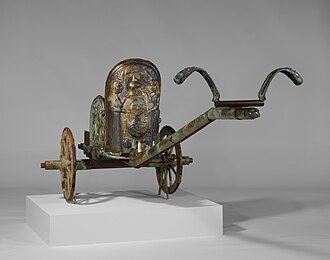
One famous example of their bronze work is the Monteleone chariot, which is one of the best-preserved and most complete bronze pieces we have from that time. The Etruscans made small bronze items that were traded far and wide. They were also good at carving detailed pictures onto bronze pieces, especially on the backs of polished bronze mirrors and the sides of special containers called cistae. A main place for making these containers was Praeneste, a town that spoke an Italic language but was part of the Etruscan culture. Some mirrors and their covers had designs carved in a low relief.
Funerary art
The Etruscans were very good at showing people in their art. They had two ways to bury their dead: burning the body or placing the whole body in a tomb. They made special containers called urns for the burned remains and stone boxes called sarcophagi for the whole body. Both were used at the same time for many years.
They made beautiful stone boxes with pictures of the person who died lying down, sometimes with their spouse. These pictures were also put on smaller urns. Later, these urns were made in two parts. The top part often showed a man or woman sitting at a feast, and the bottom part had carvings, sometimes showing stories from Greek tales. Many of these were made quickly and not by the best artists, but they still tell us about the time they were made because the colours changed over the years.
Art and religion
Etruscan art was often linked to their religious beliefs and practices. Unlike in ancient Egypt or ancient Greece, the Etruscans had a more negative view of what happened after death. Many pieces of Etruscan art that we know about today come from cemeteries, showing scenes related to religious ideas and remembering people who had passed away.
Museums
Etruscan tombs were often taken apart early on, especially for their valuable metals. Starting from the Renaissance, people collected Etruscan objects like painted vases and stone boxes very much. Many of these were sent to other countries before rules stopped it, and now big museums all over the world have good groups of these items. However, the biggest and most important collections are still in Italy, in cities like Rome, Florence, and others that were once part of Etruscan land. These museums have items found by modern scientists studying the past.
Important museums in Italy include the National Etruscan Museum in the Villa Giulia in Rome, the National Archaeological Museum in Florence, the Vatican Museums, the Tarquinia National Museum, and the Archeological Civic Museum in Bologna. You can also see some old tombs that have been cleaned out at places like Cerveteri.
Between 2021 and 2022, a big show of Etruscan art was held at the MARQ Archaeological Museum of Alicante in Spain. The show, called Etruscans: The Dawn of Rome, had many items borrowed from the National Archaeological Museum in Florence and the Guarnacci Etruscan Museum in Volterra.
Images
Related articles


This article is a child-friendly adaptation of the Wikipedia article on Etruscan art, available under CC BY-SA 4.0.
Images from Wikimedia Commons. Tap any image to view credits and license.