 Safekipedia
Gian Lorenzo Bernini
Adapted from Wikipedia · Discoverer experience
Gian Lorenzo Bernini was an Italian artist who lived from 7 December 1598 to 28 November 1680. He was a talented sculptor, architect, painter, and city planner. Bernini was known for his amazing skills in many areas of art, making him a true master of his time.
People often compare Bernini to Shakespeare because of how greatly he shaped sculpture. He created the Baroque style of sculpture, which changed how people thought about art. Besides sculpture, Bernini also wrote plays, acted, and even designed stage shows. He made many beautiful things, like lamps, tables, and mirrors.
As an architect, Bernini designed many important buildings, churches, and public squares. He was especially famous for his huge fountains and monuments. His ability to mix sculpture, painting, and architecture made his work stand out. Bernini was seen as a successor to the great artist Michelangelo because of his creativity and skill with marble.
Biography
Gian Lorenzo Bernini was born on December 7, 1598, in Naples, to Angelica Galante and Pietro Bernini, a Mannerist sculptor from Florence. He was the sixth of their thirteen children. Recognized as a prodigy at just eight years old, Bernini was encouraged by his father and gained admiration from powerful patrons who praised him as "the Michelangelo of his century."
In 1606, his father received a commission and moved the family to Rome, where Gian Lorenzo continued his training. His talent soon caught the attention of Cardinal Scipione Borghese, leading to important commissions. Bernini’s early works often involved collaboration with his father, but he quickly established himself as a leading sculptor.
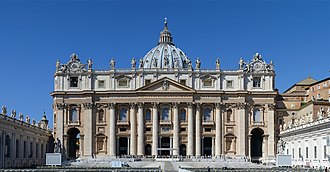
Under the patronage of Pope Urban VIII, Bernini’s career flourished. He took on major roles in Rome, including architect of St. Peter’s Basilica. His contributions included the Baldacchino, the decoration of the basilica’s piers, and various tombs and monuments. Bernini’s ability to capture personal characteristics in his portraits earned him a reputation as an exceptional artist.
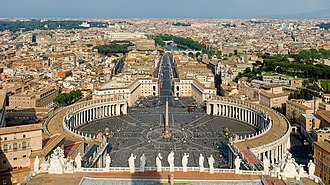
Despite a setback with the failed bell towers at St. Peter’s Basilica, Bernini regained his standing and continued to receive significant commissions. His work during the pontificate of Pope Alexander VII included the design of St. Peter’s Square, transforming the area into an iconic space. Bernini also worked on various churches and public spaces, showcasing his versatility as an artist.
In his later years, Bernini remained active, completing important works such as the statue of the Blessed Ludovica Albertoni. He died on November 28, 1680, and was buried in the Basilica of Santa Maria Maggiore.
Personal life
Gian Lorenzo Bernini had a complicated personal life. In the late 1630s, he became involved with a married woman named Costanza. This caused a lot of trouble in his family. Later, in 1639, Bernini married a young woman named Caterina Tezio and they had eleven children together.
During his life, Bernini lived in many different homes in Rome. One of his important homes was across from a church called Santa Maria Maggiore. After his father passed away, they moved closer to the Vatican where Bernini could work more easily. In 1639, he bought his own large house where he could keep his studio and many artworks. Even though another artist, Pietro da Cortona, also owned his own home, Bernini was proud of having his own space to create.
Works of art, architecture, and mixed genre
Sculpture
Bernini was most famous for his work as a sculptor. He learned this skill from his father, who was also a sculptor. His sculptures include many different sizes, from small garden pieces to very large statues. Most of his sculptures were made from marble, but some were made from bronze. Bernini created many famous sculptures, including portrait busts of important people, religious statues, and mythological figures. He often made models in clay before creating the final sculpture.
Architecture
Though Bernini started as a sculptor, he also became a very important architect. He worked on many buildings in Rome, including St. Peter's Square and several palaces. He designed both new buildings and made changes to existing ones. His architecture had a big influence across Europe.
His first big architectural projects were the new front of the church of Santa Bibiana and the Baldachin, a large bronze canopy, in St. Peter's Basilica. Later, he designed the square and colonnade in front of St. Peter's Basilica. He also worked on other important places in the Vatican, like the grand stairway called the Scala Regia and the Chair of Saint Peter.
Bernini did not build many churches from scratch, but he worked on several existing ones. He designed three new churches in Rome and nearby towns. When he went to Paris, he suggested designs for the Louvre Palace, but they were not chosen.
Fountains
Bernini was also known for his beautiful fountains in Rome. These fountains were both practical and artistic. His first fountain, called the Barcaccia, was made to work with a low water supply. Other famous fountains include the Triton Fountain, the Fountain of the Bees, and the Fountain of the Four Rivers in Piazza Navona. These fountains were known for their beauty and clever designs.
Tomb monuments and other works
Bernini also created tomb monuments for important people, like Popes and cardinals. One famous monument is the Elephant and Obelisk near the Pantheon. This sculpture was designed to hold an ancient Egyptian obelisk. The elephant carries the obelisk on its back, and there is an inscription connecting ancient gods to the Virgin Mary.
Bernini also worked on smaller projects, like a fountain for a palace in Lisbon. He designed the fountain, and one of his students made the sculpture.
Paintings, drawings, and work for the theatre
Bernini learned painting from his father and another artist. He painted mainly portraits and a few other subjects. Only a few of his paintings survive today. He also made many drawings for his sculptures and architecture projects.
In addition to his other work, Bernini wrote and performed in plays. These plays were popular in Rome and included special effects like flooding and fire. Though few of his plays survive, they were well-known for their humor and impressive effects.
Influence and post-mortem reputation
Gian Lorenzo Bernini had many skilled artists who worked with him. Some of these artists were Luigi Bernini, Stefano Speranza, Giuliano Finelli, Andrea Bolgi, Giacomo Antonio Fancelli, Lazzaro Morelli, Francesco Baratta, Ercole Ferrata, and others. His closest helpers were Giulio Cartari for sculpture and Mattia de Rossi for architecture. They traveled to Paris to help Bernini with projects for King Louis XIV.
Bernini had rivals too, especially in architecture, such as Francesco Borromini and Pietro da Cortona. They all worked together early on but later competed for projects. In sculpture, he competed with Alessandro Algardi and François Duquesnoy, though they passed away long before Bernini.
Many painters also worked under Bernini’s guidance, creating important parts of his designs for churches and other places.
Bernini’s life was first written about by his son Domenico, and other biographies followed. Over time, people’s opinions about Bernini changed. At first, many did not like his dramatic style, but later, scholars began to appreciate his work. Today, Bernini is highly respected, and his art is celebrated around the world. His influence can still be seen in many famous places, and he remains one of the greatest artists of all time.
Selected works
Main article: List of works by Gian Lorenzo Bernini
Gian Lorenzo Bernini was a talented artist known for his sculptures, buildings, and paintings. His works include famous statues, beautiful fountains, and important places of worship.
His sculptures feature stories from history and religion, like The Goat Amalthea with the Infant Jupiter and a Faun, Apollo and Daphne, and The Ecstasy of Saint Teresa. He also created well-known fountains such as the Fontana della Barcaccia and the Fontana dei Quattro Fiumi in Rome.
In addition to sculptures and fountains, Bernini designed important buildings like St. Peter's Square in Vatican City and painted portraits and religious scenes. His art can be seen in museums and churches around the world.
Images
Related articles




This article is a child-friendly adaptation of the Wikipedia article on Gian Lorenzo Bernini, available under CC BY-SA 4.0.
Images from Wikimedia Commons. Tap any image to view credits and license.