 Safekipedia
Hawk-Eye
Adapted from Wikipedia · Discoverer experience
Hawk-Eye is a special computer system that helps track where a ball is going during sports. It uses cameras around a stadium to watch the ball and figure out its path. This helps referees and players make better decisions.
The system was created in the United Kingdom by Paul Hawkins and first used in cricket in 2000. It can be accurate to within just 2.6 mm, which is very precise.
Hawk-Eye is now used in many sports like baseball, cricket, tennis, badminton, rugby union, soccer, and more. It helps decide things like whether a tennis player’s serve was good or if a soccer ball crossed the goal line. This makes games fairer and more exciting to watch.
Method of operation
All Hawk-Eye systems work by using many fast video cameras placed in different spots around the playing area. These cameras take pictures very quickly, and the system uses them to follow the ball’s movement. By looking at the pictures from at least two cameras at the same time, the system can figure out where the ball is and where it is going.
The system builds up a path showing where the ball has been and can even guess where it will go next. It can also tell if the ball hit something like a line or a wall, and whether any rules were broken. This information is shown as a moving picture, so referees, TV viewers, or coaches can see it almost right away. The system also stores all this information so people can later look at stats and compare players or games.
History
Hawk-Eye was created in 2000 by engineers at Roke Manor Research Limited in Romsey, England. It was first used during cricket games shown on Channel 4 television.
In 2006, a group of investors bought the company to help grow its use in sports like cricket, tennis, and basketball. Later, in 2011, the company was sold to Sony, a big Japanese electronics company.
Deployment in sport
Cricket
Main article: Umpire Decision Review System
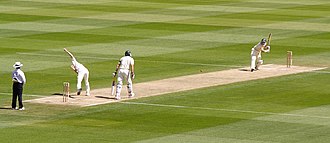
The technology was first used by Channel 4 during a Test match between England and Pakistan on Lord's Cricket Ground, on 21 May 2001. It is used by many TV networks to track the path of balls. Its main use in cricket is to help decide if a ball hit by a batsman would have hit the stumps.
In 2008/2009, the ICC tried a system where teams could ask for help from Hawk-Eye if they disagreed with a decision. Now, the system helps decide three important things:
- Where the ball bounced
- Where it hit the batsman's leg
- Where the ball would have gone after hitting the batsman
The system also shows how fast a bowler throws and how they swing the ball. It can show all the balls a batsman faced and where they hit the ball.
Tennis
For a history of electronic line calling in tennis, see Electronic line judge
In 2004, during a match between Serena Williams and Jennifer Capriati at the 2004 US Open, some calls were wrong. This led to talks about using technology to help with line calls.
In late 2006, Hawk-Eye was tested and passed for use in professional tennis. It has been used in big tournaments like Wimbledon and the US Open. Players can challenge calls, and the system helps decide if a ball was in or out.
In 2021, the Australian Open became the first Grand Slam to use Hawk-Eye Live, calling shots in real time instead of line judges, partly to help during the COVID-19 pandemic.
Association football
Main article: Goal-line technology
Hawk-Eye is one of the systems allowed by FIFA to help decide if a ball fully crossed the goal line. It is used in leagues like the Premier League, Serie A, and Bundesliga to avoid mistakes in deciding if a goal was scored.
Snooker
At the 2007 World Snooker Championship, the BBC used Hawk-Eye to show what players see. It is now used at the World Championship and some other big tournaments to help viewers see what the players are facing, but it does not help referees make decisions.
Gaelic games
In Ireland, Hawk-Eye was introduced in 2013 for championship matches at Croke Park in Dublin. It was meant to help avoid arguments about scores. However, there have been some mistakes, and it has been stopped at times while problems are fixed.
Australian football
In 2013, the Australian Football League tested Hawk-Eye to help with score reviews in matches at the MCG during Round 15.
Badminton
The BWF introduced Hawk-Eye in 2014 for line call decisions and to show shuttlecock speed in major events, first used in the 2014 India Super Series tournament.
Gridiron football
The National Football League started using Hawk-Eye for measuring distances on the field in the 2025 season.
Baseball
Main article: Automated Ball-Strike System
Hawk-Eye is used to call balls and strikes in professional baseball leagues. In the U.S., it began use in Major League Baseball (MLB) for the 2026 season, after being tested in Minor League Baseball since 2019. It has also been used for instant replay reviews in MLB since the 2014 season.
Concerns about accuracy
Hawk-Eye is well-known to sports fans for helping in games like cricket and tennis. Even though most people like this technology, some have raised concerns. During the 2007 Wimbledon Championships, there was a moment when Hawk-Eye said a ball was very close to being out, but some thought it was too close to be right.
Some people worry that the system’s small error margin might not always show exactly what happened. Experts have said that while Hawk-Eye is very useful, it might not be perfect and that everyone should understand its limits. They also think Hawk-Eye might have trouble predicting where a cricket ball will go right after it bounces.
Use in computer games
The Hawk-Eye system has been used in several computer games to make the action look more like what you see on TV. It was used in games like Brian Lara International Cricket 2005, Brian Lara International Cricket 2007, Ashes Cricket 2009, and International Cricket 2010. A similar system was added to the Xbox 360 version of Smash Court Tennis 3, but not to the PSP version. It also appears in games like Don Bradman Cricket 14 and Don Bradman Cricket 17, where it is called Big Eye.
Competition
Cyclops was a computer system used in professional tennis as an electronic line judge since 1980. It has now been replaced by Hawk-Eye at big tournaments like the Grand Slams.
FoxTenn is another system that competes with Hawk-Eye. It uses real data to trace the path of the ball and mark it, even on clay surfaces.
Images
Related articles



This article is a child-friendly adaptation of the Wikipedia article on Hawk-Eye, available under CC BY-SA 4.0.
Images from Wikimedia Commons. Tap any image to view credits and license.