 Safekipedia
Hydrogen atom
Adapted from Wikipedia · Discoverer experience
A hydrogen atom is an atom of the chemical element hydrogen. The electrically neutral hydrogen atom contains a single positively charged proton in the nucleus, and a single negatively charged electron bound to the nucleus by the Coulomb force. Atomic hydrogen constitutes about 75% of the baryonic mass of the universe.
In everyday life on Earth, isolated hydrogen atoms (called "atomic hydrogen") are extremely rare. Instead, a hydrogen atom tends to combine with other atoms in compounds, or with another hydrogen atom to form ordinary (diatomic) hydrogen gas, H2. "Atomic hydrogen" and "hydrogen atom" in ordinary English use have overlapping, yet distinct, meanings. For example, a water molecule contains two hydrogen atoms, but does not contain atomic hydrogen (which would refer to isolated hydrogen atoms).
Atomic spectroscopy shows that there is a discrete infinite set of states in which a hydrogen (or any) atom can exist, contrary to the predictions of classical physics. Attempts to develop a theoretical understanding of the states of the hydrogen atom have been important to the history of quantum mechanics, since all other atoms can be roughly understood by knowing in detail about this simplest atomic structure.
Isotopes
Main article: Isotopes of hydrogen
Hydrogen has three main types, called isotopes. The most common one, called protium, has just a proton and an electron and no neutrons. It makes up almost all natural hydrogen.
Another type, called deuterium, has one neutron along with a proton and an electron. It is used in some special machines. A third type, called tritium, has two neutrons but it doesn’t stay around for long—it changes over time.
Heavier types of hydrogen can only be made in special science tools and they disappear very quickly.
Hydrogen ion
Main articles: hydrogen cation and hydrogen anion
Neutral hydrogen atoms are rare on their own, but they are common when connected to other atoms. Hydrogen atoms can also change forms. If a neutral hydrogen atom loses its electron, it becomes a cation, written as "H+" and sometimes called hydron. Free protons are found in space and in solar wind. In water solutions of acids like hydrochloric acid, what is really formed is hydronium, H3O+, when the acid gives a hydrogen to a water molecule.
If a hydrogen atom gains an extra electron, it becomes an anion, written as "H–" and called hydride.
Theoretical analysis
The hydrogen atom is important in quantum mechanics and quantum field theory because it is a simple system with two parts that has many clear solutions.
Failed classical description
Experiments in 1909 showed that atoms have a small, positive center with a thin, negative area around it. This made scientists wonder how such a system could stay stable. Classical physics suggested that if an electron moved in a circle and gave off energy, it would quickly fall into the center. However, atoms appear stable. Also, atoms were seen to give off only specific colors of light, not a mix of colors. The answer would come with the development of quantum mechanics.
Bohr–Sommerfeld model
In 1913, Niels Bohr made a simple model to explain the hydrogen atom. His model had a few key ideas:
- Electrons can only be in certain circles or paths, called stationary states.
- Electrons do not give off light while in these stationary states.
- Electrons can jump from one path to another, gaining or losing energy.
Bohr’s ideas matched experiments better than the old models.
Schrödinger equation
The Schrödinger equation is a main idea in quantum mechanics. It helps us find where the electron is likely to be. The simplest state of the hydrogen atom is called the ground state. This state has the lowest energy and is where the electron is usually found.
The Schrödinger equation works for simple systems like the hydrogen atom but needs more complex tools for bigger atoms or molecules.
Visualizing the hydrogen electron orbitals
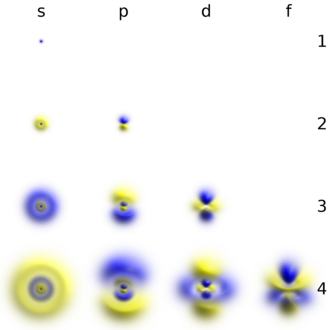
The picture shows the first few shapes of the hydrogen atom. These shapes show where the electron is likely to be found. The simplest shape, called the 1s state, is the one with the lowest energy.
Features going beyond the Schrödinger solution
There are some small effects that the Schrödinger equation does not fully explain. These include the speed of the electron, the interaction between the electron’s spin and its motion, and small shifts in energy caused by quantum effects. These effects are explained by more advanced theories.
Alternatives to the Schrödinger theory
Scientists have found different ways to understand the hydrogen atom besides the most common method. One way was created using special math rules by Wolfgang Pauli. Another method was shown in 1979 by Duru and Kleinert using a different idea from Feynman.
There are also other models, like Bohm mechanics and a special math method called the complex Hamilton–Jacobi formulation.
Related articles




This article is a child-friendly adaptation of the Wikipedia article on Hydrogen atom, available under CC BY-SA 4.0.
Images from Wikimedia Commons. Tap any image to view credits and license.