 Safekipedia
Ice sheet
Adapted from Wikipedia · Discoverer experience
An ice sheet is a huge mass of glacial ice that covers surrounding land and is larger than 50,000 km² (19,000 sq mi). Right now, there are two main ice sheets on Earth: the Antarctic ice sheet and the Greenland ice sheet. These ice sheets are the largest glacial bodies on our planet, much bigger than smaller ice caps or mountain glaciers. They can have several high points called ice domes from which the ice flows outward, and they are usually drained by fast-moving areas of ice known as ice streams and outlet glaciers near their edges.
Even though the surface of an ice sheet looks very cold, the bottom part is often warmer because of heat coming from inside the Earth, called geothermal heat. In some places, this causes melting, and the water helps the ice sheet move faster. This melting creates quick-moving channels inside the ice sheet.
Ice sheets are always moving slowly. The ice gradually flows from the highest central area outward toward the edges. Although the slope is gentle in the middle, it becomes steeper near the edges.
As the world gets warmer because of climate change, this can affect ice sheets. It may take thousands of years for warm air to reach the bottom of the ice, but melting on the surface can create lakes of water that flow to the base and help the ice move. The growth and shrinkage of ice sheets are closely tied to Earth's history of cold periods, called glacial periods, during ice ages. Huge ancient ice sheets once covered much of North America and Europe, and their melting marked the start of today’s warmer period. Today, the future of the Greenland and Antarctic ice sheets is very important because their changes can affect global climate change and sea level rise.
Overview
An ice sheet is a huge mass of ice that covers a large piece of land, more than 50,000 km2. Today, there are two big ice sheets on Earth: one in Greenland and another in Antarctica. These ice sheets are very thick, with an average depth of about 2 km (1 mile). They grow because the snow that falls on them doesn’t melt; instead, it gets squished by the weight of newer snow.
Ice sheets are still growing today. For example, during World War II, a Lockheed P-38 Lightning fighter plane crashed in Greenland in 1942. When people found it 50 years later, it was buried under 81 meters (268 feet) of ice that had formed over those years.
Dynamics
Even stable ice sheets are always moving. The ice slowly flows from the tallest central part of the ice sheet toward the edges. This happens because there is more ice building up in the middle and less ice at the edges, where some melts away. The difference in slope causes the ice to start moving. Gravity helps this motion, but the speed depends on the temperature and the ground under the ice. Changes in these factors can cause the ice to move faster for short periods.
Tides in the ocean can also affect how fast ice moves. During certain tides, parts of the ice can stop moving for hours and then surge forward quickly after high tide.
Warmer temperatures can affect ice sheets by creating lakes of meltwater on top. These lakes can reach the bottom of the ice and make it move faster.
When ice reaches the edges where the ground meets the ocean, it can break off into the water as icebergs. Floating pieces of ice, called ice shelves, can also break off. When an ice shelf breaks up, the glaciers behind it can start moving faster. For example, when a large floating ice shelf called Larsen B broke apart, the glaciers behind it began to flow more quickly.
The stability of these ice shelves depends on the temperature of the ocean water. Warmer water can melt the bottom of the ice shelves, making them thinner and less able to hold back the glaciers behind them.
Some parts of Antarctica, like the West Antarctic Ice Sheet, sit below sea level and could lose ice quickly if the ocean warms. Two important glaciers there, Thwaites and Pine Island, have been thinning and moving faster in recent years. This could cause sea levels to rise by several inches in the next few decades.
Most of the East Antarctic Ice Sheet is not at risk in the same way. However, one large glacier there called Totten Glacier could also lose ice quickly if conditions change.
Some scientists think that tall ice cliffs could collapse under their own weight once supporting ice is gone. This could cause rapid melting and raise sea levels by a meter or more by 2100. However, this idea is debated. Evidence from past climate changes suggests that sea levels did not rise as much as this theory predicts, and other factors might prevent such collapses from happening quickly.
Earth's current two ice sheets
There are two huge masses of ice on Earth called ice sheets. These are the Antarctic ice sheet and the Greenland ice sheet. If all the ice sheets and glaciers in the world melted, it would take a very long time—thousands of years—but it would raise the level of the oceans by about 66 meters, or 216 feet. However, melting sea ice and ice shelves does not change the level of the sea.
Role in carbon cycle
Historically, ice sheets were thought to play no role in the carbon cycle. But research in the 2010s showed that ice sheets host special tiny life forms, and they store and move a lot of carbon — more than 100 billion tonnes.
There is a big difference between the two ice sheets. Under the Greenland ice sheet, there is only about 0.5–27 billion tonnes of carbon. But under Antarctica, scientists think there is 6,000–21,000 billion tonnes of carbon. If this carbon is released as meltwater, it could make climate change worse by adding more carbon dioxide to the air.
For comparison, the Arctic permafrost holds about 1,400–1,650 billion tonnes of carbon, and humans add around 40 billion tonnes of carbon dioxide each year. In one place in Greenland, at Russell Glacier, meltwater releases methane — a gas that heats up the planet more than carbon dioxide. But many special bacteria there help reduce these emissions.
In geologic timescales
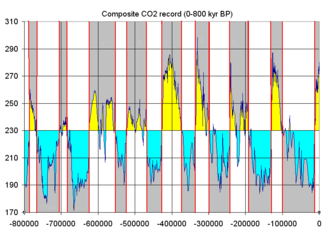
The Earth’s climate has changed over very long periods due to patterns in how much sunlight reaches our planet. These patterns are caused by the shape of Earth’s orbit and its tilt, which change slowly because of the gravity of other planets.
During the past 100,000 years, large parts of the ice sheet that once covered much of North America broke apart. This sent many icebergs into the North Atlantic Ocean. When these icebergs melted, they left behind rocks and other materials, creating layers known as ice-rafted debris. These events happen roughly every 7,000 to 10,000 years during cold periods.
Scientists also study sudden warmings in the northern hemisphere that happen about every 1,500 years. These warm periods often follow the large iceberg events, but they also happen more often. By studying ice from both Greenland and Antarctica, scientists have noticed that the ice sheets in these places did not warm up at the same time. The ice in Antarctica began to warm thousands of years before Greenland did, though why this happened is still being studied.
Images
Related articles




This article is a child-friendly adaptation of the Wikipedia article on Ice sheet, available under CC BY-SA 4.0.
Images from Wikimedia Commons. Tap any image to view credits and license.